

Golden Beauty c1957
Praca pt Golden Beauty c1957 was created by the renowned American artist Gil Elvgren, kto urodził się w 1914 i zmarł w 1980. Elvgren is celebrated for his iconic pin-up art, which emerged during the mid-20th century. His work captured the playful, idealized, and sensual depictions of women that were prevalent in advertising and popular culture at the time. Ten kawałek, “Złote Piękno,” z 1957, exemplifies his signature style, with a soft focus on the female form, idealized beauty, and vibrant colors that invoke a sense of warmth and allure.

Spis treści
Przedmiot i kompozycja
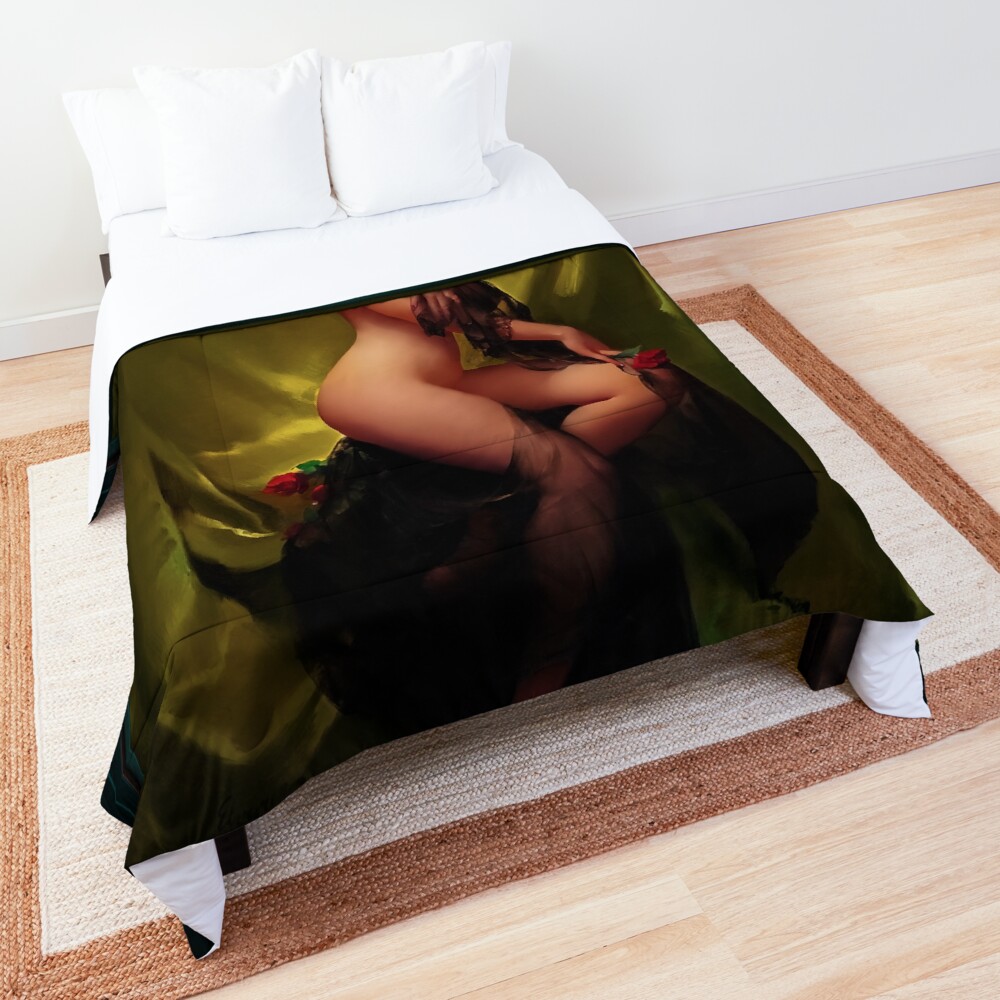
W sercu Golden Beauty c1957 is the central figure of a young woman, depicted in a soft, glamorous pose that radiates elegance and sensuality. She is seated gracefully on a chaise lounge, surrounded by the soft folds of luxurious drapery in hues of golden yellow and deep green. Her facial expression, a subtle smile, exudes confidence and charm, giving the impression of a woman at ease with herself and her surroundings. Her blonde hair cascades in waves, framed by the vibrant backdrop that emphasizes her delicate features. The figure’s posture is one of languid elegance, with one arm bent at the elbow, supporting herself while the other delicately holds a rose, symbolizing beauty and femininity.
The model is presented in a moment of vulnerability, her modesty barely maintained by a sheer piece of fabric that drapes across her body. jednak, the pose never seems overly provocative; raczej, it conveys an innocence combined with an air of self-assuredness. The artist’s use of light and shadow around the model’s form accentuates her curves and enhances the overall mood of sensuality without crossing into excess. The juxtaposition of her delicate pose with the ethereal background imbues the piece with a sense of dreamlike allure, as if she were a figure who exists somewhere between reality and fantasy.
Materiały i technika
Gil Elvgren employed the classic technique of oil painting for Złote Piękno, allowing him to achieve a rich depth of color and a smooth finish that is characteristic of his work. The brushstrokes, choć subtelny, are used effectively to create the illusion of softness and fluidity in the woman’s skin, włosy, and fabric. The luxurious velvet-like texture of the fabric draped around her body contrasts with the softness of her skin and the delicate features of her face, showcasing Elvgren’s expert control over his medium. The artist’s skillful application of highlights and shadows gives the entire composition a sense of three-dimensionality, enhancing the viewer’s perception of the figure as a tangible, lifelike presence.
In terms of the background, Elvgren uses rich, almost glowing shades of green and yellow to set a luxurious, almost surreal stage for his subject. These colors enhance the golden tones in the woman’s hair, creating a harmonious relationship between the model and her surroundings. The fabric folds in the background echo the folds of her clothing, guiding the viewer’s eye across the canvas and creating a sense of movement within the otherwise still image.
Temat i nastrój
Temat Złote Piękno is rooted in the idealized portrayal of feminine beauty that was a hallmark of mid-20th-century advertising and magazine illustrations. jednak, Elvgren transcends mere commercial art by infusing his subject with a depth of personality and elegance. The model is not a passive object; she is a fully realized figure who exudes both strength and grace. Tytuł Złote Piękno underscores her radiant and almost ethereal quality, which is further heightened by the luminous quality of the painting’s palette. The soft glow surrounding her reinforces this sense of divine beauty, presenting her as both an ideal and an inspiration.
The mood of the painting is one of playful elegance. There is an undeniable sense of flirtation in the woman’s pose, but it is tempered by her poised and dignified demeanor. This duality of innocence and allure creates a mood of warmth, czar, i ponadczasowa elegancja. The soft color palette evokes feelings of nostalgia, transporting the viewer to an era of glamorous Hollywood stars and the golden age of pin-up art.
The backdrop plays a crucial role in reinforcing this mood. Miękkie, golden glow suggests a moment of repose in a dreamlike world, where the viewer can escape into the fantasy of beauty and elegance. The green tones introduce an element of nature and tranquility, further complementing the serenity of the moment and the quiet confidence of the woman. The balance between light and dark, soft and bold, creates a visual harmony that guides the viewer’s emotional response to the painting, making it both inviting and captivating.
Significance of the Artist
Gil Elvgren was a key figure in the development of the pin-up art style during the 1940s and 1950s. His work was part of a broader cultural phenomenon that celebrated femininity, piękno, and sexual allure in a way that was playful and innocent yet undeniably seductive. Elvgren’s mastery of light and shadow, Jego dbałość o szczegóły, and his ability to capture the charm and elegance of his models made him one of the leading artists of the genre. Złote Piękno exemplifies these qualities, showcasing his ability to balance sensuality with sophistication.
The artist’s influence on American popular culture, especially in terms of advertising, ilustracja, i moda, cannot be overstated. His work resonated with audiences at a time when there was a strong cultural focus on the idealized image of women. Elvgren’s portrayal of women, while often sexualized, is never crude or aggressive; Zamiast, it reflects a nuanced view of feminine allure that blends playfulness, piękno, i łaska.
Wniosek
Złote Piękno by Gil Elvgren is a quintessential example of mid-20th-century American pin-up art. Through his masterful use of oil paint, Elvgren has created an image that transcends the commercial intent of many of his contemporaries, offering a glimpse into a world of idealized beauty, łaska, and charm. The artwork continues to captivate audiences today, serving as both a reflection of the cultural landscape of its time and an enduring symbol of feminine elegance.
Golden Beauty to wyretuszowana reprodukcja starych mistrzów sztuki cyfrowej obrazu domeny publicznej, która jest dostępna do zakupu jako rolowany druk online.
Biografia artysty
Informacje poniżej pochodzą z Wikipedia.org
Gillette A. Elvgren urodził się w St. Paweł, Minnesota, i uczęszczał do liceum uniwersyteckiego. Po ukończeniu studiów, rozpoczął studia artystyczne w Minneapolis Institute of Arts.
Później przeniósł się do Chicago, aby studiować w American Academy of Art, i ukończył Akademię w okresie wielkiej depresji, w wieku dwudziestu dwóch lat.
Po ukończeniu studiów Elvgren dołączył do stajni artystów w Stevens i Gross, Najbardziej prestiżowa agencja reklamowa w Chicago, i został protegowanym artysty Haddona Sundbloma.
W 1937, Gil zaczął malować pin-upy z kalendarzem dla Louisa F. Dow, jedna z wiodących amerykańskich firm wydawniczych, w tym czasie stworzył około 60 pin-up girl pracuje na płótnie 22″ × 28″ i wyróżnia je nadrukowanym podpisem.
Wiele z jego pin-upów zostało odtworzonych jako rysunki nosa na samolotach wojskowych podczas II wojny światowej; i to było mniej więcej w tym czasie w 1944, że do Elvgrena zwróciła się firma Brown and Bigelow Publishing Company; firma, która nadal dominuje w branży produkcji kalendarzy, specjalności reklamowe i artykuły promocyjne.
W następnym roku od 1945 dopóki 1972, Elvgren był związany z Brown & Wydawnictwo Bigelow, i rozpoczął współpracę z 24 cal o 30 calowe płótna, format, którego użyje w następnym 30 lat, i podpisał swoją pracę kursywą.
Elvgren odniósł komercyjny sukces. Mieszkał w różnych lokalizacjach, i działał od lat 30. do 70. XX wieku. W 1951 zaczął malować w pracowni w swoim domu, potem w Winnetce, Illinois, korzystanie z asystenta do ustawiania oświetlenia, buduj rekwizyty i sceny, zestawy fotograficzne, i przygotuj swoje farby.
Jego klientami były znane firmy, takie jak Brown i Bigelow, Koks, General Electric i firma Sealy Mattress, aby wymienić tylko kilka. Ponadto, w latach 40. i 50. ilustrował historie dla wielu czasopism, takich jak The Saturday Evening Post i Good Housekeeping.
Wśród modelek i hollywoodzkich legend, które Elvgren malował podczas swojej kariery, była Myrna Hansen, Donna Reed, Barbara Hale, Arlene Dahl, Lola Albright i Kim Novak.