

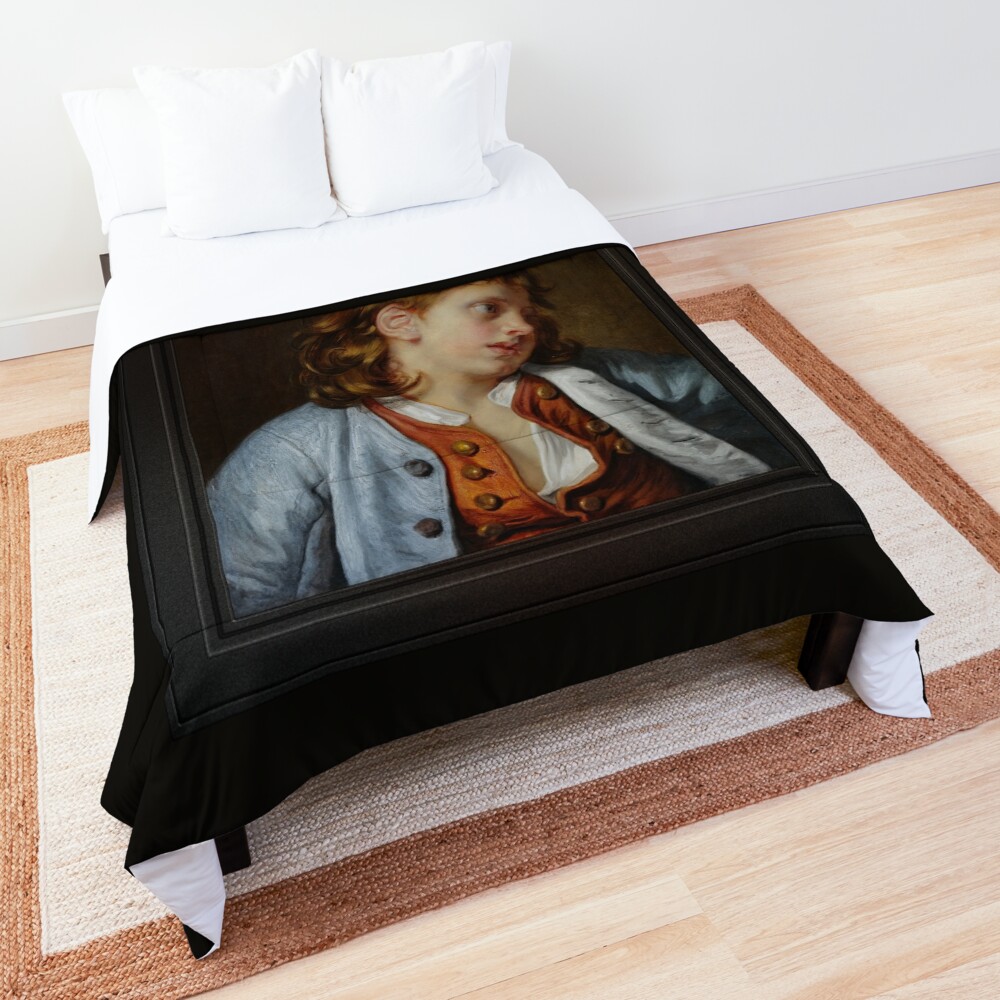
Head of a Young Boy c1763
L'opera intitolata Head of a Young Boy was created in 1763 dal famoso pittore francese Jean-Baptiste Greuze (1694 – 1774). This evocative portrait encapsulates the tenderness and innocence of youth, showcasing the artist’s remarkable skill in rendering emotion and character through subtle details and masterful brushwork. Greuze, often celebrated for his depiction of genre scenes, espressione emotiva, and moral themes, brings to life the essence of a young boy’s contemplative nature. The painting focuses on the head of the subject, highlighting the texture of his skin, the softness of his features, and his expression, all while employing Greuze’s characteristic realism and sensitivity to human emotion.
Sommario
Soggetto e composizione
The primary focus of the painting is the head and upper torso of a young boy, his age perhaps around twelve or thirteen, in a quiet, pensive moment. His head is turned slightly to the side, with his gaze directed downward and to the right, giving him an air of introspection.
The boy’s delicate features are captured with such precision that one can almost feel the texture of his youthful skin and the lightness of his soft, curly hair. Il suo volto, framed by loose waves of chestnut-brown hair, appears serene but is infused with a sense of melancholy. I suoi occhi, though soft, seem to communicate an underlying depth of emotion, as if the artist intended to capture more than just a physical likeness but also a moment of emotional reflection.
The boy is dressed in a simple, yet somewhat refined, outfit characteristic of mid-18th century French fashion for young boys. He wears a garment with a reddish-brown underlay, partially revealed beneath a loose, blue jacket adorned with brass buttons.
The colors of his attire, earthy and muted, serve to complement the naturalistic tones of his face, emphasizing the lifelike quality of the portrait. The texture of his clothing is rendered with exquisite detail, with Greuze’s signature soft brushwork lending an almost tactile quality to the fabric, conveying the impression that the viewer could reach out and feel the texture of the materials.
Stile artistico e tecnica
Jean-Baptiste Greuze is widely regarded as a master of Rococo realism, and this portrait is a prime example of his ability to merge delicate, refined aesthetics with profound emotional depth. The artist’s technique in Head of a Young Boy showcases his sensitivity to the nuances of light and shadow. The light source comes from the left, illuminating the boy’s face and highlighting the softness of his youthful skin.
The light plays delicately across his features, creating a gentle contrast between the highlights on his forehead, nose, and cheek, and the subtle shadows around his eyes and under his chin. This masterful use of chiaroscuro (il contrasto tra luce e buio) brings a lifelike three-dimensionality to the figure, enhancing the sense of realism.
Greuze’s brushwork is soft yet precise, with every detail carefully rendered to evoke texture and form. The softness of the skin is portrayed through gentle, fluid strokes, while the more textured elements, such as the buttons on the jacket and the folds of fabric, are painted with sharper, more defined lines. This balance of soft and hard brushwork gives the portrait its depth and realism, and contributes to the tender mood of the piece.
Tema e umore
The theme of the painting appears to focus on the quiet, reflective nature of childhood. Unlike other portraits of children from this period that may emphasize their status or wealth, Greuze seems to highlight the vulnerability and introspective quality of youth. The boy’s subtle, almost melancholic expression evokes a sense of innocence and fragility, suggesting that the subject’s internal world is being gently explored by the artist.
His somewhat somber expression does not indicate sadness, but rather a contemplation of his surroundings or of life itself. This emotional depth is characteristic of Greuze’s genre paintings, which often dealt with themes of morality, human emotion, and the complexities of youth.
The mood of the painting is calm and introspective. The boy’s expression, along with the gentle lighting and muted tones of his clothing, creates a sense of quietude and reflection. La semplicità della composizione, focused solely on the boy’s head and upper torso, reinforces this meditative atmosphere, inviting the viewer to contemplate the nature of childhood and the emotional depth that Greuze was able to capture within his subjects.
Materiali e Tecnica
Head of a Young Boy is executed in oil paint on canvas, a medium in which Greuze excelled throughout his career. The use of oil allows for the rich, textured application of pigment, which enhances the three-dimensional quality of the figure and the intricate detailing of the boy’s features and clothing. Greuze’s skill in layering paint, as well as his ability to manipulate light and shadow, demonstrates the technical expertise that made him one of the most respected portraitists of his time.
The choice of canvas as the support material provides a smooth surface on which Greuze could build up his layers of paint with precision. The texture of the canvas itself, though barely perceptible to the naked eye, contributes to the painting’s overall atmosphere, helping to absorb and diffuse light in a way that enhances the lifelike appearance of the subject. The depth of color, particularly in the boy’s face, is achieved through delicate glazing techniques, which involve applying thin layers of translucent paint over a dried base layer to create a luminous effect.
Conclusione
Nel Head of a Young Boy, Jean-Baptiste Greuze demonstrates his exceptional talent for capturing the emotional and psychological depth of his subjects. The young boy, rendered with delicate realism, becomes not just a portrait of a child, but an exploration of the inner life of youth.
L'umore sereno del dipinto, combined with its meticulous technique and evocative use of light and shadow, transports the viewer to a world where emotions and thoughts are quietly expressed through the subtleties of human expression. This artwork remains a testament to Greuze’s mastery in the realm of portraiture, offering a timeless reflection on the nature of youth and the complexities of human emotion.
Questa è una riproduzione di vecchi maestri di arte digitale rimasterizzata di un'immagine di dominio pubblico disponibile come stampa su tela online.
Biografia dell'artista
Le seguenti informazioni sono derivate da La caccia nelle paludi pontine
Jean è nato a Tournus, Francia dentro 1725 come sesto figlio di un maestro piastrellista che riconobbe il suo talento in tenera età; mandandolo a Lione, Francia per studiare con il ritrattista francese Charles Grandon (1691 – 1762).
All'età di circa 30 ha lasciato Lione, e si recò a Parigi, Francia per studiare all'Académie royale de peinture et de sculpture o all'Accademia reale di pittura e scultura; che all'epoca era la principale istituzione artistica della Francia durante l'ultima parte dell'Ancien Régime (Antico Regime ~1500 a 1789), fino alla sua abolizione 1793 durante la Rivoluzione francese.
Sebbene di grande talento e di grande successo durante gli anni Sessanta e Settanta del Settecento, avere mecenati del calibro della marchesa de Pompadour (1721 – 1764), L'imperatrice Caterina II di Russia (R. 1762 – 1796), e Ange Laurent di La Live de Jully (1725 – 1779); la sua natura ribelle e i conflitti con i funzionari dell'Accademia e del Salon si sarebbero rivelati la sua sfortuna; soprattutto dopo il suo matrimonio con Anne Marie Babuty nel 1759; il che si sarebbe rivelato un disastro per lui, poiché si sapeva che aveva avuto varie relazioni con i suoi studenti e modelli, che gli causò la perdita di reddito e l'umiliazione pubblica.
Quando il matrimonio finì 34 anni dopo sua moglie ricevette un sostanzioso risarcimento, che lo lasciò in gravi difficoltà finanziarie e al momento della sua morte 1805 all'età di 80 era quasi al verde.