

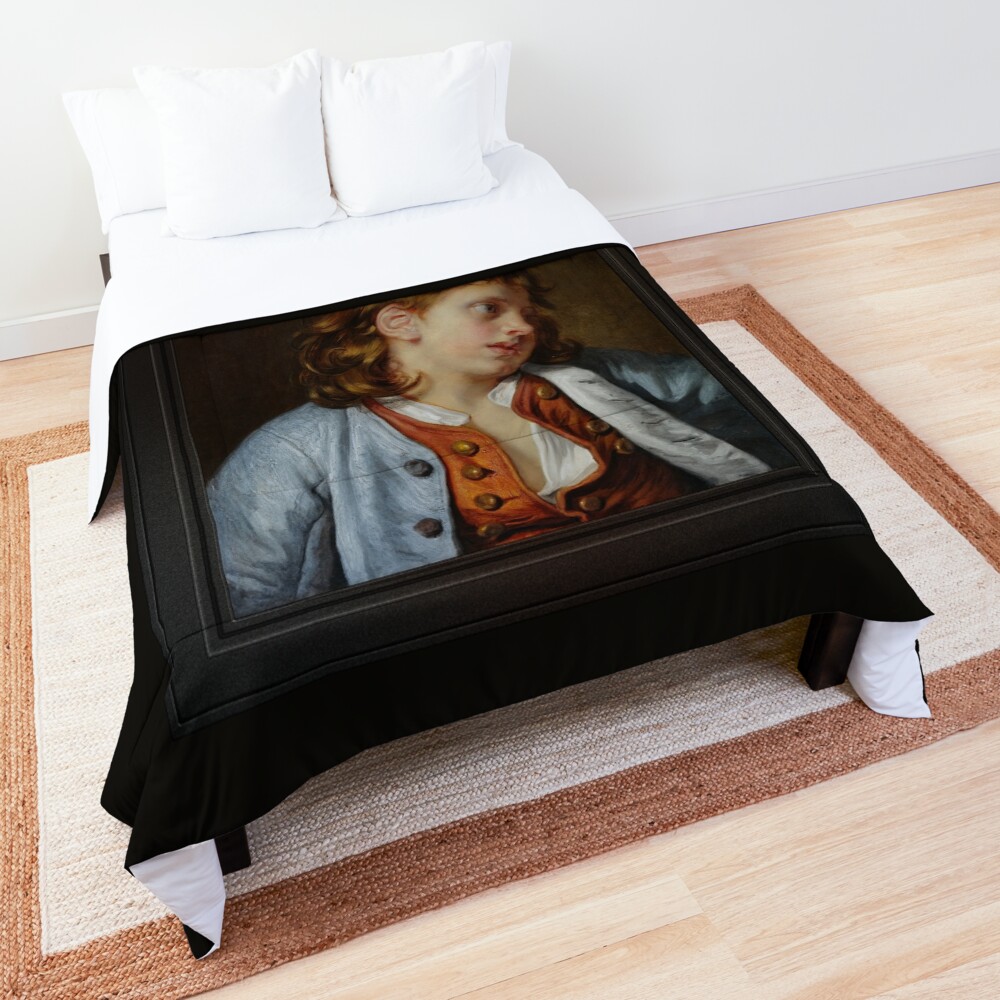
Head of a Young Boy c1763
タイトルのアートワーク 少年の頭 で作成されました 1763 有名なフランスの画家による ジャン=バティスト・グルーズ (1694 – 1774). This evocative portrait encapsulates the tenderness and innocence of youth, showcasing the artist’s remarkable skill in rendering emotion and character through subtle details and masterful brushwork. グルーズ, often celebrated for his depiction of genre scenes, 感情的な表現, and moral themes, brings to life the essence of a young boy’s contemplative nature. The painting focuses on the head of the subject, highlighting the texture of his skin, the softness of his features, and his expression, all while employing Greuze’s characteristic realism and sensitivity to human emotion.
目次
主題と構成
The primary focus of the painting is the head and upper torso of a young boy, his age perhaps around twelve or thirteen, in a quiet, pensive moment. His head is turned slightly to the side, with his gaze directed downward and to the right, giving him an air of introspection.
The boy’s delicate features are captured with such precision that one can almost feel the texture of his youthful skin and the lightness of his soft, 巻き毛. 彼の顔, framed by loose waves of chestnut-brown hair, appears serene but is infused with a sense of melancholy. 彼の目, 柔らかいけれども, seem to communicate an underlying depth of emotion, as if the artist intended to capture more than just a physical likeness but also a moment of emotional reflection.
The boy is dressed in a simple, yet somewhat refined, outfit characteristic of mid-18th century French fashion for young boys. He wears a garment with a reddish-brown underlay, partially revealed beneath a loose, blue jacket adorned with brass buttons.
The colors of his attire, earthy and muted, serve to complement the naturalistic tones of his face, emphasizing the lifelike quality of the portrait. The texture of his clothing is rendered with exquisite detail, with Greuze’s signature soft brushwork lending an almost tactile quality to the fabric, conveying the impression that the viewer could reach out and feel the texture of the materials.
芸術的なスタイルとテクニック
Jean-Baptiste Greuze is widely regarded as a master of Rococo realism, and this portrait is a prime example of his ability to merge delicate, refined aesthetics with profound emotional depth. The artist’s technique in 少年の頭 showcases his sensitivity to the nuances of light and shadow. The light source comes from the left, illuminating the boy’s face and highlighting the softness of his youthful skin.
The light plays delicately across his features, creating a gentle contrast between the highlights on his forehead, nose, and cheek, and the subtle shadows around his eyes and under his chin. This masterful use of chiaroscuro (明かりと暗闇のコントラスト) brings a lifelike three-dimensionality to the figure, enhancing the sense of realism.
Greuze’s brushwork is soft yet precise, with every detail carefully rendered to evoke texture and form. The softness of the skin is portrayed through gentle, fluid strokes, while the more textured elements, such as the buttons on the jacket and the folds of fabric, are painted with sharper, more defined lines. This balance of soft and hard brushwork gives the portrait its depth and realism, and contributes to the tender mood of the piece.
テーマと雰囲気
The theme of the painting appears to focus on the quiet, reflective nature of childhood. Unlike other portraits of children from this period that may emphasize their status or wealth, Greuze seems to highlight the vulnerability and introspective quality of youth. The boy’s subtle, almost melancholic expression evokes a sense of innocence and fragility, suggesting that the subject’s internal world is being gently explored by the artist.
His somewhat somber expression does not indicate sadness, but rather a contemplation of his surroundings or of life itself. This emotional depth is characteristic of Greuze’s genre paintings, which often dealt with themes of morality, human emotion, and the complexities of youth.
The mood of the painting is calm and introspective. The boy’s expression, along with the gentle lighting and muted tones of his clothing, creates a sense of quietude and reflection. The simplicity of the composition, focused solely on the boy’s head and upper torso, reinforces this meditative atmosphere, inviting the viewer to contemplate the nature of childhood and the emotional depth that Greuze was able to capture within his subjects.
素材と技法
少年の頭 is executed in oil paint on canvas, a medium in which Greuze excelled throughout his career. The use of oil allows for the rich, textured application of pigment, which enhances the three-dimensional quality of the figure and the intricate detailing of the boy’s features and clothing. Greuze’s skill in layering paint, as well as his ability to manipulate light and shadow, demonstrates the technical expertise that made him one of the most respected portraitists of his time.
The choice of canvas as the support material provides a smooth surface on which Greuze could build up his layers of paint with precision. The texture of the canvas itself, though barely perceptible to the naked eye, contributes to the painting’s overall atmosphere, helping to absorb and diffuse light in a way that enhances the lifelike appearance of the subject. The depth of color, particularly in the boy’s face, is achieved through delicate glazing techniques, which involve applying thin layers of translucent paint over a dried base layer to create a luminous effect.
結論
に 少年の頭, Jean-Baptiste Greuze demonstrates his exceptional talent for capturing the emotional and psychological depth of his subjects. The young boy, rendered with delicate realism, becomes not just a portrait of a child, but an exploration of the inner life of youth.
絵の穏やかな雰囲気, combined with its meticulous technique and evocative use of light and shadow, transports the viewer to a world where emotions and thoughts are quietly expressed through the subtleties of human expression. This artwork remains a testament to Greuze’s mastery in the realm of portraiture, offering a timeless reflection on the nature of youth and the complexities of human emotion.
これは、オンラインでキャンバス プリントとして入手できるパブリック ドメインのイメージのリマスターされたデジタル アートの古いマスターの複製です。.
アーティスト略歴
以下の情報はから派生しています NGA.gov
ジャンはトゥルニュで生まれました, フランス 1725 瓦職人の六男として、幼い頃から自分の才能に気づいた; 彼をリヨンに送る, フランス、フランスの肖像画家シャルル・グランドンに師事 (1691 – 1762).
くらいの年齢で 30 彼はリヨンを去った, そしてパリへ旅行しました, フランス王立絵画彫刻アカデミーまたは王立絵画彫刻アカデミーで学ぶ; 当時、アンシャン レジーム後期のフランス最高の美術機関でした。 (旧体制 ~1500 ~ 1789), 廃止されるまで 1793 フランス革命中.
非常に才能があり、1760 年代から 1770 年代には大成功を収めましたが、, ポンパドゥール侯爵夫人などの後援者がいる (1721 – 1764), ロシア皇后エカチェリーナ2世 (r. 1762 – 1796), ラ・ライブ・ド・ジュリーのアンジュ・ローランと (1725 – 1779); 彼の反抗的な性格とアカデミーやサロンの関係者との対立が彼の不幸となることになる; 特にアン・マリー・バビュティとの結婚後は、 1759; それは彼にとって災難となるだろう, 彼女は彼の生徒やシッターとさまざまな関係を持っていたことが知られていたため、, それが彼に収入の喪失と世間の屈辱をもたらした.
結婚生活が終わったとき 34 数年後、彼の妻は多額の和解金を受け取った, そのせいで彼は悲惨な財政状態に陥り、亡くなるまでに 1805 歳の時に 80 彼は破産寸前だった.