

Head of a Young Woman c1849
“Tête de jeune femme” c1849, by German painter Hermann Winterhalter (1808 – 1891), is an exquisite portrait that captures the refined elegance and subtle emotional depth characteristic of mid-19th century European art. Halter d'hiver, renowned for his portraits of royal families and aristocracy, excels in this work, showcasing a young woman in a composition marked by grace, sérénité, and an air of mystery. Le style, mood, and technical execution place this piece squarely within the tradition of Romanticism, which celebrates the expression of emotion, beauté naturelle, and individualism.
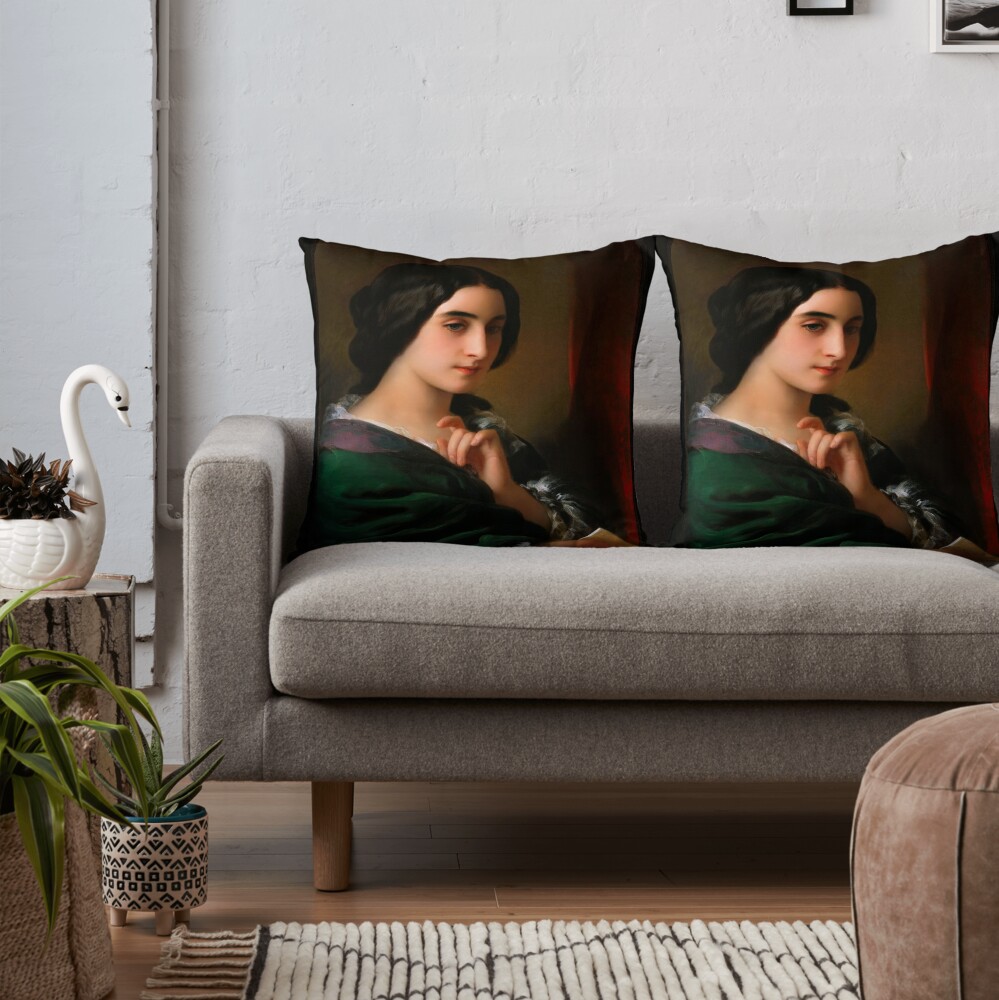
Table des matières
Sujet et composition
The subject of this portrait is a young woman, depicted in half-profile with an engaging yet contemplative expression. The woman is dressed in a dark, richly detailed gown, the flowing fabric of which contrasts elegantly with the softness of her pale skin. Ses cheveux, a cascade of dark waves, is styled neatly, framing her face and adding a sense of refinement and care to her appearance. She gazes slightly to the right, her eyes conveying a sense of quiet introspection, as if caught in a moment of personal reflection. Her right hand, gently resting on her chest, adds an intimate quality to the painting, as though she is caught in a fleeting, delicate gesture of thought or emotion.
The composition focuses tightly on her head and upper torso, with minimal background distraction. Le doux, blurred background hints at a warm, ambient setting that complements her serene expression without drawing attention away from her figure. The artist uses light to delicately illuminate her face, emphasizing the softness of her features. The background itself is subtly rendered, with muted colors that do not compete with the woman’s detailed attire and poised demeanor.
Style and Techniques
Winterhalter’s style is steeped in the traditions of 19th-century portraiture, where precision in rendering the subject’s likeness was essential, but where emotional expression was also paramount. His careful use of light and shadow on the woman’s face highlights the gentle curvature of her cheeks and the softness of her jawline, emphasizing both the delicate and noble aspects of her character. This technique demonstrates Winterhalter’s mastery in the manipulation of chiaroscuro—the treatment of light and shade—which was integral to creating depth and volume in the painting.
The artist’s handling of the young woman’s gown is another remarkable aspect of the portrait. The fabric appears lush and tangible, its folds and drapery rendered with great care to suggest weight and texture. Winterhalter pays close attention to the rendering of the material’s sheen and the way the fabric naturally falls, allowing it to interact beautifully with the light sources in the painting. This skill not only emphasizes the luxurious quality of the woman’s attire but also reflects the importance of social status and wealth, which were central themes in Winterhalter’s portraiture.
The brushwork itself is smooth and almost invisible, giving the painting an almost ethereal quality. The meticulous finish, devoid of visible brushstrokes, imparts a sense of polish and refinement that befits the subject’s aristocratic portrayal. This technical finesse is characteristic of Winterhalter’s larger body of work, which often aimed to achieve a harmonious balance between idealized beauty and realism.
Thème et humeur
The theme of the portrait is deeply rooted in Romantic ideals, specifically the emphasis on individual beauty and introspection. Unlike many portraits of the time that focused on formal poses and overt displays of wealth, Winterhalter’s depiction of the young woman feels intimate and contemplative. There is no sense of boastful exhibitionism in her pose. Au lieu, her expression is quiet and reserved, allowing the viewer to interpret her emotions as one of thoughtful serenity or even melancholy. Her gaze is soft yet direct, drawing the viewer into her personal world.
The mood of the painting is reflective and calm. L'éclairage tamisé, coupled with the muted palette of the background and the subject’s attire, imbues the scene with a sense of quiet elegance. This mood is reflective of the 19th-century fascination with inner life and personal reflection, as opposed to the more outwardly focused portrayals of earlier eras. The juxtaposition of the young woman’s graceful appearance with the gentle tone of the work emphasizes her emotional depth and the nuanced complexities of her character.
Materials and Presentation
This work is painted with oil on canvas, a medium that allows for the smooth blending of light and shadow. Oil paint was a standard medium during this period, prized for its richness and the ability to achieve a high degree of realism. The artist’s use of oil paint in this portrait allowed for the depiction of skin tones with remarkable subtlety and warmth, contributing to the soft luminosity of the subject’s face and the overall atmosphere of the piece.
The size of the painting is relatively intimate, further enhancing the personal and introspective nature of the portrait. The young woman is captured in a moment that feels private, as if she has been paused mid-thought. This closeness invites the viewer to connect with the subject on a more personal level, almost as if they are intruding on a private moment of introspection.
Conclusion
Hermann Winterhalter’s “Tête de jeune femme” is a testament to the artist’s skill in capturing the refinement, élégance, and emotional depth of his subjects. Through his meticulous technique, use of light, and emphasis on the subject’s introspective nature, Winterhalter creates an intimate portrayal that transcends the mere visual. The woman’s graceful demeanor, combined with the rich textures of her clothing and the soft, ambiance contemplative, makes this painting an exemplary work of 19th-century portraiture. It not only captures the likeness of the woman but also hints at the subtle emotional currents that run beneath her composed exterior, making it a timeless piece of classical art.
Head of a Young Woman est une reproduction remasterisée de maîtres anciens d'art numérique d'une image du domaine public qui est disponible en tant que impression sur toile en ligne.
Biographie de l'artiste
Informations ci-dessous dérivées de Wikipedia.org
Hermann Winterhalter est né dans le petit village de Menzenschwand, (fait maintenant partie de Sankt Blasien), dans la Forêt-Noire allemande dans l'électorat de Baden, en avril 20, 1805.
Il était le septième enfant de Fidel Winterhalter (1773 – 1863), un agriculteur et producteur de résine dans le village, et sa femme Eva Meyer (1765 – 1838), membre d'une famille Menzenschwand établie de longue date.
Son père était d'origine paysanne et a eu une influence puissante dans sa vie, lui faisant suivre les traces de son frère aîné Franz Winterhalter dont Hermann était très proche.. Des huit frères et sœurs, seulement quatre ont survécu à la petite enfance.
Hermann a commencé sa carrière artistique, quand il a été formé pour la première fois comme lithographe (La lithographie est une méthode d'impression basée à l'origine sur l'immiscibilité de l'huile et de l'eau. L'impression est d'une pierre (calcaire lithographique) ou une plaque métallique avec une surface lisse. Il a été inventé en 1796 de l'auteur et acteur allemand Alois Senefelder (1771 – 1834) comme une méthode bon marché de publication d'œuvres théâtrales.).
De là, il a ensuite étudié la peinture à Munich, Allemagne et Rome, Italie; après quoi il s'installe à Paris, France où il travaille avec son frère Franz et expose au Salon de 1838 – 1841, 1847 et 1869.
Dans les années 1850, Hermann a commencé de manière indépendante sa propre petite pratique de portrait, créant des œuvres respectées telles que Jeune Fille d'Ariccia et le portrait de son mécène parisien Nicolas-Louis Planat de la Faye.
Après la chute du Second Empire français (qui était le régime impérial bonapartiste de 18 ans de Napoléon III à partir de janvier 14, 1852 à septembre 4, 1870, entre la IIe République et la IIIe République, de France.); Hermann et son frère Franz ont décidé de se retirer à Baden; un territoire historique du sud de l'Allemagne et du nord de la Suisse, des deux côtés du Rhin supérieur.
Où Franz est mort en 1873; tandis qu'Hermann pendant presque 20 plus d'années, décès en février 24, 1891 à Karlsruhe – la deuxième plus grande ville de l'état fédéral allemand du Bade-Wurtemberg.