

Perdu dans ses pensées
“Perdu dans ses pensées,” peint en 1868 par Henri Guillaume Schlesinger (1814 – 1893), est un bel exemple de la capacité de l’artiste à transmettre un engagement émotionnel profond et des nuances délicates à travers le portrait.. Schlesinger, né en France de parents allemands, était un artiste prolifique dont les œuvres se concentraient souvent sur des scènes intimes de contemplation, en particulier des femmes dans les moments de réflexion tranquille. Cette pièce particulière est une excellente représentation de son style, mettant en vedette une jeune fille capturée dans un moment de solitude réfléchie, incarnant le sentiment d’introspection et de profondeur émotionnelle pour lequel les œuvres de Schlesinger sont connues.
La jeune fille du tableau est assise, sa posture gracieuse mais légèrement affaissée, ce qui suggère une introspection tranquille voire une subtile lassitude. Ses mains, délicatement serrés ensemble, repose sur un livre ouvert, et d'autre part, she loosely holds a string of beads that she seems to have been lightly playing with or holding absentmindedly. This soft gesture, combined with her gaze slightly averted, invites the viewer to ponder her thoughts. The somber expression on her face suggests she may be lost in deep contemplation, yet there is a sense of peacefulness about her demeanor that contrasts with any overt signs of distress.
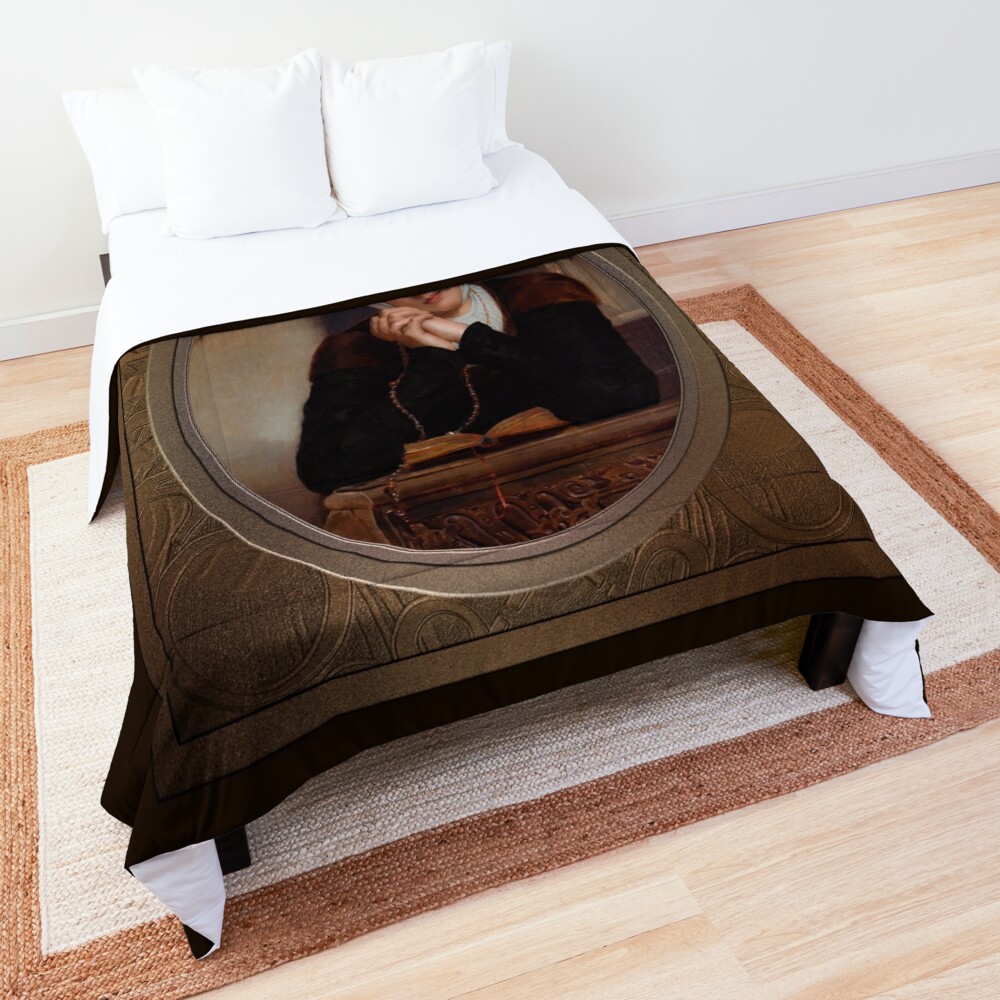
Table des matières
Composition et style
Schlesinger’s technical skill in this painting is evident in the careful rendering of textures and light. The detailed folds of the woman’s attire, particularly the dark velvet shawl that rests gently around her shoulders, are depicted with remarkable precision, showing off Schlesinger’s mastery of fabric textures. The dark tones of her clothing contrast with the lighter, soft whites and beiges of the headscarf and the subtle sheen on the book, lending depth to the composition. L’utilisation du clair-obscur par l’artiste, le contraste entre la lumière et l'obscurité, adds an emotional weight to the work, emphasizing the woman’s features while enveloping the rest of the composition in a soft, lumière presque éthérée.
The background is subtly painted in a muted tone, suggesting an interior space, perhaps a library or study. The slightly blurred architecture, framed by an arched window, hints at a more significant environment without detracting from the central subject. This indirect approach to the setting underscores the girls’s emotional focus, with the artist carefully keeping the viewer’s attention on her face and hands, where the emotional narrative resides.
L'ambiance et le thème
L'ambiance de “Perdu dans ses pensées” is one of reflective solitude. The title itself suggests that the woman is momentarily detached from her surroundings, enveloppée dans son monde intérieur. Ce tableau incarne le thème de la contemplation, un motif récurrent dans l’œuvre de Schlesinger, qui explorait souvent la vie intérieure de ses sujets. L’apparent isolement de la femme du monde extérieur implique un moment de réflexion personnel, où les pensées, peut-être sur un sujet émotionnel profond ou une question philosophique, occuper son esprit.
Malgré le calme dans son expression, il y a une tension sous-jacente dans sa pose, celui qui fait allusion à une complexité plus silencieuse. Son front plissé, le léger affaissement de ses lèvres, et la façon dont elle serre les mains étroitement ensemble indique une pensée réfléchie, peut-être même troublé, état mental. Encore, l'absence d'explosions émotionnelles manifestes ou de gestes dramatiques permet au spectateur de se sentir comme s'il s'agissait d'une intrusion dans un domaine privé., fleeting moment of contemplation.
Les objets environnants, namely the book and rosary-like beads, add layers to the interpretation of this scene. The book could symbolize knowledge, réflexion, or even spiritual contemplation, while the beads may hint at a religious or meditative practice, evoking a sense of ritual or calm within the woman’s reflective moment. Ensemble, these objects provide a sense of depth, suggesting the woman’s inner life may be rich with thought, possibly on matters both intellectual and spiritual.
Matériel et technique
Schlesinger’s choice of oil on canvas allows for rich detail and smooth transitions in shading, enabling him to convey the subtleties of the fabric and skin textures with ease. The artist’s ability to model the light on the face, capturing the soft glow of the skin, is a hallmark of his style. The smoothness of the skin contrasts beautifully with the texture of the velvet shawl, the glossy book pages, and the delicate shine of the beads, highlighting Schlesinger’s ability to bring different materials to life with his brushwork.
The artist’s careful attention to light is not just technical but emotional. The soft glow surrounding the woman’s face and hands imbues the painting with a gentle warmth, which contrasts with the cooler tones of the background. This technique highlights the figure’s serenity and invites the viewer to feel a sense of calm while also suggesting a world beyond the subject that is distant, almost intangible.
Conclusion
“Perdu dans ses pensées” is a masterpiece that encapsulates Schlesinger’s unique ability to portray both the beauty and complexity of human introspection. Through the delicate rendering of the girl’s features and surroundings, Schlesinger invites the viewer into an intimate moment of quiet contemplation. The painting not only emphasizes the emotional depth of the figure but also the artist’s skill in capturing mood through lighting, texture, and subtle details. The woman in the painting is not just a passive observer but an active participant in her moment of thought, and Schlesinger’s work offers a glimpse into her quiet, reflective world.
Il s'agit d'une reproduction de maîtres anciens d'art numérique remasterisée d'une image du domaine public qui est disponible en tant que impression sur toile.