

Head of a Young Woman c1849
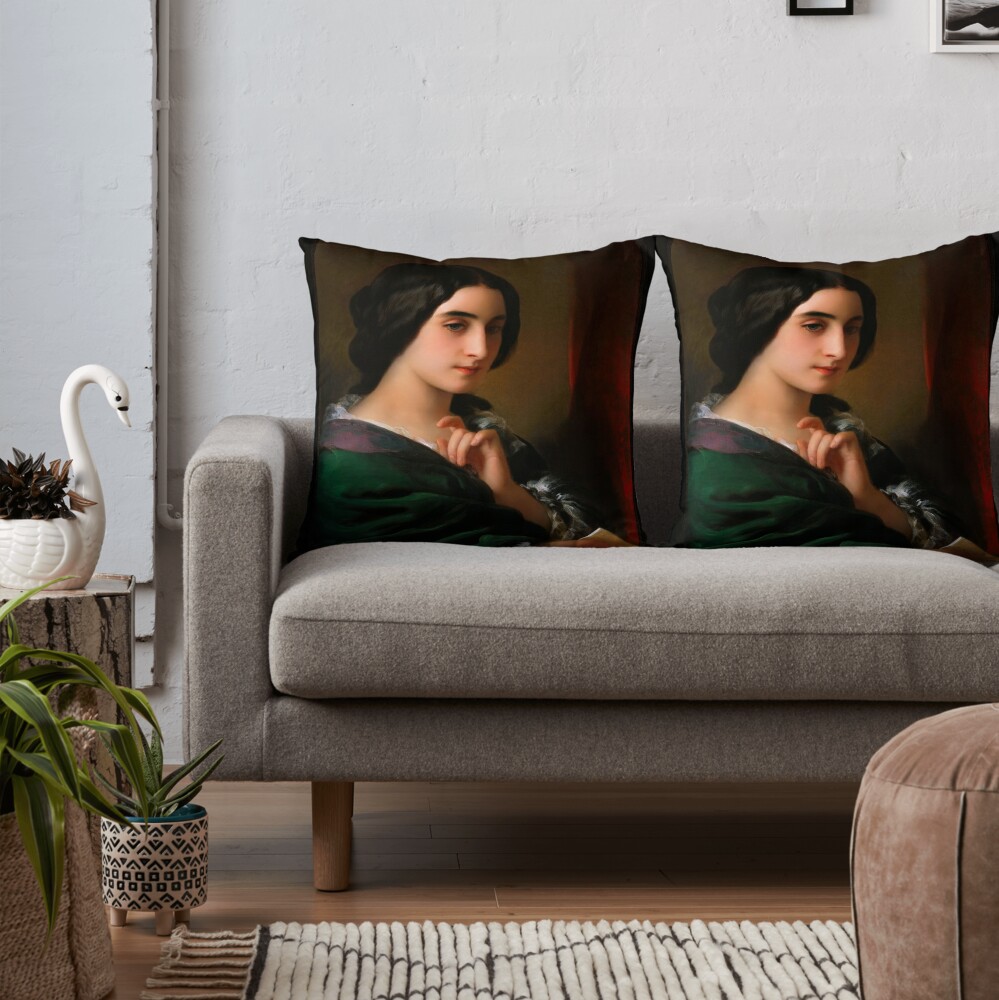
“Head of a Young Woman” c1849, by German painter Hermann Winterhalter (1808 – 1891), is an exquisite portrait that captures the refined elegance and subtle emotional depth characteristic of mid-19th century European art. Winterhâlder, renowned for his portraits of royal families and aristocracy, excels in this work, showcasing a young woman in a composition marked by grace, serenity, and an air of mystery. De styl, stimming, and technical execution place this piece squarely within the tradition of Romanticism, which celebrates the expression of emotion, natuerlike skientme, and individualism.
Ynhâldsopjefte
Underwerp en komposysje
The subject of this portrait is a young woman, yn healprofyl ôfbylde mei in meinimmende doch neitinkende útdrukking. De frou is klaaid yn in tsjuster, ryk detaillearre jurk, wêrfan it streamende stof elegant kontrastearret mei de sêftens fan har bleke hûd. Har hier, in kaskade fan tsjustere weagen, is netjes styled, framing har gesicht en it tafoegjen fan in gefoel fan ferfining en soarch oan har uterlik. Se sjocht efkes nei rjochts, har eagen jouwe in gefoel fan stille yntrospeksje oer, as fongen yn in momint fan persoanlike besinning. Har rjochterhân, sêft rêstend op har boarst, foeget in yntime kwaliteit ta oan it skilderij, as is se fongen yn in flechtich, delicate gebeart fan gedachte of emoasje.
De komposysje rjochtet him strak op har holle en boppeste torso, mei minimale eftergrûnôflieding. De sêfte, wazige eftergrûn hints op in waarm, ambient ynstelling dy't har serene útdrukking oanfolje sûnder de oandacht fuort te lûken fan har figuer. De keunstner brûkt ljocht om har gesicht delikaat te ferljochtsjen, beklamje de sêftens fan har funksjes. De eftergrûn sels is subtyl werjûn, mei gedempte kleuren dy't net konkurrearje mei de detaillearre klean en posityf gedrach fan 'e frou.
Style and Techniques
Winterhalter's styl is trochdreaun yn 'e tradysjes fan 19e-ieuske portretten, dêr't krektens yn it werjaan fan de likenis fan it ûnderwerp essinsjeel wie, mar dêr't ek emosjonele útdrukking foarop stie. Syn soarchfâldich gebrûk fan ljocht en skaad op it gesicht fan 'e frou markeart de sêfte kroming fan har wangen en de sêftens fan har kaak., de klam op sawol de delikate as foarname aspekten fan har karakter. Dizze technyk toant de behearsking fan Winterhalter yn 'e manipulaasje fan chiaroscuro - de behanneling fan ljocht en skaad - dy't yntegraal wie foar it meitsjen fan djipte en folume yn it skilderij.
De hanneling fan 'e keunstner fan' e jurk fan 'e jonge frou is in oar opmerklik aspekt fan it portret. De stof liket weelderich en taastber, syn plooien en drapery rendered mei grutte soarch te suggerearje gewicht en textuur. Winterhalter besteget goed omtinken oan it werjaan fan de glâns fan it materiaal en de manier wêrop de stof natuerlik falt, wêrtroch it prachtich ynteraksje kin mei de ljochtboarnen yn it skilderij. Dizze feardigens beklammet net allinich de lúkse kwaliteit fan 'e klean fan' e frou, mar wjerspegelet ek it belang fan sosjale status en rykdom, which were central themes in Winterhalter’s portraiture.
The brushwork itself is smooth and almost invisible, giving the painting an almost ethereal quality. The meticulous finish, devoid of visible brushstrokes, imparts a sense of polish and refinement that befits the subject’s aristocratic portrayal. This technical finesse is characteristic of Winterhalter’s larger body of work, which often aimed to achieve a harmonious balance between idealized beauty and realism.
Tema en stimming
The theme of the portrait is deeply rooted in Romantic ideals, specifically the emphasis on individual beauty and introspection. Unlike many portraits of the time that focused on formal poses and overt displays of wealth, Winterhalter’s depiction of the young woman feels intimate and contemplative. D'r is gjin gefoel fan grutsk ekshibisjonisme yn har pose. Ynstee, har útdrukking is stil en reservearre, wêrtroch't de sjogger har emoasjes ynterpretearje kin as ien fan betochtsume sereniteit of sels weemoed. Har blik is sêft, mar direkt, lûkt de sjogger yn har persoanlike wrâld.
De stimming fan it skilderij is reflektyf en kalm. De sêfte ferljochting, kombinearre mei it gedempte palet fan 'e eftergrûn en de klean fan it ûnderwerp, imbues it toaniel mei in gefoel fan stille elegânsje. Dizze stimming reflektearret de 19e-ieuske fassinaasje mei ynderlik libben en persoanlike refleksje, yn tsjinstelling ta de mear nei bûten rjochte portretten fan eardere tiidrekken. De njonkenstelling fan it sierlike uterlik fan 'e jonge frou mei de sêfte toan fan it wurk beklammet har emosjonele djipte en de nuansearre kompleksiteit fan har karakter.
Materials and Presentation
Dit wurk is skildere mei oalje op doek, a medium that allows for the smooth blending of light and shadow. Oil paint was a standard medium during this period, prized for its richness and the ability to achieve a high degree of realism. The artist’s use of oil paint in this portrait allowed for the depiction of skin tones with remarkable subtlety and warmth, contributing to the soft luminosity of the subject’s face and the overall atmosphere of the piece.
The size of the painting is relatively intimate, further enhancing the personal and introspective nature of the portrait. The young woman is captured in a moment that feels private, as if she has been paused mid-thought. This closeness invites the viewer to connect with the subject on a more personal level, almost as if they are intruding on a private moment of introspection.
Konklúzje
Hermann Winterhalter’s “Head of a Young Woman” is a testament to the artist’s skill in capturing the refinement, sierlikens, and emotional depth of his subjects. Through his meticulous technique, use of light, and emphasis on the subject’s introspective nature, Winterhalter creates an intimate portrayal that transcends the mere visual. The woman’s graceful demeanor, combined with the rich textures of her clothing and the soft, contemplative atmosphere, makes this painting an exemplary work of 19th-century portraiture. It not only captures the likeness of the woman but also hints at the subtle emotional currents that run beneath her composed exterior, making it a timeless piece of classical art.
Head of a Young Woman is a remastered digital art old masters reproduction of a public domain image that is available as a canvas print online.
Artist Bio
Info hjirûnder ôflaat fan Wikipedia.org
Hermann Winterhalter was born in the small village of Menzenschwand, (now part of Sankt Blasien), in Germany’s Black Forest in the Electorate of Baden, on April 20, 1805.
He was the seventh child of Fidel Winterhalter (1773 – 1863), a farmer and resin producer in the village, and his wife Eva Meyer (1765 – 1838), a member of a long established Menzenschwand family.
His father was of peasant stock and was a powerful influence in his life making him follow in his older brother Franz Winterhalter footsteps whom Hermann was very close to. Of the eight brothers and sisters, only four survived infancy.
Hermann began his artistic career, when he was first trained as a lithographer (Lithography is a method of printing originally based on the immiscibility of oil and water. The printing is from a stone (lithographic limestone) or a metal plate with a smooth surface. It was invented in 1796 by German author and actor Alois Senefelder (1771 – 1834) as a cheap method of publishing theatrical works.).
From there he later went on to study painting in Munich, Germany and Rome, Itaalje; after which he moved to Paris, France where he worked with his brother Franz and exhibited at the Salon from 1838 – 1841, 1847 en 1869.
In th 1850s Hermann independently started a small portrait practice of his own, creating respected works such as Young Girl from Ariccia and the portrait of his Parisian patron Nicolas-Louis Planat de la Faye.
After the fall of the Second French Empire (which was the 18-year Imperial Bonapartist regime of Napoleon III from January 14, 1852 to September 4, 1870, between the Second Republic and Third Republic, of France.); Hermann and his brother Franz decided to retire to Baden; a historical territory in South Germany and North Switzerland, on both sides of the Upper Rhine.
Where Franz died in 1873; while Hermann for almost 20 more years, passing away on February 24, 1891 in Karlsruhe – the second-largest city of the German federal state of Baden-Württemberg.