

Head Of A Young Woman c1780s
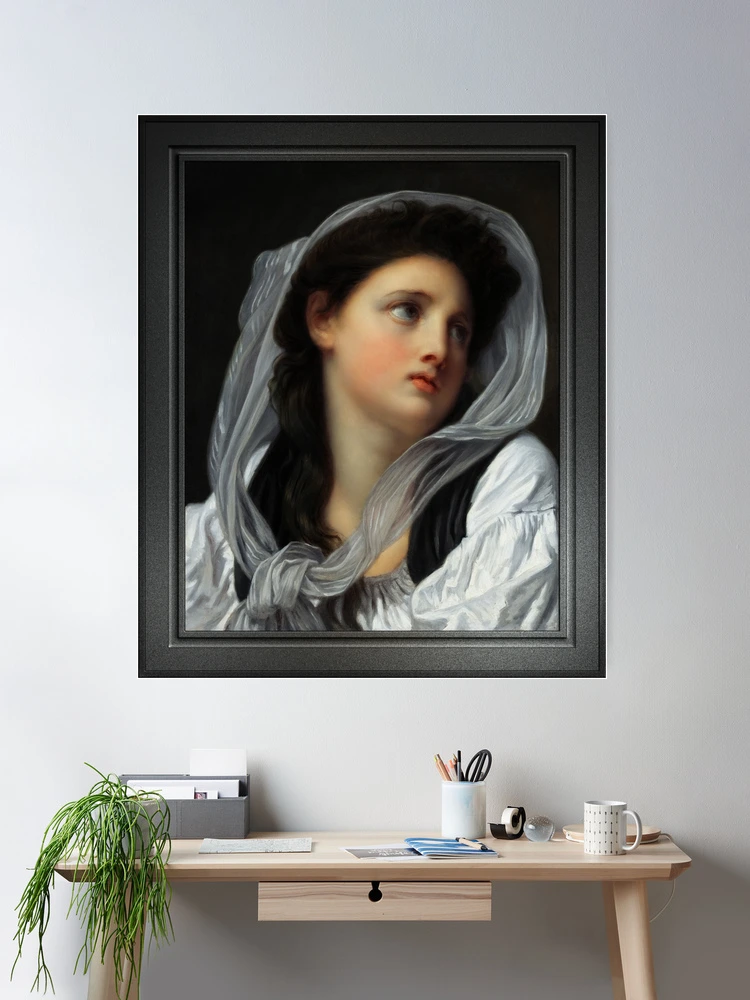
Kunstværket “Head Of A Young Woman c1780s” blev skabt af den berømte franske kunstner Jean-Baptiste Greuze (1725 – 1805). Greuze, a master of the Rococo and Neoclassical movements, has long been celebrated for his emotional portrayal of the human form, particularly in his genre scenes and portraiture. I dette maleri, Greuze presents a close-up view of a young woman, capturing her delicate features and emotional expression. The subject’s appearance and pose evoke a quiet sense of vulnerability and contemplation, typical of the artist’s focus on intimate, personal moments.
Indholdsfortegnelse
Emnet: A Moment of Vulnerability
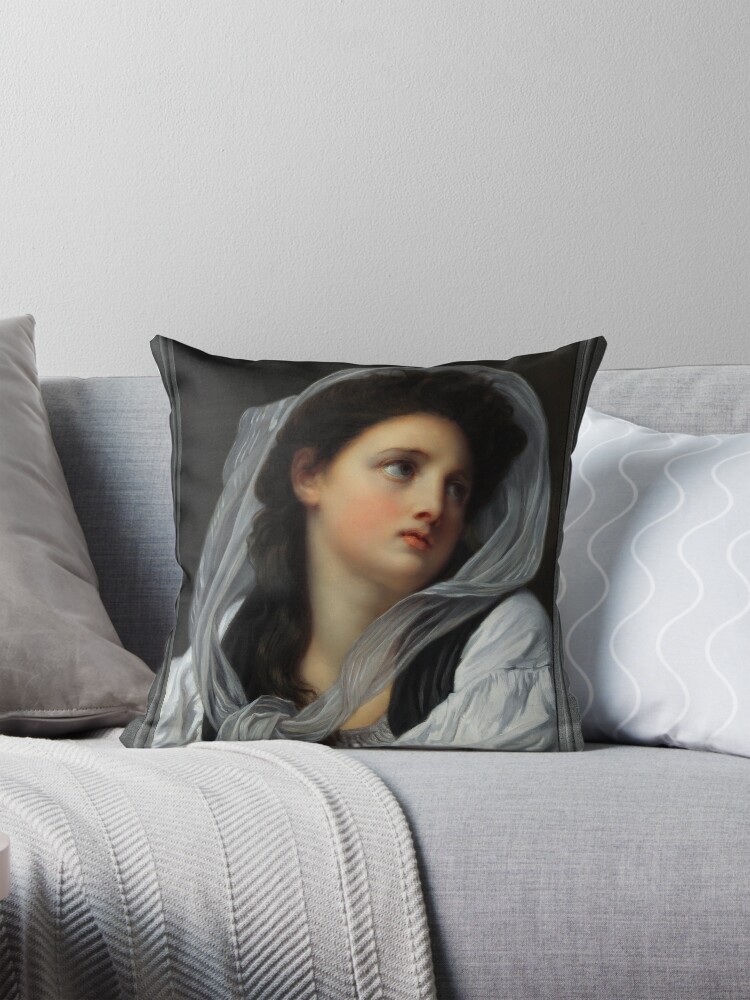
The young woman portrayed in this painting seems to be in a state of introspection, her gaze directed upward and slightly to the side, as though lost in thought or perhaps caught in a fleeting moment of emotion. Her head is slightly tilted, and her face, framed by flowing, soft fabric, adds an element of delicacy to the composition. The transparent veil-like material, which drapes gently over her head and shoulders, creates a soft contrast to the more defined features of her face, enhancing the subject’s fragile and ethereal quality. The veil’s soft folds suggest an underlying sense of modesty and demureness, qualities often emphasized in Greuze’s portraits of young women.
Her pale complexion, highlighted by soft brushstrokes, adds to the overall gentle mood of the piece. Hendes øjne, slightly wide, exude a quiet vulnerability. The expression is not one of distress but rather one of thoughtful quietude, inviting the viewer to engage with her internal world, though it remains shrouded in mystery. The subtle play of light on her face further enhances her youthful innocence and purity, while the deep shadows surrounding her create a mood of melancholy, emphasizing her isolation in this intimate moment.
Materialer og teknikker: A Masterful Rendering of Light and Texture
Greuze, kendt for sin omhyggelige opmærksomhed på detaljer, employed traditional oil painting techniques to create a strikingly realistic and textured portrait. The rendering of the young woman’s face and veil shows the artist’s exceptional ability to manipulate light and shadow, particularly in his treatment of the skin’s texture and the translucent fabric.
The artist’s mastery of chiaroscuro – the contrast between light and dark – creates a deep sense of volume in the subject’s face, allowing each delicate contour to emerge. The pale tones of her face are subtly warmed by the naturalistic application of color, creating a softness that feels almost tangible. Greuze’s use of the fine details in her hair and the transparent veil elevates the portrait beyond a simple likeness, offering instead a nuanced representation of the subject’s emotional depth.
The veil, a key element in the composition, is rendered with exceptional care. Each fold and layer is crafted to suggest a sense of weight and fluidity, and its lightness contrasts with the more defined features of the young woman’s face. The contrast between the smoothness of her skin and the texture of the veil emphasizes the artist’s understanding of fabric as both an element of fashion and a device to enhance the mood and meaning of the composition.
The Emotional Tone and Psychological Depth
Greuze’s work is often praised for its emotional depth, and this portrait of the young woman is no exception. The expression on her face hints at complex psychological states: she appears to be caught in a moment of emotional tension, one that does not necessarily suggest joy or sorrow but rather a contemplative or pensive state. The choice to depict the subject in such a vulnerable moment rather than in a more formal or rigid pose adds an element of relatability to the viewer, drawing them into the scene and inviting them to interpret her emotional state.
The mood created by the painting is one of quiet introspection, heightened by the somber dark background that isolates the young woman from her surroundings. This dark backdrop allows the viewer’s focus to remain entirely on the subject, further deepening the emotional resonance of the portrait.
The juxtaposition of light and dark, along with the contrast between the soft skin and the flowing fabric, creates a feeling of fragility that permeates the entire composition. This exploration of emotional depth was characteristic of the Rococo period, where portraiture was often used to convey not only the physical likeness of a subject but also their inner emotional life.
Konklusion: A Timeless Portrait of Youth and Vulnerability
“Head of a Young Woman” stands as a remarkable example of Jean-Baptiste Greuze’s skill in portraying the emotional complexity of the human figure. Through his masterful handling of light, skygge, og tekstur, Greuze captures a moment of delicate beauty and introspection, inviting the viewer to contemplate not only the external features of the subject but also her internal world. The artwork is a testament to the artist’s ability to evoke complex psychological and emotional states through the medium of oil paint, offering a portrait that transcends time and remains poignant even today.
Denne digitale kunstskabelse, som med alt det kunstværk, der kan findes på Xzendor7-webstedet, er det tilgængeligt for køb online i en række materialeformater, herunder lærredstryk, akryltryk, metaltryk, trætryk, indrammede tryk, plakater, og som rullede lærredstryk i forskellige størrelser fra 12 tommer til 72 tommer afhængigt af størrelsen på det faktiske kunstværk og den print-on-demand-butik, du vælger at købe kunsten fra.
Kunstværket er også tilgængeligt på en bred vifte af mænds og kvinders beklædning, krus, totes, tørklæder, notesbøger og journaler og mange boligindretningsprodukter.
Om Kunstneren
Nedenstående oplysninger er afledt af NGA.gov
Jean blev født i Tournus, Frankrig i 1725 som den sjette søn af en fliselæggermester, der anerkendte hans talent i en meget tidlig alder; sender ham til Lyon, Frankrig for at studere hos den franske portrætmaler Charles Grandon (1691 – 1762).
I en alder af ca 30 han forlod Lyon, og rejste til Paris, Frankrig for at studere ved Académie royale de peinture et de sculpture eller Royal Academy of Painture and Sculpture; som på det tidspunkt var Frankrigs førende kunstinstitution under den sidste del af Ancien Régime (Gamle Regiem ~1500 til 1789), indtil den blev afskaffet 1793 under den franske revolution.
Skønt meget talentfuld og meget succesfuld i 1760'erne og 1770'erne, have mæcener af folk som Marquise de Pompadour (1721 – 1764), Kejserinde Catherine II af Rusland (r. 1762 – 1796), og Ange Laurent fra La Live de Jully (1725 – 1779); hans oprørske natur og konflikter med Akademiets og Salons embedsmænd ville vise sig at være hans ulykke; især efter hans ægteskab med Anne Marie Babuty i 1759; hvilket skulle vise sig at være en katastrofe for ham, da hun var kendt for at have haft forskellige affærer med hans elever og oppassere, hvilket medførte ham tab af indkomst og offentlig ydmygelse.
Da ægteskabet sluttede 34 år senere modtog hans kone et betydeligt forlig, hvilket efterlod ham i en alvorlig økonomisk situation og på tidspunktet for hans død i 1805 i en alder af 80 han var næsten knust.