

Psyche c1786
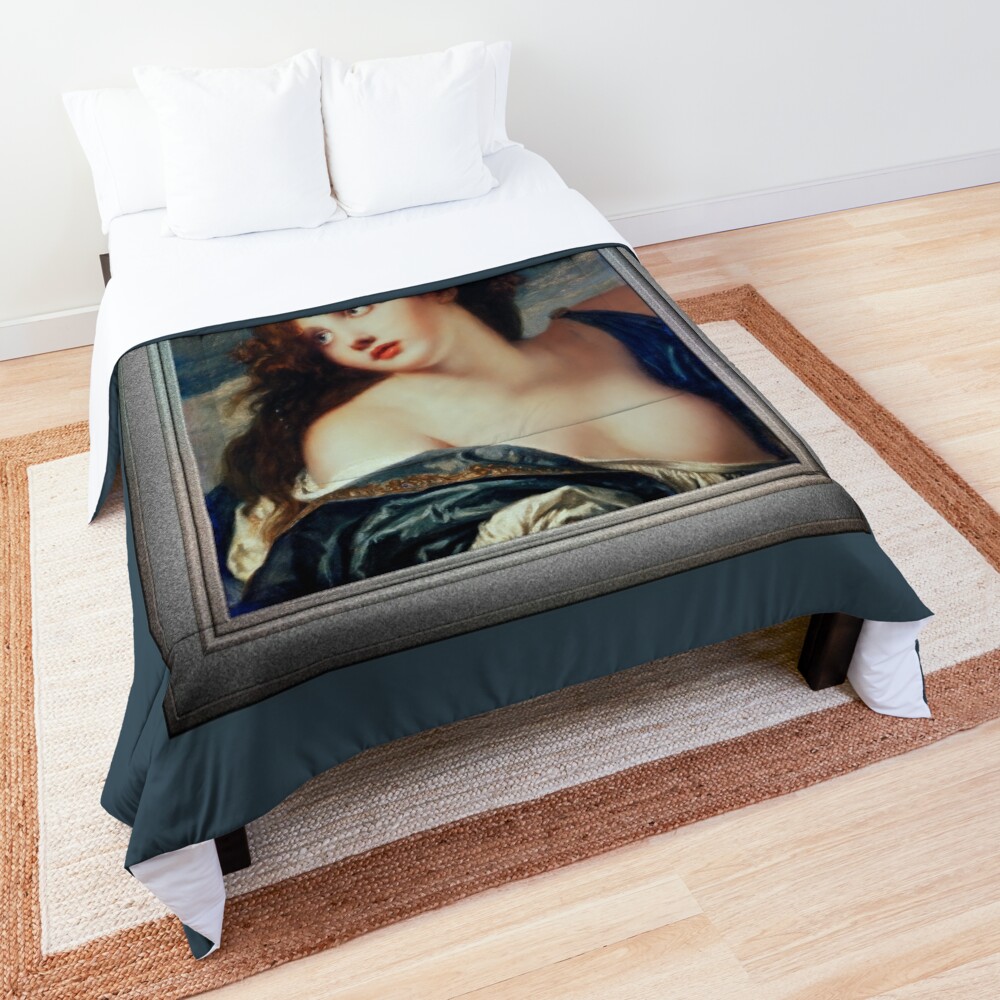
Kunstværket med titlen Psyche fra 1786, created by French painter Jean-Baptiste Greuze (1725 – 1805), depicts an emotional and intimate moment in mythological storytelling. This painting captures the mythical figure Psyche in a delicate and poignant portrayal, showcasing Greuze’s mastery of light, struktur, and emotional depth. I dette stykke, Greuze uses soft hues and detailed expressions to bring to life the timeless myth of Psyche, a mortal woman whose beauty was so extraordinary that it led her into a series of trials that ultimately resulted in her becoming immortal.
Indholdsfortegnelse
Hovedemnet: Psyche’s Emotional Expression
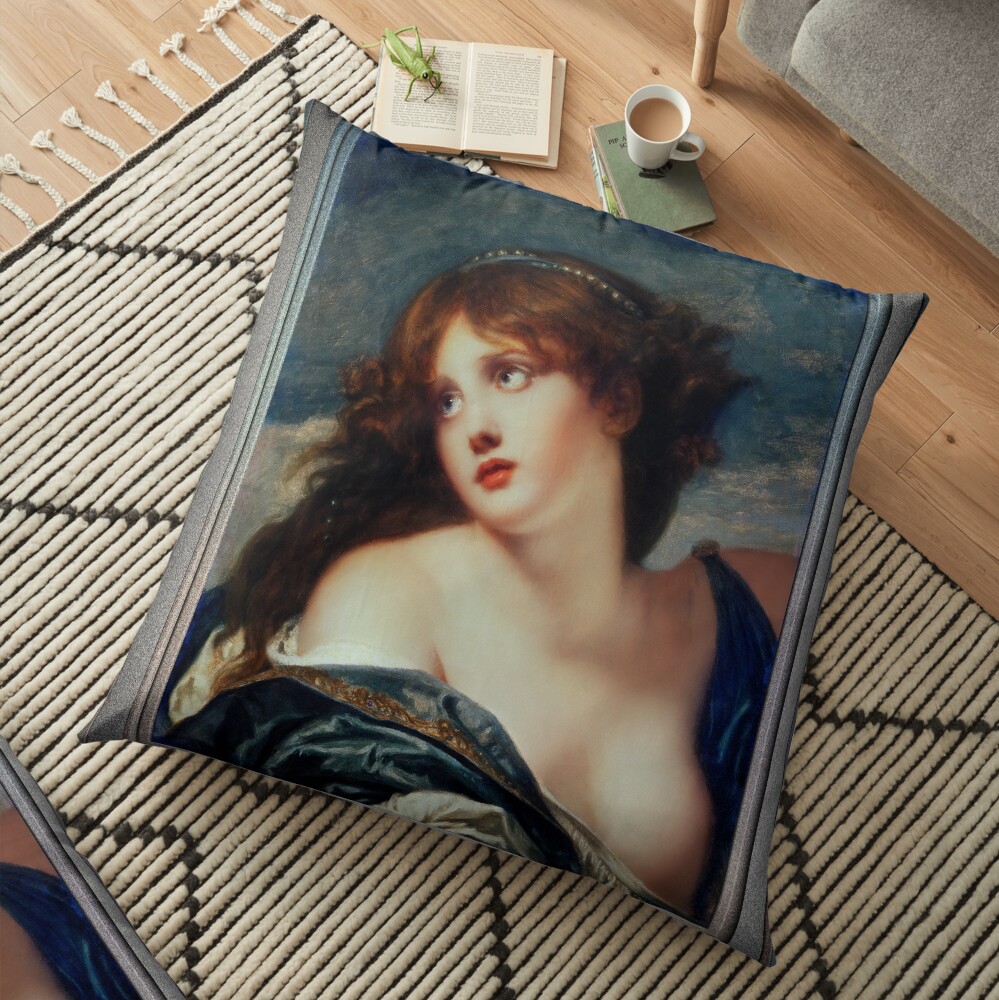
Psyche is the central figure of the composition, rendered with grace and sensuality. She is portrayed in a moment of quiet contemplation, her eyes gazing upward with an expression that reflects both vulnerability and longing. Her delicate features—rounded cheeks, soft lips, and large, expressive eyes—are painted with such fine detail that they evoke a sense of realism, almost lifelike in their intensity. This is characteristic of Greuze’s style, where he excelled in capturing human emotion with a remarkable sense of tenderness and psychological depth.
Psyche’s long, flowing hair is styled in loose curls that cascade over her shoulders, adding to her ethereal and delicate appearance. A pearl headband adorns her hair, symbolizing both her beauty and her connection to the divine. The way her hair is painted suggests movement, as though caught in a gentle breeze. The artist’s attention to such fine details not only enhances her beauty but also reinforces the dreamlike quality of the scene.
The Clothing and Materials
Psyche is dressed in a lavish garment of blue and gold. The fabric flows elegantly around her shoulders and neck, rendered with Greuze’s characteristic skill at depicting textures. The deep blue of the robe contrasts beautifully with the soft white of her exposed skin, creating a striking visual balance. The robe is adorned with golden trims, which enhance its luxurious appearance, symbolizing the celestial and divine nature of Psyche herself. Greuze’s treatment of the fabric is particularly noteworthy, with light and shadow playing across the material in such a way that it almost seems tangible, as though the viewer could reach out and touch the smoothness of the silk.
The fine texture of the fabric serves as a metaphor for the vulnerability and fragility of Psyche’s character, amplifying her emotional turmoil. The clothing, with its soft folds and the shimmering sheen of the material, adds a layer of complexity to the emotional tone of the painting. The robe’s rich colors and sumptuous fabric reflect Psyche’s dual nature—both mortal and divine, human and otherworldly.
Baggrunden og indstillingen
Baggrunden på maleriet er blød, atmospheric blend of cool blues and whites. It lacks any overt detail, but it works to emphasize Psyche’s figure. The simple, almost abstract background contrasts with the highly detailed foreground, focusing the viewer’s attention entirely on the subject. This technique reflects Greuze’s ability to create intimacy within his compositions, drawing the viewer into the emotional state of the subject without distraction.
The sky-like backdrop also evokes the idea of vastness and infinity, suggesting the mythological setting from which Psyche originates. The gentle gradients of color create a sense of space and airiness, adding to the dreamlike atmosphere of the painting. Psyche’s figure appears almost suspended in space, as though she is caught in a moment between earth and the heavens.
Stilen og teknikken
Jean-Baptiste Greuze was known for his ability to capture human emotion through his mastery of light and shadow, as well as his use of soft, harmoniske farver. I Psyche, the artist’s use of soft, glowing light on the figure’s face creates a sense of naturalism, drawing attention to the emotional expression of the subject. The light falls gently on Psyche’s skin, highlighting her delicate features while creating a contrast with the darker tones of her hair and clothing. This use of light and shadow is not just a stylistic choice but serves to emphasize the psychological depth of the painting, imbuing Psyche with a sense of inner conflict and longing.
Greuze’s technique in handling the human form is another striking element of this work. The artist captures the natural curves of Psyche’s body with fluid lines, giving her an air of graceful motion even though she is seated in stillness. The folds of her robe, the movement of her hair, and the nuanced expression on her face all combine to create a portrait that is both emotionally compelling and visually arresting.
The Mood and Theme
Stemningen af Psyche is one of wistful longing and quiet contemplation. The expression on Psyche’s face suggests a deep emotional turmoil, possibly related to the trials and tribulations she faces in the myth. There is a sense of sadness and resignation in her gaze, as though she is caught between hope and despair. The artist captures this emotional complexity through his careful rendering of her facial expression and posture, conveying a sense of vulnerability that resonates deeply with the viewer.
The theme of the painting—Psyche’s journey from mortal to divine—adds layers of meaning to the artwork. The mythological tale of Psyche and her eventual union with Cupid, the god of love, is one of transformation, kærlighed, og ofre. Greuze’s portrayal of Psyche’s emotional state hints at the internal conflict she faces as she navigates these challenges. In this work, Greuze does not focus on the grandiose or heroic elements of the myth but rather on the human, emotional aspect of the character, making the figure of Psyche relatable and deeply human.
Konklusion
Psyche c1786 by Jean-Baptiste Greuze is a masterpiece that captures both the beauty and the emotional depth of its mythological subject. Through his delicate rendering of Psyche’s form, expressive face, and elegant attire, Greuze has created a timeless portrayal of a woman caught between the mortal and divine worlds. The emotional resonance of the painting, combined with its technical mastery, places this work among the finest examples of Greuze’s career and offers a powerful exploration of human emotion within the context of classical mythology.
Dette er en remastered digital art old masters reproduktion af et offentligt domæne billede, der er tilgængeligt som en lærred print online.
Denne digitale kunstskabelse, som med alt det kunstværk, der kan findes på Xzendor7-webstedet, er det tilgængeligt for køb online i en række materialeformater, herunder lærredstryk, akryltryk, metaltryk, trætryk, indrammede tryk, plakater, og som rullede lærred udskriver i forskellige størrelser fra 12 tommer til 72 tommer afhængigt af størrelsen på det faktiske kunstværk og den print-on-demand-butik, du vælger at købe kunsten fra.
Kunstværket er også tilgængeligt på en bred vifte af mænds og kvinders beklædning, krus, totes, tørklæder, notesbøger og journaler og mange boligindretningsprodukter.
Om Kunstneren
Nedenstående oplysninger er afledt af NGA.gov
Jean blev født i Tournus, Frankrig i 1725 som den sjette søn af en fliselæggermester, der anerkendte hans talent i en meget tidlig alder; sender ham til Lyon, Frankrig for at studere hos den franske portrætmaler Charles Grandon (1691 – 1762).
I en alder af ca 30 han forlod Lyon, og rejste til Paris, Frankrig for at studere ved Académie royale de peinture et de sculpture eller Royal Academy of Painture and Sculpture; som på det tidspunkt var Frankrigs førende kunstinstitution under den sidste del af Ancien Régime (Gamle Regiem ~1500 til 1789), indtil den blev afskaffet 1793 under den franske revolution.
Skønt meget talentfuld og meget succesfuld i 1760'erne og 1770'erne, have mæcener af folk som Marquise de Pompadour (1721 – 1764), Kejserinde Catherine II af Rusland (r. 1762 – 1796), og Ange Laurent fra La Live de Jully (1725 – 1779); hans oprørske natur og konflikter med Akademiets og Salons embedsmænd ville vise sig at være hans ulykke; især efter hans ægteskab med Anne Marie Babuty i 1759; hvilket skulle vise sig at være en katastrofe for ham, da hun var kendt for at have haft forskellige affærer med hans elever og oppassere, hvilket medførte ham tab af indkomst og offentlig ydmygelse.
Da ægteskabet sluttede 34 år senere modtog hans kone et betydeligt forlig, hvilket efterlod ham i en alvorlig økonomisk situation og på tidspunktet for hans død i 1805 i en alder af 80 han var næsten knust.