

Kopf einer jungen Frau um 1780
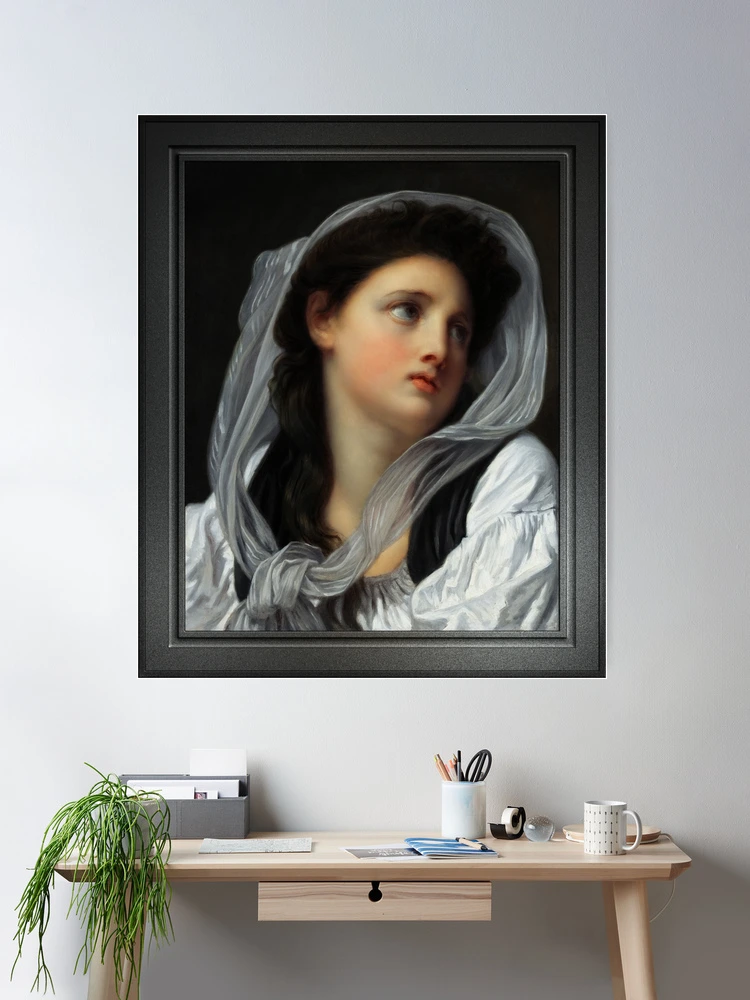
Das Kunstwerk “Kopf einer jungen Frau um 1780” wurde vom renommierten französischen Künstler geschaffen Jean-Baptiste Greuze (1725 – 1805). Greuze, ein Meister des Rokoko und des Neoklassizismus, wird seit langem für seine emotionale Darstellung der menschlichen Form gefeiert, insbesondere in seinen Genreszenen und Porträts. In diesem Gemälde, Greuze präsentiert eine Nahaufnahme einer jungen Frau, Er fängt ihre zarten Gesichtszüge und ihren emotionalen Ausdruck ein. Das Aussehen und die Haltung des Subjekts rufen ein ruhiges Gefühl der Verletzlichkeit und Kontemplation hervor, typisch für den Fokus des Künstlers auf Intimität, persönliche Momente.
Inhaltsverzeichnis
Das Thema: Ein Moment der Verletzlichkeit
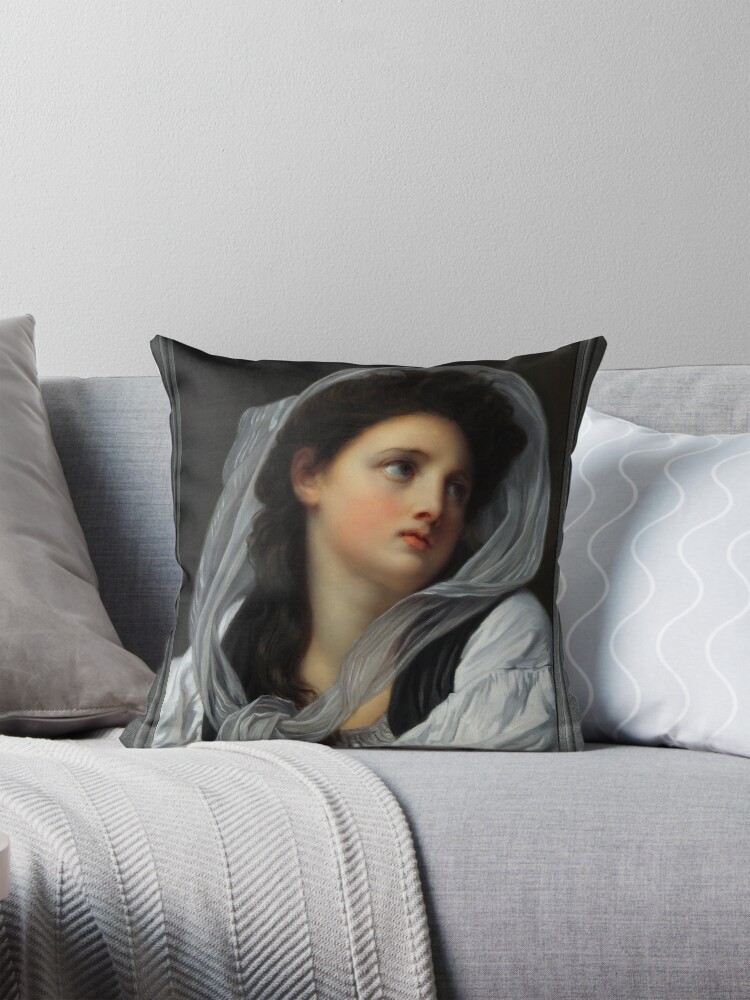
The young woman portrayed in this painting seems to be in a state of introspection, her gaze directed upward and slightly to the side, as though lost in thought or perhaps caught in a fleeting moment of emotion. Her head is slightly tilted, and her face, framed by flowing, soft fabric, adds an element of delicacy to the composition. The transparent veil-like material, which drapes gently over her head and shoulders, creates a soft contrast to the more defined features of her face, enhancing the subject’s fragile and ethereal quality. The veil’s soft folds suggest an underlying sense of modesty and demureness, qualities often emphasized in Greuze’s portraits of young women.
Her pale complexion, highlighted by soft brushstrokes, adds to the overall gentle mood of the piece. Ihre Augen, slightly wide, exude a quiet vulnerability. The expression is not one of distress but rather one of thoughtful quietude, inviting the viewer to engage with her internal world, though it remains shrouded in mystery. The subtle play of light on her face further enhances her youthful innocence and purity, while the deep shadows surrounding her create a mood of melancholy, emphasizing her isolation in this intimate moment.
Materialien und Techniken: Eine meisterhafte Wiedergabe von Licht und Textur
Greuze, known for his meticulous attention to detail, employed traditional oil painting techniques to create a strikingly realistic and textured portrait. The rendering of the young woman’s face and veil shows the artist’s exceptional ability to manipulate light and shadow, particularly in his treatment of the skin’s texture and the translucent fabric.
The artist’s mastery of chiaroscuro – the contrast between light and dark – creates a deep sense of volume in the subject’s face, allowing each delicate contour to emerge. The pale tones of her face are subtly warmed by the naturalistic application of color, creating a softness that feels almost tangible. Greuze’s use of the fine details in her hair and the transparent veil elevates the portrait beyond a simple likeness, offering instead a nuanced representation of the subject’s emotional depth.
Der Schleier, a key element in the composition, wird mit außerordentlicher Sorgfalt durchgeführt. Each fold and layer is crafted to suggest a sense of weight and fluidity, and its lightness contrasts with the more defined features of the young woman’s face. The contrast between the smoothness of her skin and the texture of the veil emphasizes the artist’s understanding of fabric as both an element of fashion and a device to enhance the mood and meaning of the composition.
Der emotionale Ton und die psychologische Tiefe
Greuze’s work is often praised for its emotional depth, and this portrait of the young woman is no exception. The expression on her face hints at complex psychological states: she appears to be caught in a moment of emotional tension, one that does not necessarily suggest joy or sorrow but rather a contemplative or pensive state. The choice to depict the subject in such a vulnerable moment rather than in a more formal or rigid pose adds an element of relatability to the viewer, drawing them into the scene and inviting them to interpret her emotional state.
The mood created by the painting is one of quiet introspection, heightened by the somber dark background that isolates the young woman from her surroundings. This dark backdrop allows the viewer’s focus to remain entirely on the subject, further deepening the emotional resonance of the portrait.
The juxtaposition of light and dark, along with the contrast between the soft skin and the flowing fabric, creates a feeling of fragility that permeates the entire composition. This exploration of emotional depth was characteristic of the Rococo period, where portraiture was often used to convey not only the physical likeness of a subject but also their inner emotional life.
Abschluss: Ein zeitloses Porträt von Jugend und Verletzlichkeit
“Kopf einer jungen Frau” ist ein bemerkenswertes Beispiel für die Fähigkeit von Jean-Baptiste Greuze, die emotionale Komplexität der menschlichen Figur darzustellen. Durch seinen meisterhaften Umgang mit Licht, Schatten, und Textur, Greuze fängt einen Moment zarter Schönheit und Introspektion ein, Sie lädt den Betrachter ein, nicht nur über die äußeren Merkmale des Subjekts nachzudenken, sondern auch über seine innere Welt. Das Kunstwerk ist ein Beweis für die Fähigkeit des Künstlers, mithilfe von Ölfarbe komplexe psychologische und emotionale Zustände hervorzurufen, bietet ein Porträt, das über die Zeit hinausgeht und auch heute noch ergreifend bleibt.
Diese digitale Kunstschöpfung, Wie alle Kunstwerke, die auf der Xzendor7-Website zu finden sind, können sie online in einer Vielzahl von Materialformaten einschließlich Leinwanddrucken erworben werden, Acryldrucke, Metalldrucke, Holzdrucke, gerahmte Drucke, Plakate, und wie gerollte Leinwanddrucke in verschiedenen Größen von 12 Zoll zu 72 Zoll, abhängig von der Größe des tatsächlichen Kunstwerks und dem Print-on-Demand-Shop, in dem Sie das Kunstwerk kaufen möchten.
Das Kunstwerk ist auch auf einer breiten Palette von Herren- und Damenbekleidung erhältlich, Tassen, Tragetaschen, Schals, Notizbücher und Tagebücher sowie viele Heimdekorationsprodukte.
Über den Künstler
Die folgenden Informationen stammen von NGA.gov
Jean wurde in Tournus geboren, Frankreich in 1725 als sechster Sohn eines Fliesenlegermeisters, der schon sehr früh sein Talent erkannte; schickte ihn nach Lyon, Frankreich, um bei dem französischen Porträtmaler Charles Grandon zu studieren (1691 – 1762).
Ungefähr im Alter von 30 er verließ Lyon, und reiste nach Paris, Frankreich, um an der Académie Royale de Peinture et de Sculpture oder der Royal Academy of Painting and Sculpture zu studieren; Das Museum war zu dieser Zeit die bedeutendste Kunstinstitution Frankreichs in der zweiten Hälfte des Ancien Régime (Alte Regiem ~1500 to 1789), bis es abgeschafft wurde 1793 während der Französischen Revolution.
Obwohl er in den 1760er und 1770er Jahren sehr talentiert und sehr erfolgreich war, mit Gönnern wie der Marquise de Pompadour (1721 – 1764), Kaiserin Katharina II. von Russland (R. 1762 – 1796), und Ange Laurent von La Live de Jully (1725 – 1779); Seine rebellische Natur und seine Konflikte mit Akademie- und Salonbeamten sollten sich als sein Unglück erweisen; insbesondere nach seiner Heirat mit Anne Marie Babuty 1759; was sich für ihn als Katastrophe erweisen würde, da bekannt war, dass sie verschiedene Affären mit seinen Schülern und Modellen hatte, was zu Einkommensverlusten und öffentlicher Demütigung führte.
Als die Ehe endete 34 Jahre später erhielt seine Frau eine stattliche Abfindung, was ihn in eine finanzielle Notlage brachte und zum Zeitpunkt seines Todes im Jahr 1805 im Alter von 80 er war fast pleite.