

Cabeza de una mujer joven c1780s
la obra de arte “Cabeza de una mujer joven c1780s” fue creado por el famoso artista francés Jean-Baptiste Greuze (1725 – 1805). Greuze, a master of the Rococo and Neoclassical movements, has long been celebrated for his emotional portrayal of the human form, particularly in his genre scenes and portraiture. en esta pintura, Greuze presents a close-up view of a young woman, capturing her delicate features and emotional expression. The subject’s appearance and pose evoke a quiet sense of vulnerability and contemplation, typical of the artist’s focus on intimate, personal moments.
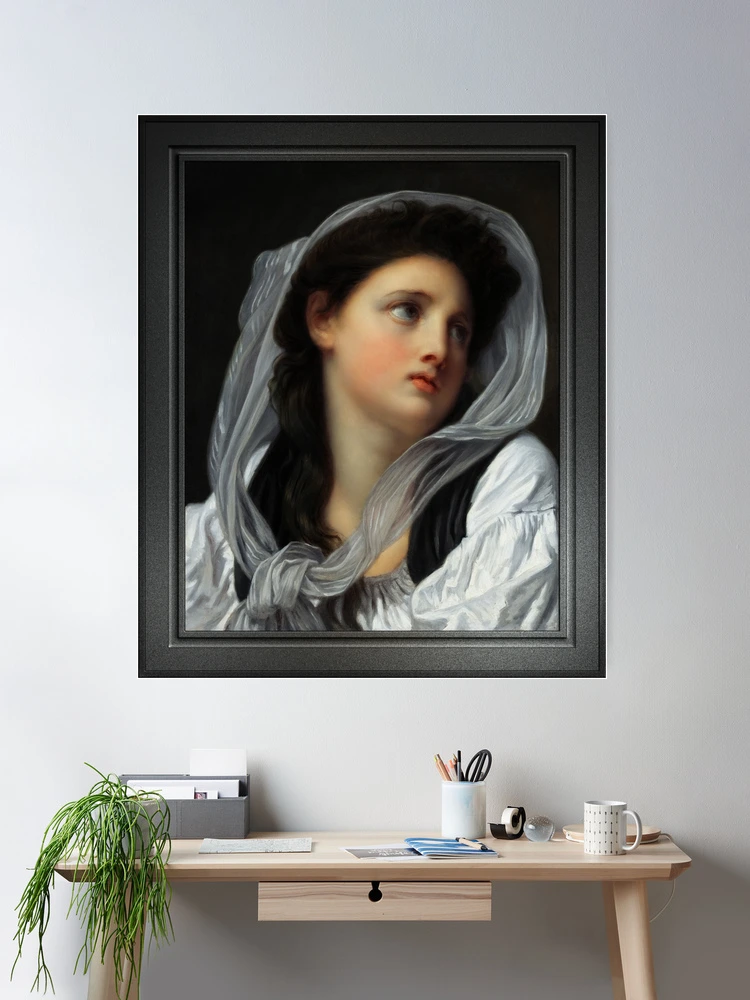
Tabla de contenido
El sujeto: A Moment of Vulnerability
The young woman portrayed in this painting seems to be in a state of introspection, her gaze directed upward and slightly to the side, as though lost in thought or perhaps caught in a fleeting moment of emotion. Her head is slightly tilted, and her face, framed by flowing, soft fabric, adds an element of delicacy to the composition. The transparent veil-like material, which drapes gently over her head and shoulders, creates a soft contrast to the more defined features of her face, enhancing the subject’s fragile and ethereal quality. The veil’s soft folds suggest an underlying sense of modesty and demureness, qualities often emphasized in Greuze’s portraits of young women.
Her pale complexion, highlighted by soft brushstrokes, adds to the overall gentle mood of the piece. Sus ojos, slightly wide, exude a quiet vulnerability. The expression is not one of distress but rather one of thoughtful quietude, inviting the viewer to engage with her internal world, though it remains shrouded in mystery. The subtle play of light on her face further enhances her youthful innocence and purity, while the deep shadows surrounding her create a mood of melancholy, emphasizing her isolation in this intimate moment.
Materiales y Técnicas: A Masterful Rendering of Light and Texture
Greuze, known for his meticulous attention to detail, employed traditional oil painting techniques to create a strikingly realistic and textured portrait. The rendering of the young woman’s face and veil shows the artist’s exceptional ability to manipulate light and shadow, particularly in his treatment of the skin’s texture and the translucent fabric.
The artist’s mastery of chiaroscuro – the contrast between light and dark – creates a deep sense of volume in the subject’s face, allowing each delicate contour to emerge. The pale tones of her face are subtly warmed by the naturalistic application of color, creating a softness that feels almost tangible. Greuze’s use of the fine details in her hair and the transparent veil elevates the portrait beyond a simple likeness, offering instead a nuanced representation of the subject’s emotional depth.
El velo, a key element in the composition, is rendered with exceptional care. Each fold and layer is crafted to suggest a sense of weight and fluidity, and its lightness contrasts with the more defined features of the young woman’s face. The contrast between the smoothness of her skin and the texture of the veil emphasizes the artist’s understanding of fabric as both an element of fashion and a device to enhance the mood and meaning of the composition.
The Emotional Tone and Psychological Depth
Greuze’s work is often praised for its emotional depth, and this portrait of the young woman is no exception. The expression on her face hints at complex psychological states: she appears to be caught in a moment of emotional tension, one that does not necessarily suggest joy or sorrow but rather a contemplative or pensive state. The choice to depict the subject in such a vulnerable moment rather than in a more formal or rigid pose adds an element of relatability to the viewer, drawing them into the scene and inviting them to interpret her emotional state.
The mood created by the painting is one of quiet introspection, heightened by the somber dark background that isolates the young woman from her surroundings. This dark backdrop allows the viewer’s focus to remain entirely on the subject, further deepening the emotional resonance of the portrait.
The juxtaposition of light and dark, along with the contrast between the soft skin and the flowing fabric, creates a feeling of fragility that permeates the entire composition. This exploration of emotional depth was characteristic of the Rococo period, where portraiture was often used to convey not only the physical likeness of a subject but also their inner emotional life.
Conclusión: A Timeless Portrait of Youth and Vulnerability
“cabeza de una mujer joven” stands as a remarkable example of Jean-Baptiste Greuze’s skill in portraying the emotional complexity of the human figure. Through his masterful handling of light, sombra, y textura, Greuze captures a moment of delicate beauty and introspection, inviting the viewer to contemplate not only the external features of the subject but also her internal world. The artwork is a testament to the artist’s ability to evoke complex psychological and emotional states through the medium of oil paint, offering a portrait that transcends time and remains poignant even today.
Esta creación de arte digital, al igual que todas las obras de arte que se pueden encontrar en el sitio web de Xzendor7, están disponibles para su compra en línea en una variedad de formatos de materiales, incluidas impresiones en lienzo, impresiones acrílicas, impresiones de metal, impresiones de madera, láminas enmarcadas, carteles, y como arrollado lienzos en una variedad de tamaños de 12 pulgadas a 72 pulgadas según el tamaño de la obra de arte real y la tienda de impresión bajo demanda en la que elija comprar la obra de arte.
La obra de arte también está disponible en una amplia gama de prendas de vestir para hombres y mujeres., tazas, totalizadores, bufandas, cuadernos y diarios y muchos productos de decoración del hogar..
Sobre el artista
La siguiente información se deriva de NGA.gov
Jean nació en Tournus, Francia en 1725 como el sexto hijo de un maestro alicatador que reconoció su talento desde muy temprana edad; enviándolo a Lyon, Francia estudiará con el retratista francés Charles Grandon (1691 – 1762).
Aproximadamente a la edad de 30 dejó Lyon, y viajó a París, Francia estudiará en la Académie royale de peinture et desculpture o la Real Academia de Pintura y Escultura; que en ese momento era la principal institución artística de Francia durante la última parte del Antiguo Régimen (Antiguo Régimen ~1500 a 1789), hasta que fue abolido en 1793 durante la Revolución Francesa.
Aunque tuvo mucho talento y tuvo mucho éxito durante las décadas de 1760 y 1770, tener mecenas de la talla de la marquesa de Pompadour (1721 – 1764), Emperatriz Catalina II de Rusia (r. 1762 – 1796), y Ange Laurent de La Live de Jully (1725 – 1779); su naturaleza rebelde y los conflictos con los funcionarios de la Academia y el Salón resultarían ser su desgracia.; especialmente después de su matrimonio con Anne Marie Babuty en 1759; lo que resultaría un desastre para él, ya que ella era conocida por haber tenido varias aventuras con sus estudiantes y asistentes., lo que le provocó pérdida de ingresos y humillación pública.
Cuando terminó el matrimonio 34 años más tarde su esposa recibió un acuerdo sustancial, lo que lo dejó en una situación financiera desesperada y en el momento de su muerte en 1805 a la edad de 80 estaba casi arruinado.