

Head Of A Young Woman c1780s
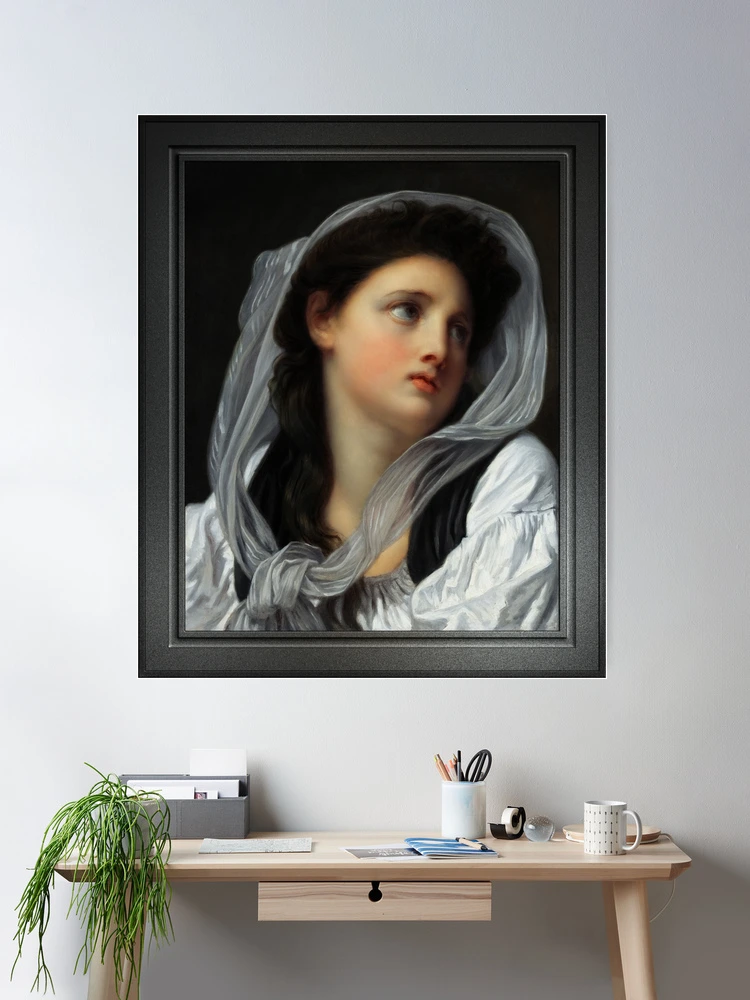
It keunstwurk “Head Of A Young Woman c1780s” waard makke troch de ferneamde Frânske keunstner Jean-Baptiste Greuze (1725 – 1805). Greuze, in master fan 'e rokoko- en neoklassisistyske bewegingen, is al lang ferneamd om syn emosjonele ferbylding fan 'e minsklike foarm, benammen yn syn sjenre sênes en portretten. Yn dit skilderij, Greuze presintearret in close-up werjefte fan in jonge frou, fange har delikate funksjes en emosjonele útdrukking. It uterlik en de pose fan it ûnderwerp ropt in stil gefoel fan kwetsberens en kontemplaasje op, typysk foar de keunstner syn fokus op yntym, persoanlike mominten.
Ynhâldsopjefte
It ûnderwerp: In momint fan kwetsberens
The young woman portrayed in this painting seems to be in a state of introspection, her gaze directed upward and slightly to the side, as though lost in thought or perhaps caught in a fleeting moment of emotion. Her head is slightly tilted, and her face, framed by flowing, soft fabric, adds an element of delicacy to the composition. The transparent veil-like material, which drapes gently over her head and shoulders, creates a soft contrast to the more defined features of her face, enhancing the subject’s fragile and ethereal quality. The veil’s soft folds suggest an underlying sense of modesty and demureness, qualities often emphasized in Greuze’s portraits of young women.
Her pale complexion, highlighted by soft brushstrokes, adds to the overall gentle mood of the piece. Har eagen, slightly wide, exude a quiet vulnerability. The expression is not one of distress but rather one of thoughtful quietude, inviting the viewer to engage with her internal world, though it remains shrouded in mystery. The subtle play of light on her face further enhances her youthful innocence and purity, while the deep shadows surrounding her create a mood of melancholy, emphasizing her isolation in this intimate moment.
Materialen en techniken: In masterlike werjefte fan ljocht en tekstuer
Greuze, known for his meticulous attention to detail, employed traditional oil painting techniques to create a strikingly realistic and textured portrait. The rendering of the young woman’s face and veil shows the artist’s exceptional ability to manipulate light and shadow, particularly in his treatment of the skin’s texture and the translucent fabric.
The artist’s mastery of chiaroscuro – the contrast between light and dark – creates a deep sense of volume in the subject’s face, allowing each delicate contour to emerge. The pale tones of her face are subtly warmed by the naturalistic application of color, creating a softness that feels almost tangible. Greuze’s use of the fine details in her hair and the transparent veil elevates the portrait beyond a simple likeness, offering instead a nuanced representation of the subject’s emotional depth.
De sluier, a key element in the composition, is rendered with exceptional care. Each fold and layer is crafted to suggest a sense of weight and fluidity, and its lightness contrasts with the more defined features of the young woman’s face. The contrast between the smoothness of her skin and the texture of the veil emphasizes the artist’s understanding of fabric as both an element of fashion and a device to enhance the mood and meaning of the composition.
De emosjonele toan en psychologyske djipte
Greuze’s work is often praised for its emotional depth, and this portrait of the young woman is no exception. The expression on her face hints at complex psychological states: she appears to be caught in a moment of emotional tension, one that does not necessarily suggest joy or sorrow but rather a contemplative or pensive state. The choice to depict the subject in such a vulnerable moment rather than in a more formal or rigid pose adds an element of relatability to the viewer, drawing them into the scene and inviting them to interpret her emotional state.
The mood created by the painting is one of quiet introspection, heightened by the somber dark background that isolates the young woman from her surroundings. This dark backdrop allows the viewer’s focus to remain entirely on the subject, further deepening the emotional resonance of the portrait.
The juxtaposition of light and dark, along with the contrast between the soft skin and the flowing fabric, creates a feeling of fragility that permeates the entire composition. This exploration of emotional depth was characteristic of the Rococo period, where portraiture was often used to convey not only the physical likeness of a subject but also their inner emotional life.
Konklúzje: In tiidleas portret fan jeugd en kwetsberens
“Head of a Young Woman” stands as a remarkable example of Jean-Baptiste Greuze’s skill in portraying the emotional complexity of the human figure. Through his masterful handling of light, skaad, en tekstuer, Greuze captures a moment of delicate beauty and introspection, inviting the viewer to contemplate not only the external features of the subject but also her internal world. The artwork is a testament to the artist’s ability to evoke complex psychological and emotional states through the medium of oil paint, offering a portrait that transcends time and remains poignant even today.
Dizze digitale keunst skepping, lykas mei al it keunstwurk dat te finen is op 'e Xzendor7-webside is online te keap yn in ferskaat oan materiaalformaten, ynklusyf canvasprints, acryl prints, metalen prints, hout prints, framed prints, posters, en as rôle canvas prints yn in ferskaat oan maten út 12 inches oan 72 inch ôfhinklik fan de grutte fan it eigentlike keunstwurk en de print-on-demand winkel wêrfan jo kieze om de keunst te keapjen.
It keunstwurk is ek te krijen op in breed oanbod fan klean foar manlju en froulju, mokken, totes, sjaals, notebooks en tydskriften en in protte home decor produkten.
Oer The Artist
De ûndersteande ynformaasje is ôflaat fan NGA.gov
Jean was born in Tournus, Frankryk yn 1725 as the sixth son of a master tiler who recognized his talent at a very early age; sending him to Lyon, France to study with the French Portrait Painter Charles Grandon (1691 – 1762).
At about the age of 30 he left Lyon, and traveled to Paris, France to study at the Académie royale de peinture et de sculpture or the Royal Academy of Painting and Sculpture; which at the time was the premier art institution of France during the latter part of the Ancien Régime (Old Regiem ~1500 to 1789), until it was abolished in 1793 during the French Revolution.
Though highly talented and very successful during the 1760s and 1770s, having patrons of the likes of the Marquise de Pompadour (1721 – 1764), Empress Catherine II of Russia (r. 1762 – 1796), and Ange Laurent de La Live de Jully (1725 – 1779); his rebellious nature and conflicts with Academy and Salon officials would prove to be his misfortune; especially after his marriage to Anne Marie Babuty in 1759; which would prove to be a disaster for him, as she was known to have had various affairs with his students and sitters, which caused him loss of income and public humiliation.
When the marriage ended 34 years later his wife received a substantial settlement, which left him in dire financial straights and by the time of his death in 1805 yn de âldens fan 80 he was nearly broke.