

Hoofd van een jonge vrouw, rond 1780
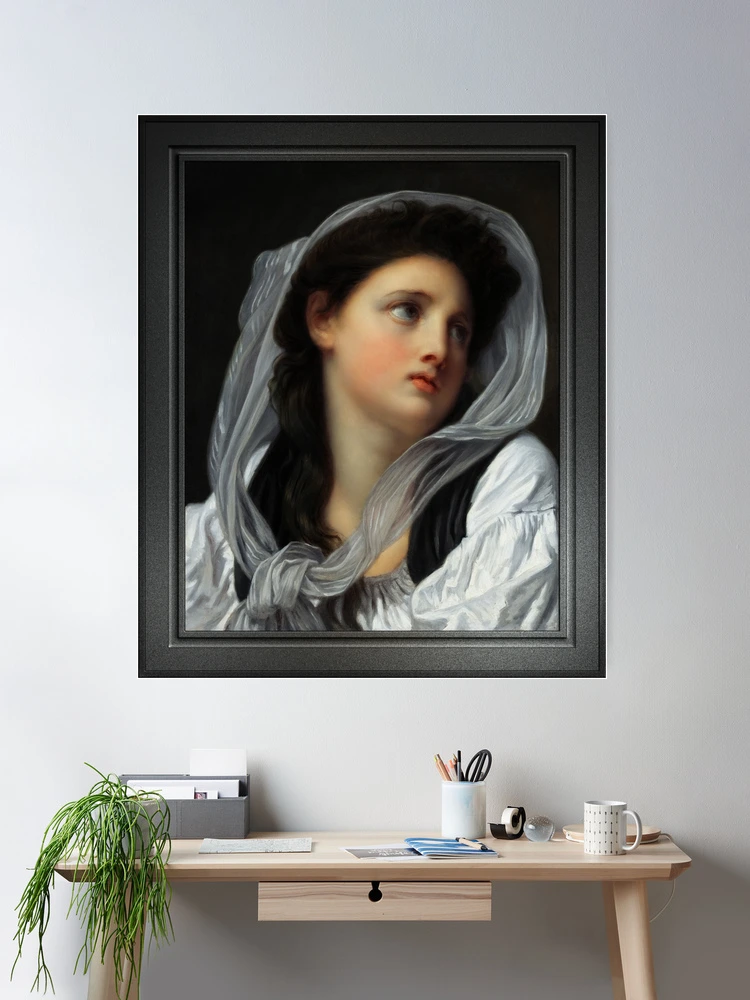
Het kunstwerk “Hoofd van een jonge vrouw, rond 1780” was created by the renowned French artist Jean Baptiste Greuze (1725 – 1805). Greuze, a master of the Rococo and Neoclassical movements, has long been celebrated for his emotional portrayal of the human form, particularly in his genre scenes and portraiture. Op dit schilderij, Greuze presents a close-up view of a young woman, capturing her delicate features and emotional expression. The subject’s appearance and pose evoke a quiet sense of vulnerability and contemplation, typical of the artist’s focus on intimate, personal moments.
Inhoudsopgave
Het onderwerp: A Moment of Vulnerability
The young woman portrayed in this painting seems to be in a state of introspection, her gaze directed upward and slightly to the side, as though lost in thought or perhaps caught in a fleeting moment of emotion. Her head is slightly tilted, and her face, framed by flowing, soft fabric, adds an element of delicacy to the composition. The transparent veil-like material, which drapes gently over her head and shoulders, creates a soft contrast to the more defined features of her face, enhancing the subject’s fragile and ethereal quality. The veil’s soft folds suggest an underlying sense of modesty and demureness, qualities often emphasized in Greuze’s portraits of young women.
Her pale complexion, highlighted by soft brushstrokes, adds to the overall gentle mood of the piece. Haar ogen, slightly wide, exude a quiet vulnerability. The expression is not one of distress but rather one of thoughtful quietude, inviting the viewer to engage with her internal world, though it remains shrouded in mystery. The subtle play of light on her face further enhances her youthful innocence and purity, while the deep shadows surrounding her create a mood of melancholy, emphasizing her isolation in this intimate moment.
Materialen en technieken: A Masterful Rendering of Light and Texture
Greuze, known for his meticulous attention to detail, employed traditional oil painting techniques to create a strikingly realistic and textured portrait. The rendering of the young woman’s face and veil shows the artist’s exceptional ability to manipulate light and shadow, particularly in his treatment of the skin’s texture and the translucent fabric.
The artist’s mastery of chiaroscuro – the contrast between light and dark – creates a deep sense of volume in the subject’s face, allowing each delicate contour to emerge. The pale tones of her face are subtly warmed by the naturalistic application of color, creating a softness that feels almost tangible. Greuze’s use of the fine details in her hair and the transparent veil elevates the portrait beyond a simple likeness, offering instead a nuanced representation of the subject’s emotional depth.
The veil, a key element in the composition, is rendered with exceptional care. Each fold and layer is crafted to suggest a sense of weight and fluidity, and its lightness contrasts with the more defined features of the young woman’s face. The contrast between the smoothness of her skin and the texture of the veil emphasizes the artist’s understanding of fabric as both an element of fashion and a device to enhance the mood and meaning of the composition.
The Emotional Tone and Psychological Depth
Greuze’s work is often praised for its emotional depth, and this portrait of the young woman is no exception. The expression on her face hints at complex psychological states: she appears to be caught in a moment of emotional tension, one that does not necessarily suggest joy or sorrow but rather a contemplative or pensive state. The choice to depict the subject in such a vulnerable moment rather than in a more formal or rigid pose adds an element of relatability to the viewer, drawing them into the scene and inviting them to interpret her emotional state.
The mood created by the painting is one of quiet introspection, heightened by the somber dark background that isolates the young woman from her surroundings. This dark backdrop allows the viewer’s focus to remain entirely on the subject, further deepening the emotional resonance of the portrait.
The juxtaposition of light and dark, along with the contrast between the soft skin and the flowing fabric, creates a feeling of fragility that permeates the entire composition. This exploration of emotional depth was characteristic of the Rococo period, where portraiture was often used to convey not only the physical likeness of a subject but also their inner emotional life.
Conclusie: A Timeless Portrait of Youth and Vulnerability
“Head of a Young Woman” stands as a remarkable example of Jean-Baptiste Greuze’s skill in portraying the emotional complexity of the human figure. Through his masterful handling of light, schaduw, en textuur, Greuze captures a moment of delicate beauty and introspection, inviting the viewer to contemplate not only the external features of the subject but also her internal world. The artwork is a testament to the artist’s ability to evoke complex psychological and emotional states through the medium of oil paint, offering a portrait that transcends time and remains poignant even today.
Deze digitale kunstcreatie, zoals bij alle kunstwerken die op de Xzendor7-website te vinden zijn, is deze online te koop in verschillende materiaalformaten, waaronder canvasafdrukken, acryl afdrukken, metalen prints, hout prints, ingelijste afdrukken, affiches, en als opgerolde canvasafdrukken in diverse maten vanaf 12 inch tot 72 inch, afhankelijk van de grootte van het daadwerkelijke kunstwerk en de print on demand-winkel waar je de kunst wilt kopen.
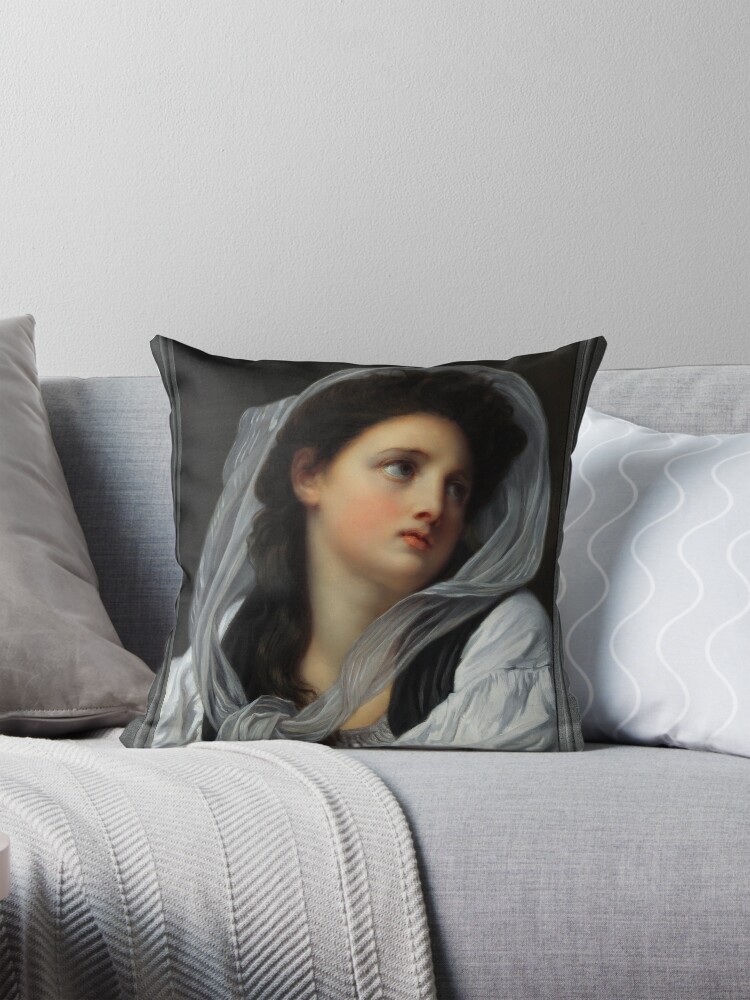
Het artwork is ook beschikbaar op een breed scala aan heren- en dameskleding, mokken, bakken, sjaals, notitieboekjes en tijdschriften en veel woondecoratieproducten.
Over de kunstenaar
De onderstaande informatie is afgeleid van NGA.gov
Jean werd geboren in Tournus, Frankrijk binnen 1725 als zesde zoon van een meester-tegelzetter die zijn talent al op zeer jonge leeftijd onderkende; hem naar Lyon te sturen, Frankrijk om te studeren bij de Franse portretschilder Charles Grandon (1691 – 1762).
Ongeveer op de leeftijd van 30 hij verliet Lyon, en reisde naar Parijs, Frankrijk om te studeren aan de Académie royale de peinture et de sculpture of de Koninklijke Academie voor Schilderkunst en Beeldhouwkunst; dat destijds de belangrijkste kunstinstelling van Frankrijk was tijdens het laatste deel van het Ancien Régime (Oude Regie ~1500 tot 1789), totdat het werd afgeschaft 1793 tijdens de Franse Revolutie.
Hoewel zeer getalenteerd en zeer succesvol in de jaren 1760 en 1770, met beschermheren van onder meer de markiezin de Pompadour (1721 – 1764), Keizerin Catharina II van Rusland (R. 1762 – 1796), en Ange Laurent van La Live de Jully (1725 – 1779); zijn rebelse karakter en conflicten met functionarissen van de Academie en de Salon zouden zijn ongeluk blijken te zijn; vooral na zijn huwelijk met Anne Marie Babuty in 1759; wat voor hem een ramp zou blijken te zijn, omdat bekend was dat ze verschillende affaires had met zijn studenten en oppassers, wat hem inkomensverlies en publieke vernedering veroorzaakte.
Toen het huwelijk eindigde 34 jaren later ontving zijn vrouw een aanzienlijke schikking, waardoor hij in moeilijke financiële problemen terechtkwam en tegen de tijd van zijn overlijden in 1805 op de leeftijd van 80 hij was bijna kapot.