

Het Jongste Broertje (The Youngest Brother)
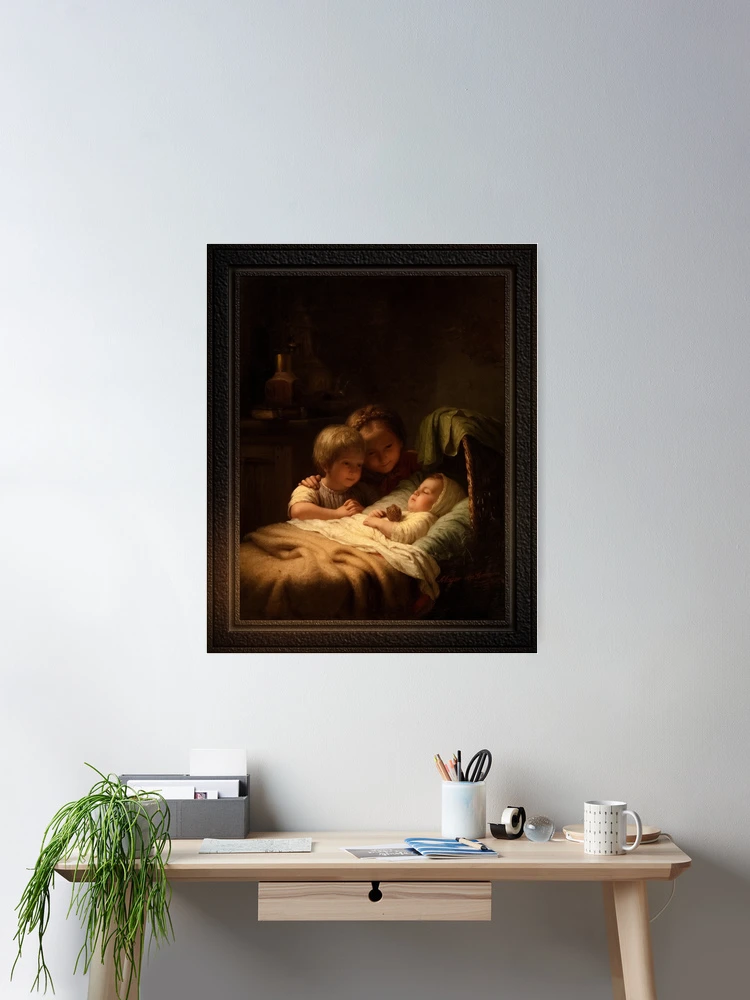
“Het Jongste Broertje” (The Youngest Brother), pintat a 1854 by the German artist Johann Georg Meyer (1813 – 1886), captures a tender and intimate moment in a domestic setting, exemplifying the genre of sentimental realism that was prevalent in mid-19th century Europe. The painting portrays three children, their expressions imbued with innocence and affection, Estableix un tou, atmospheric backdrop that enhances the emotional weight of the scene. This quiet and serene composition highlights Meyer’s attention to the subtleties of childhood emotions and familial love, rendered with a softness and warmth that invite the viewer to reflect on themes of family, care, and fragility.
Taula de continguts
Composition and Figures
In the center of the composition lies the youngest child, swaddled in a light white blanket, dormint tranquil en un bressol. El suau, trets arrodonits del nen, banyada per una llum suau, evoca una sensació de tranquil·litat i innocència. El nen adormit, probablement el tema del títol de la pintura, es posiciona com a punt focal, simbolitza la vulnerabilitat i la tendresa. Els seus ulls estan tancats, i la seva cara és serena, creant un estat d'ànim pacífic que contrasta amb les expressions més dinàmiques dels nens que l'envolten. La mà petita del nen està enrotllada al voltant d'un objecte petit, possiblement una joguina o un element de comoditat, millorant encara més la sensació de pau i satisfacció.
Flanquejant el bressol hi ha dos germans grans, les seves expressions s'omplien d'un afectuós interès i preocupació pel nadó. El noi de l'esquerra, amb els seus cabells ros escarpats i els seus ulls amples, mira l'infant amb un sentiment d'amor profund, while his hand rests on the edge of the cradle, gently touching the child. La seva postura és tendra, suggestive of his role as a protective older sibling.
The girl on the right, with dark hair neatly styled in braids, leans forward with an expression of quiet joy, her lips slightly parted as though caught in a moment of reverence for the infant. The play of light and shadow on their faces suggests a shared emotional experience, one marked by familial devotion and a deep bond between the children.
Fons i atmosfera
The background of the painting is dark and indistinct, rendered with subtle brushstrokes that suggest a cozy, habitació poc il·luminada, likely part of a modest home. There are a few elements that offer hints about the interior, such as the faint outlines of a wooden cabinet or shelves, and an assortment of domestic objects, que creen una sensació de familiaritat i comoditat.
El fons no distreu de les figures en primer pla, en canvi, serveix per amplificar la intimitat emocional de l'escena. El pintor ha utilitzat amb habilitat tons apagats de marró, or, i nata per crear un ambient càlid i tranquil, invocant sentiments de calma i seguretat. La suau barreja de llum i ombra millora la tranquil·litat del moment, permetent que les figures surtin suaument de la foscor.
Paleta de colors i tècnica
L'ús de Meyer del color és limitat però evocador. La paleta de marrons, verds suaus, cremes, i els grocs apagats impregnen l'escena d'un càlid, to gairebé daurat, reflectint la naturalesa tranquil·la i reconfortant del tema. La font de llum sembla que prové de l'esquerra, casting a soft glow on the children’s faces and bodies while leaving parts of the room in shadow. This play of light and shadow emphasizes the forms and textures of the figures, particularly the softness of the children’s clothing and the delicate texture of the blankets. The choice of colors suggests a deep emotional warmth, heightening the viewer’s emotional connection to the scene.
The painting’s technique is notable for its fine detail and subtle realism. Meyer uses a soft, almost velvety brushwork to depict the textures of the children’s faces, their clothing, and the folds of the bedding, creating a smooth and tender finish. The artist has a masterful command of light, using it not just to illuminate the figures but to enhance the emotional tone of the painting. The light seems to symbolically embrace the children, highlighting their faces and bodies in a manner that suggests care, protecció, i amor.
Estat d'ànim i tema
L'estat d'ànim de “Het Jongste Broertje” is one of quiet reverence and emotional tenderness. The closeness of the siblings to the sleeping infant evokes a sense of familial love and protection, as well as a deep connection to the simple joys of childhood. There is a timeless quality to the scene, as though the act of watching over a younger sibling is a universal experience, one that transcends time and culture. The peaceful expressions of the children, coupled with the calm environment, convey a mood of safety and harmony, inviting the viewer to reflect on the precious nature of childhood and the bonds that tie families together.
The theme of childhood innocence is central to the painting, with the depiction of the infant’s peaceful sleep standing as a metaphor for the purity and vulnerability of early life. The two older children’s attentive gazes and their protective postures reinforce the idea of familial responsibility and love. Meyer’s careful rendering of the figures and their emotional expressions underscores the theme of care, making this work not only a representation of childhood but also an exploration of the intimate emotional connections between siblings.
Conclusió
“Het Jongste Broertje” stands as an exemplary work of 19th-century sentimental realism, capturing a deeply emotional moment within a domestic setting. Johann Georg Meyer’s painting transcends mere depiction, offering a narrative that speaks to the universal experiences of childhood and family. A través del seu ús magistral de la llum, color, and brushwork, Meyer evokes a sense of warmth and tenderness that resonates with viewers even today. El suau, peaceful scene reflects a bygone era when the bonds of family were cherished and protected, and childhood innocence was considered sacred.
The Youngest Brother is a retouched digital old masters reproduction of a public domain art masterpiece image.
Aquesta creació d'art digital, com amb totes les obres d'art que es poden trobar al lloc web de Xzendor7, es poden comprar en línia en una varietat de formats de material, incloses impressions de llenç, impressions acríliques, estampes de metall, estampes de fusta, impressions emmarcades, cartells, i com impressions de llenços enrotllats en una varietat de mides de 12 polzades a 72 polzades depenent de la mida de l'obra d'art real i de la botiga d'impressió sota demanda on trieu comprar l'art.
L'obra d'art també està disponible en una àmplia gamma de roba d'home i dona, tasses, bosses, mocadors, quaderns i revistes i molts productes de decoració de la llar.
Sobre l'artista
Informació a continuació derivada de Wikipedia.org
Johann Meyer va començar els seus estudis artístics a 1834 a l'edat de 21, quan va anar a Düsseldorf i va ingressar a l'Acadèmia d'Art, dirigit pel pintor romàntic alemany Friedrich Wilhelm Schadow (1789 – 1862), que era fill de l'escultor germano-prussià Johann Gottfried Schadow (1764 – 1850).
Set anys després a 1841 Meyer el seu propi estudi a Düsseldorf, però més tard es va traslladar a Berlín 1853 a mesura que augmentava la seva popularitat i fama.
Tot i que l'interès primerenc de Meyer va ser crear escenes de la Bíblia; més tard en la seva carrera va dedicar la seva atenció a la creació d'escenes de gènere de la vida quotidiana , amb un enfocament a la pagesia de Hesse, i després sobre el retrat de l'aspecte patètic de la vida familiar.
Imatges com "El jubileu d'un pastor de Hesse" c1843, 'La nit de Nadal,''Blindman's Buff,''El retorn del soldat,"La inundació" c1846, "La filla arrepentida" c1852, estan plens d'una simpatia intensa amb els "annals simples dels pobres".
També va pintar altres escenes que es van inspirar en la vida infantil, que incloïa 'The Little Flower Girl c1853', ‘El conte de fades,''Nens jugant a Blindman's Buff,’ ‘Avi i nét,’ i d’altres.
Encara que més tard en la seva carrera també va fer pintures de dones joves, ja sigui en posicions individuals o en grup; i aquests inclouen "The Tryst", "La carta d'amor" i "La carta" c1873.