

El hermano mas joven (El hermano mas joven)
“El hermano mas joven” (El hermano mas joven), pintado 1854 by the German artist Johann Georg Meyer (1813 – 1886), captures a tender and intimate moment in a domestic setting, exemplifying the genre of sentimental realism that was prevalent in mid-19th century Europe. The painting portrays three children, their expressions imbued with innocence and affection, frente a un suave, atmospheric backdrop that enhances the emotional weight of the scene. This quiet and serene composition highlights Meyer’s attention to the subtleties of childhood emotions and familial love, rendered with a softness and warmth that invite the viewer to reflect on themes of family, care, and fragility.
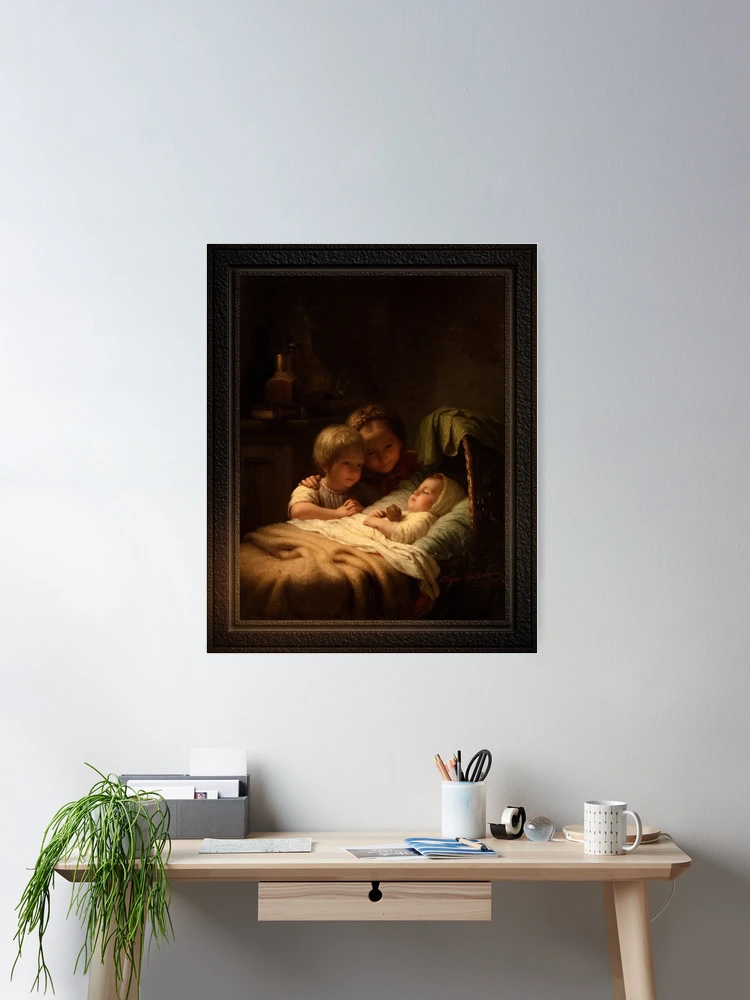
Tabla de contenido
Composition and Figures
In the center of the composition lies the youngest child, swaddled in a light white blanket, sleeping peacefully in a cradle. Lo suave, rounded features of the child, bathed in a gentle light, evoke a sense of tranquility and innocence. The sleeping infant, likely the subject of the painting’s title, is positioned as the focal point, symbolizing vulnerability and tenderness. Their eyes are closed, and their face is serene, creating a peaceful mood that contrasts with the more dynamic expressions of the surrounding children. The child’s tiny hand is curled around a small object, possibly a toy or comfort item, further enhancing the sense of peacefulness and contentment.
Flanking the cradle are two older siblings, their expressions filled with an affectionate interest and concern for the baby. The boy on the left, with his tousled blonde hair and wide eyes, gazes at the infant with a sense of deep love, while his hand rests on the edge of the cradle, gently touching the child. Su postura es tierna., suggestive of his role as a protective older sibling.
The girl on the right, with dark hair neatly styled in braids, leans forward with an expression of quiet joy, her lips slightly parted as though caught in a moment of reverence for the infant. The play of light and shadow on their faces suggests a shared emotional experience, one marked by familial devotion and a deep bond between the children.
Background and Atmosphere
The background of the painting is dark and indistinct, rendered with subtle brushstrokes that suggest a cozy, dimly lit room, likely part of a modest home. There are a few elements that offer hints about the interior, such as the faint outlines of a wooden cabinet or shelves, and an assortment of domestic objects, which create a sense of familiarity and comfort.
The background does not distract from the figures in the foreground, instead serving to amplify the emotional intimacy of the scene. The painter has skillfully used muted tones of brown, oro, and cream to craft an atmosphere that is both warm and quiet, invoking feelings of calm and security. The soft blending of light and shadow enhances the peacefulness of the moment, allowing the figures to emerge gently from the darkness.
Paleta de colores y técnica
Meyer’s use of color is restrained yet evocative. The palette of browns, soft greens, cremas, and muted yellows imbues the scene with a warm, almost golden hue, reflecting the calm and comforting nature of the subject matter. The light source seems to come from the left, casting a soft glow on the children’s faces and bodies while leaving parts of the room in shadow. This play of light and shadow emphasizes the forms and textures of the figures, particularly the softness of the children’s clothing and the delicate texture of the blankets. The choice of colors suggests a deep emotional warmth, heightening the viewer’s emotional connection to the scene.
The painting’s technique is notable for its fine detail and subtle realism. Meyer uses a soft, almost velvety brushwork to depict the textures of the children’s faces, their clothing, and the folds of the bedding, creating a smooth and tender finish. The artist has a masterful command of light, using it not just to illuminate the figures but to enhance the emotional tone of the painting. The light seems to symbolically embrace the children, highlighting their faces and bodies in a manner that suggests care, protección, y amor.
Estado de ánimo y tema
El estado de ánimo de “El hermano mas joven” is one of quiet reverence and emotional tenderness. The closeness of the siblings to the sleeping infant evokes a sense of familial love and protection, as well as a deep connection to the simple joys of childhood. Hay una cualidad atemporal en la escena, as though the act of watching over a younger sibling is a universal experience, one that transcends time and culture. The peaceful expressions of the children, coupled with the calm environment, convey a mood of safety and harmony, inviting the viewer to reflect on the precious nature of childhood and the bonds that tie families together.
The theme of childhood innocence is central to the painting, with the depiction of the infant’s peaceful sleep standing as a metaphor for the purity and vulnerability of early life. The two older children’s attentive gazes and their protective postures reinforce the idea of familial responsibility and love. Meyer’s careful rendering of the figures and their emotional expressions underscores the theme of care, making this work not only a representation of childhood but also an exploration of the intimate emotional connections between siblings.
Conclusión
“El hermano mas joven” stands as an exemplary work of 19th-century sentimental realism, capturing a deeply emotional moment within a domestic setting. Johann Georg Meyer’s painting transcends mere depiction, offering a narrative that speaks to the universal experiences of childhood and family. A través de su magistral uso de la luz., color, and brushwork, Meyer evokes a sense of warmth and tenderness that resonates with viewers even today. Lo suave, peaceful scene reflects a bygone era when the bonds of family were cherished and protected, and childhood innocence was considered sacred.
El hermano menor es una reproducción digital retocada de una obra maestra de arte de dominio público..
Esta creación de arte digital, al igual que todas las obras de arte que se pueden encontrar en el sitio web de Xzendor7, están disponibles para su compra en línea en una variedad de formatos de materiales, incluidas impresiones en lienzo, impresiones acrílicas, impresiones de metal, impresiones de madera, láminas enmarcadas, carteles, y como lienzos enrollados en una variedad de tamaños, desde 12 pulgadas a 72 pulgadas según el tamaño de la obra de arte real y la tienda de impresión bajo demanda en la que elija comprar la obra de arte.
La obra de arte también está disponible en una amplia gama de prendas de vestir para hombres y mujeres., tazas, totalizadores, bufandas, cuadernos y diarios y muchos productos de decoración del hogar..
Sobre el artista
Información a continuación derivada de Wikipedia.org
Johann Meyer inició sus estudios artísticos en 1834 a la edad de 21, cuando fue a Düsseldorf y entró en la Academia de Arte, que fue dirigido por el pintor romántico alemán Friedrich Wilhelm Schadow (1789 – 1862), quien era el hijo del escultor germano-prusiano Johann Gottfried Schadow (1764 – 1850).
Siete años después en 1841 Meyer su propio estudio en Düsseldorf, pero luego se mudó a Berlín en 1853 a medida que aumentaba su popularidad y fama.
Aunque el interés inicial de Meyer fue crear escenas de la Biblia; Más adelante en su carrera, centró su atención en la creación de escenas de género de la vida cotidiana. , con un enfoque en el campesinado de Hesse, y luego en la representación del aspecto patético de la vida familiar.
Imágenes como "El jubileo de un pastor de Hesse" c1843, 'Nochebuena,' 'La gallina ciega,"El regreso del soldado,'' La inundación 'c1846, 'La hija arrepentida' c1852, están llenos de intensa simpatía por los "simples anales de los pobres".
También pintó otra escena que se inspiró en la vida de la infancia., que incluía "La niña de las flores c1853", 'El cuento de hadas,"Niños jugando a Blindman's Buff",'‘Abuelo y nieto,' y otros.
Mientras que más adelante en su carrera también hizo pinturas de mujeres yougn, ya sea en poses individuales o grupales; y estos incluían "La cita", 'La carta de amor' y 'La carta' c1873.