

Het Jongste Broertje (Am Bràthair a b' òige)
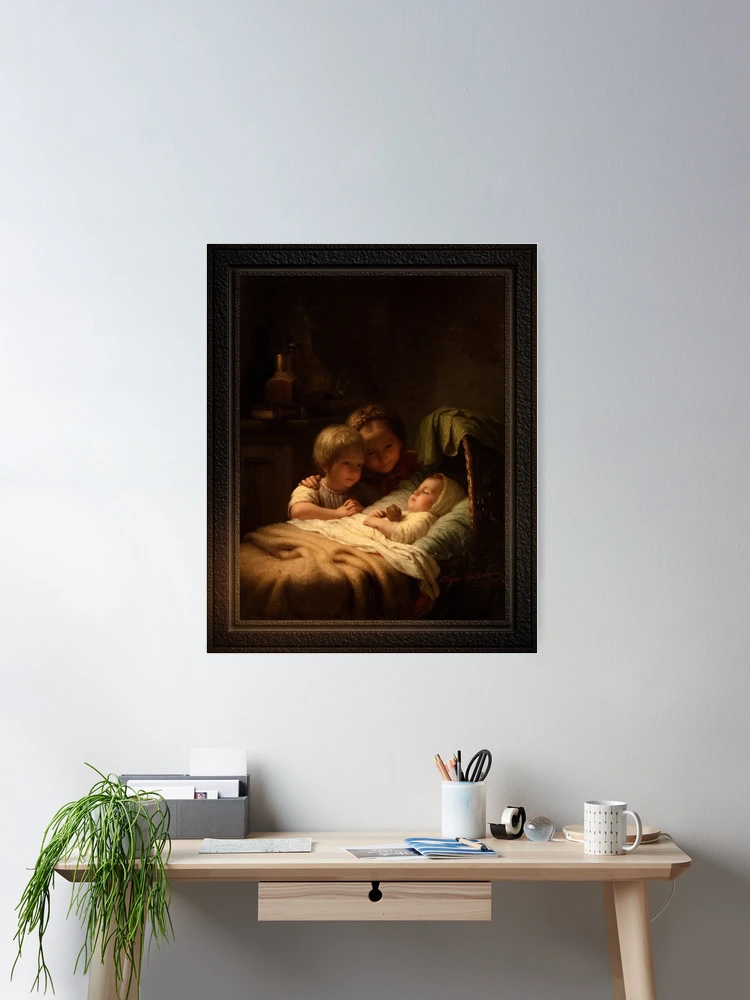
“Het Jongste Broertje” (Am Bràthair a b' òige), mar thoradh air stèidheachadh an Salon des Refusés le riaghaltas na Frainge 1854 by the German artist Johann Georg Meyer (1813 – 1886), captures a tender and intimate moment in a domestic setting, exemplifying the genre of sentimental realism that was prevalent in mid-19th century Europe. The painting portrays three children, their expressions imbued with innocence and affection, suidhichte an aghaidh bog, atmospheric backdrop that enhances the emotional weight of the scene. This quiet and serene composition highlights Meyer’s attention to the subtleties of childhood emotions and familial love, rendered with a softness and warmth that invite the viewer to reflect on themes of family, care, agus cugallach.
Clàr-innse
Composition and Figures
In the center of the composition lies the youngest child, swaddled in a light white blanket, sleeping peacefully in a cradle. Am bog, rounded features of the child, bathed in a gentle light, dhùisgeas mothachadh air suaimhneas agus neo-chiontas. An leanabh cadail, is dòcha gur e cuspair tiotal an dealbh, air a shuidheachadh mar phrìomh àite, a’ samhlachadh so-leòntachd agus tairgse. Tha an sùilean dùinte, agus tha an aghaidh sàmhach, a’ cruthachadh faireachdainn sìtheil a tha eadar-dhealaichte bho bheachdan nas beothaile na cloinne mun cuairt. Tha làmh bheag an leanaibh air a lùbadh timcheall rud beag, is dòcha dèideag no rud comhfhurtachd, ag àrdachadh tuilleadh faireachdainn de shìth agus de shòlas.
Air gach taobh den chreathail tha dithis pheathraichean nas sine, bha na beachdan aca air an lìonadh le ùidh ghràdhach agus dragh don leanabh. Am balach air an taobh chlì, le a fhalt bàn tostach agus sùilean farsaing, ag amharc air an leanabh le mothachadh air gràdh domhainn, fhad 's a tha a làmh na laighe air oir a' chreathail, suathadh gu socair ris an leanabh. Tha an suidheachadh aige tairgse, suggestive of his role as a protective older sibling.
The girl on the right, with dark hair neatly styled in braids, leans forward with an expression of quiet joy, her lips slightly parted as though caught in a moment of reverence for the infant. The play of light and shadow on their faces suggests a shared emotional experience, one marked by familial devotion and a deep bond between the children.
Cùl-fhiosrachadh agus Atmosphere
The background of the painting is dark and indistinct, rendered with subtle brushstrokes that suggest a cozy, dimly lit room, likely part of a modest home. There are a few elements that offer hints about the interior, such as the faint outlines of a wooden cabinet or shelves, and an assortment of domestic objects, which create a sense of familiarity and comfort.
The background does not distract from the figures in the foreground, instead serving to amplify the emotional intimacy of the scene. The painter has skillfully used muted tones of brown, òr, and cream to craft an atmosphere that is both warm and quiet, invoking feelings of calm and security. The soft blending of light and shadow enhances the peacefulness of the moment, allowing the figures to emerge gently from the darkness.
Palette dath agus teicneòlas
Meyer’s use of color is restrained yet evocative. The palette of browns, soft greens, creamh, and muted yellows imbues the scene with a warm, almost golden hue, reflecting the calm and comforting nature of the subject matter. The light source seems to come from the left, casting a soft glow on the children’s faces and bodies while leaving parts of the room in shadow. This play of light and shadow emphasizes the forms and textures of the figures, particularly the softness of the children’s clothing and the delicate texture of the blankets. The choice of colors suggests a deep emotional warmth, heightening the viewer’s emotional connection to the scene.
The painting’s technique is notable for its fine detail and subtle realism. Meyer uses a soft, almost velvety brushwork to depict the textures of the children’s faces, their clothing, and the folds of the bedding, creating a smooth and tender finish. The artist has a masterful command of light, using it not just to illuminate the figures but to enhance the emotional tone of the painting. The light seems to symbolically embrace the children, highlighting their faces and bodies in a manner that suggests care, dìon, agus gaol.
Mood agus cuspair
Faireachdainn de “Het Jongste Broertje” is one of quiet reverence and emotional tenderness. The closeness of the siblings to the sleeping infant evokes a sense of familial love and protection, as well as a deep connection to the simple joys of childhood. There is a timeless quality to the scene, as though the act of watching over a younger sibling is a universal experience, one that transcends time and culture. The peaceful expressions of the children, coupled with the calm environment, convey a mood of safety and harmony, inviting the viewer to reflect on the precious nature of childhood and the bonds that tie families together.
The theme of childhood innocence is central to the painting, le dealbh de chadal sìtheil an leanaibh na sheasamh mar mheafar airson purrachd agus so-leòntachd beatha thràth. Tha an dà shealladh aire chloinne as sine agus an suidheachadh dìon a’ daingneachadh a’ bheachd air uallach teaghlaich agus gaol. Tha an dealbh faiceallach aig Meyer de na h-àireamhan agus na seallaidhean tòcail aca a’ daingneachadh cuspair a’ chùraim, a’ dèanamh na h-obrach seo chan ann a-mhàin mar riochdachadh air leanabachd ach cuideachd mar sgrùdadh air na ceanglaichean tòcail dlùth a tha eadar peathraichean is peathraichean.
Co-dhùnadh
“Het Jongste Broertje” a’ seasamh mar shàr-obair de fhìor-eòlas sentimental na 19mh linn, a’ glacadh àm gu math tòcail taobh a-staigh suidheachadh dachaigheil. Tha an dealbh aig Johann Georg Meyer a’ dol thairis air dìreach dealbh, a’ tabhann aithris a bhruidhneas ri eòlasan uile-choitcheann leanabachd is teaghlaich. Tro a chleachdadh maighstir de sholas, dath, agus obair bhruis, Meyer evokes a sense of warmth and tenderness that resonates with viewers even today. Am bog, peaceful scene reflects a bygone era when the bonds of family were cherished and protected, and childhood innocence was considered sacred.
The Youngest Brother is a retouched digital old masters reproduction of a public domain art masterpiece image.
An cruthachadh ealain didseatach seo, mar a tha leis a h-uile obair-ealain a gheibhear air làrach-lìn Xzendor7 ri fhaighinn airson a cheannach air-loidhne ann an grunn chruthan stuth a’ gabhail a-steach clò-bhualaidhean canabhas, dealbhan acrylic, clò-bhualaidhean meatailt, clò-bhualaidhean fiodha, lèileagan frèam, postairean, agus mar chlò-bhualadh canabhas air a roiligeadh ann an grunn mheudan bho 12 òirlich gu 72 òirlich a rèir meud an fhìor obair-ealain agus a’ bhùth clò-bhualaidh air iarrtas a thaghas tu airson an ealain a cheannach.
Tha an obair-ealain cuideachd ri fhaighinn air raon farsaing de dh’ aodach fireannaich is boireannaich, mugaichean, toitean, sgarfaichean, leabhraichean notaichean agus irisean agus mòran stuthan sgeadachaidh dachaigh.
Mu dheidhinn an Neach-ealain
Fiosrachadh gu h-ìosal a thàinig bho Wikipedia.org
Johann Meyer began his artistic studies in 1834 aig aois 21, when he went to Düsseldorf and entered the Academy of Art, which was run by German Romantic Painter Friedrich Wilhelm Schadow (1789 – 1862), who was the son of German-Prussian sculptor Johann Gottfried Schadow (1764 – 1850).
Seven years later in 1841 Meyer his own studio in Düsseldorf, but later moved to Berlin in 1853 as his popularity and famed increased.
Though Meyer’s early interest was in creating scenes from the Bible; later on in his career he turned his attention to creating genre scenes of every day life , with a focus on Hessian peasantry, and then on the portrayal of the pathetic aspect of family life.
Such pictures as ‘The Jubilee of a Hessian Pastor’ c1843, ‘Christmas Eve,’ ‘Blindman’s Buff,’ ‘The Soldier’s Return,’ ‘The Inundation’ c1846, ‘The Repentant Daughter’ c1852, are full of intense sympathy with the “simple annals of the poor.”
He also painted other scene that took inspiration from childhood life, which included ‘The Little Flower Girl c1853’, ‘The Fairy Tale,’ ‘Children Playing Blindman’s Buff,’ ‘Grandfather and Grandchild,’ and others.
Nas fhaide air adhart na dhreuchd rinn e dealbhan de bhoireannaich òga, an dàrna cuid ann an suidheachadh singilte no buidhne; agus nam measg bha ‘The Tryst’, ‘An Litir Gràdh’ agus ‘An Litir’ c1873.