

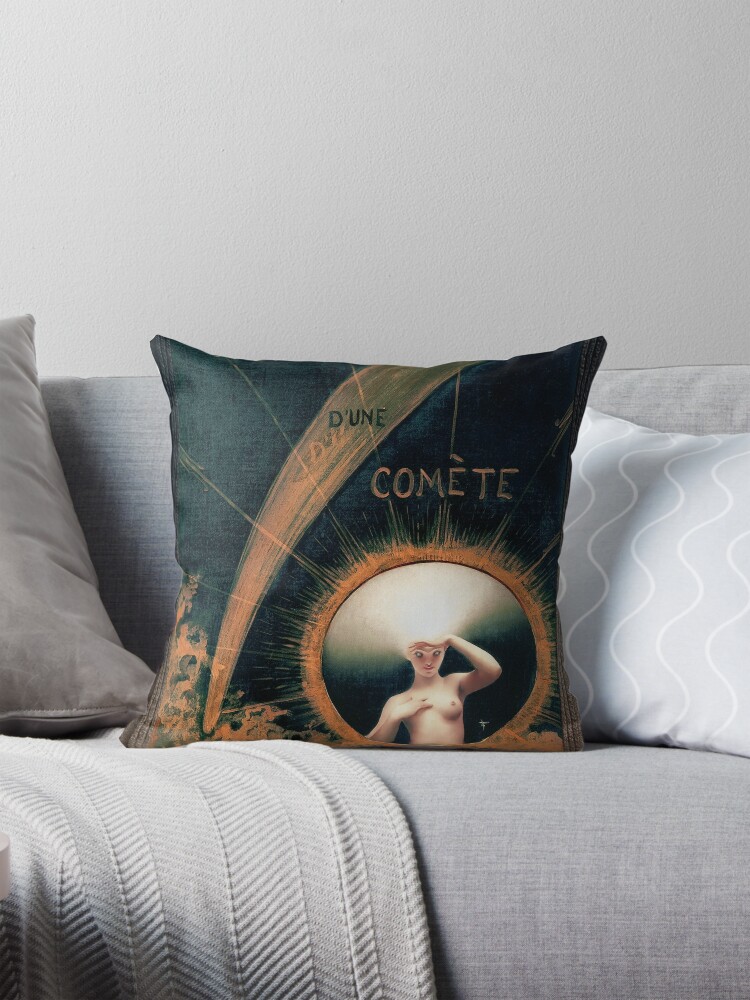
Histoire dune Comete (History Of A Comet) c1897
Luis Ricardo Falero‘s painting “Histoire d’une Comète” (History of a Comet), oanmakke yn 1897, embodies the intersection of science, mytology, en sensualiteit, blending them into a narrative that speaks to the imagination of its time. Born in Spain in 1851 en yngean 1896, Falero was known for his romanticized depictions of the female figure, often intertwining her with celestial themes. His works were steeped in allegory and mysticism, exploring the interplay between the human form and the cosmic. “Histoire d’une Comète” is gjin útsûndering; it is a captivating representation of a comet’s journey, personified in the form of a celestial woman, evoking both mystery and grandeur.
Ynhâldsopjefte
It haadûnderwerp en komposysje
At the heart of the painting is a striking female figure, luminous and ethereal, who gazes out of the canvas, drawing the viewer into a surreal interaction. Har pose, with one arm raised to shield her eyes, suggests that she is a cosmic being, perhaps an embodiment of the comet herself. This woman, naked and seemingly untouched by time, is framed by a glowing, otherworldly aura. Har bleek, almost ghostly complexion contrasts sharply with the dark, textured backdrop, emphasizing her luminous quality.
The subject’s features are soft and symmetrical, karakteristyk foar Falero syn idealisearre froulike foarm. Har hier is in sulveren halo, útstriele út, fierder fersterkjen fan har himelske natuer. De figuer leit foar in grutte, circular gebiet fan tsjuster, dy't tsjinnet as in portal of it sintrum fan 'e sturt fan' e komeet. De heldere, skerpe strielen fan 'e sturt fan 'e komeet streaken oer it doek, konvergearje by de foarm fan 'e frou en ferljochtsje har silhouet. De komeet is sawol it ûnderwerp as it symboal fan it keunstwurk, it oanbieden fan in dûbele narratyf fan wittenskiplike ûntdekking en mytologyske ferbylding.
Foarwerpen, Terrein, and Symbolism
De eftergrûn fan it skilderij is in djip, fluwelig grien dat oergiet yn in tsjuster, hast kosmysk blau as it nei bûten beweecht, it meitsjen fan in gefoel fan djipte en ûneinichheid. Dit kleurenpalet suggerearret de grinsleaze aard fan it universum, wêr't de trochgong fan 'e komeet en de etheryske oanwêzigens fan 'e frou de krusing fan it bekende en it ûnbekende symbolisearje.
De sturt fan 'e komeet sels wurdt yn sweeping werjûn, fjoerige streken dy't út 'e hoeke lofterboppe komme, oer it doek bôge nei de frou. Dizze streken binne net allinich artistike fersieringen, mar tsjinje as in direkte fisuele foarstelling fan it paad fan 'e komeet troch de himel. De komeet is sawol in letterlik objekt yn it skilderij as in symboal fan 'e fergonklike aard fan tiid en bestean. It ferbyldet beweging, feroaring, en de konstante trochgong fan himellichems troch de kosmos.
De fysike bleatheid fan 'e frou is net allinich in artistike kar, mar in bewuste metafoar. It suggerearret suverens en kwetsberens, meitsje har in skip foar kosmyske krêften. Har opheven earm, which shields her eyes, invokes the idea of revelation and discovery. The viewer, through her gaze, is invited to witness the unfolding of the comet’s story, much like how astronomers might peer through telescopes to understand the universe. The idea of revelation is further emphasized by the surrounding elements, such as the trailing streaks of the comet, which allude to the idea of a narrative unfolding through time.
Styl, Tema, en Mood
Falero’s technique in “Histoire d’une Comète” blends elements of Romanticism and Symbolism, creating a scene that is both dreamlike and charged with emotional intensity. The exaggerated, almost mystical qualities of the comet and the woman suggest a thematic focus on the unknown and the exploration of celestial bodies. The painting’s atmospheric quality, where the celestial and human realms meet, also touches on themes of fate and destiny.
The mood of the painting is one of quiet contemplation, but it is also imbued with a sense of grandeur and awe. The woman’s serene expression and the comet’s fiery passage create an otherworldly tension between the cosmic and the human. The color contrasts—the pale figure against the dark background, the warm glow of the comet’s tail against the cool tones of the universe—enhance this sense of duality. There is an undeniable mysticism to the work, with the viewer left to wonder about the true nature of the comet and the woman, and the larger cosmic forces at play.
De kar fan Falero om it himellichem te yntegrearjen as sawol in wittenskiplik as mytologysk objekt ûnderstreket de fassinaasje fan 'e lette 19e ieu foar astronomy en de groeiende belangstelling foar de mystearjes fan it universum. It mingjen fan dizze eleminten yn it skilderij is in skaaimerk fan 'e symbolistyske beweging, dy't socht om djippere wierheden bûten de materiële wrâld te ferkennen.
Materiaal en technyk
Yn termen fan materialen, Falero brûkte wierskynlik oaljeferve op doek, in medium dat tastien foar de rike lagen en ljochte kwaliteit dy't definiearret it wurk. Syn borstelstreken binne sawol delikaat en bewust, it tafoegjen fan tekstuer en djipte oan 'e komeet syn sturt en de frou syn figuer. De komposysje fan it skilderij is tige kontrolearre, mei de sintrale figuer soarchfâldich omkaam troch it útstriele ljocht fan de komeet. This control over the composition adds to the otherworldly precision of the work, heightening the sense of cosmic order and harmony.
The painting’s intricate detailing of the comet’s tail and the softness of the woman’s skin indicate Falero’s mastery of the medium. His blending of light and shadow is particularly notable in the way the comet’s rays illuminate the woman’s body, creating a dramatic contrast that draws attention to the figure while simultaneously suggesting the vast, cosmic space in which she exists.
Histoire dune Comete is a retouched digital art old masters reproduction of a public domain image.
Artist Bio Derived Wikipedia.org
Falero waard berne yn Granada en folge oarspronklik in karriêre yn 'e Spaanske marine, mar joech it oan syn âlden teloarstelling; doe't hy besleat om nei Parys te reizgjen, dêr't er keunst studearre, skiekunde en meganyske technyk.
Tidens is stúdzjes yn skiekunde en meganyske technyk; hy achte de eksperiminten dy't er dwaan moast te gefaarlik, sa liedt er him syn oandacht allinnich op it skilderjen te rjochtsjen.
Dêrtroch waard hy studint fan de Frânske portretskilder en oriïntalist Gabriel-Joseph-Marie-Augustin Ferrier (1847 – 1914). Nei Parys, hy ferhuze nei Londen, dêr't er syn stúdzje trochgie, en úteinlik fêstige.
Falero hie in bysûndere belangstelling foar astronomy en ferwurke himelske konstellaasjes yn in protte fan syn wurken, lykas “It houlik fan in komeet” en “Twin Stars”. Syn belangstelling en kennis fan astronomy late him ek ta it yllustrearjen fan it wurk fan Camille Flammarion.
Yn 1896, it jier fan syn dea, Maud Harvey oanklage Falero foar heitemskip. It pak bewearde dat Falero Harvey ferliede doe't se wie 17, earst tsjinne as syn húsfrou, en dan syn model. Doe't er ûntduts dat se swier wie, hy joech har ôf.
Se wûn de saak en waard fiif shilling per wike takend yn stipe fan har bern. Falero stoar yn University College Hospital, Londen, yn de âldens fan 45