

Hunting in the Pontine Marshes
Ĉasado en la Pontaj Marĉoj c1833 de franca farbisto Horace Vernet (Émile Jean-Horace Vernet 1789 – 1863); known for his Portraits, Orientalist and Battlefield scenes.
This is a dramatic and beautiful pejzaĝo scene of two men, one a guide rowing the boat, the other a hunter with a rifle taking aim from inside the boot, with his trusted dog by his side.
The two men are hunting a duck in a lush and colorful landscape of tall trees and high grasses as they pass underneath fallen tree that is bare of its bark and shines white in the daylight.
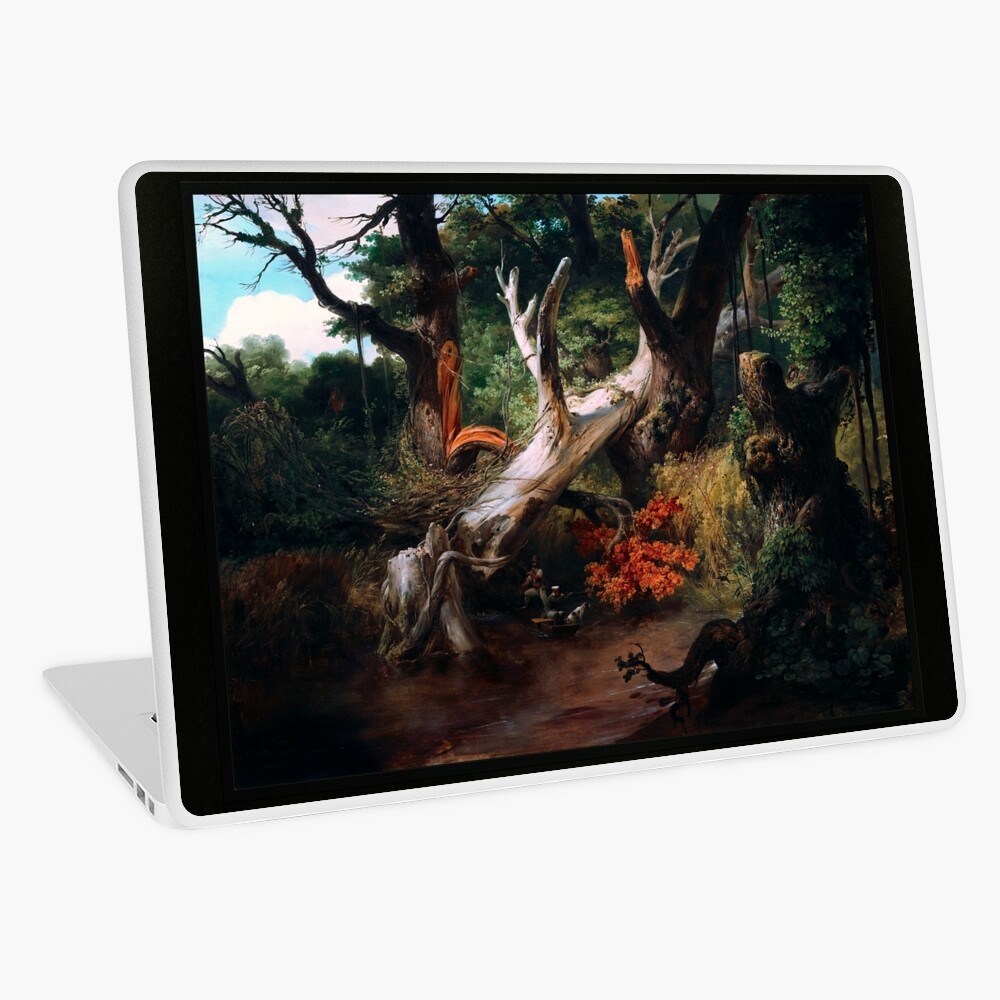
Ĉi tio estas retuŝita cifereca arto malnova majstra reproduktaĵo de publika domajna bildo aĉetebla kiel a ruliĝinta tolo presaĵo rete.
Informoj Malsupre Derivita De NGA.gov kaj Vikipedio.org
Horace came from a long line of artist; he was born to French Painter Carle Vernet (Antoine Charles Horace Vernet 1758 – 1836), who was the youngest child of French Painter Claude-Joseph Vernet (1714 – 1789); France’s foremost painter of land- and seascapes.
On his mothers side of the family he was the grandson of the French engraver Jean Moreau le Jeune (1741 – 1814); and he was casually trained by his father, who was a chronicler of the elegancies of the post-Revolutionary decades and the empire.
Horace was a child prodigy and in his teens was considered a professional artist; kaj en 1811 opened his own studio producing artwork in fashion design, caricatures, portretoj, horses in the manner of his father, and landscapes in the manner of his grandfather.
De 1821 al 1826 he painted a series of revolutionary and Napoleonic wars battles scenes Jemmapes, Montmirail, Hanau, and Valmy, painted for the duc d’Orléans, which gave a foretaste of that type of artwork he would later specialize in.
Kvankam li havis malestimon por la burbona registaro kiu estis en povo tiutempe kaj elmontris sian abomenon kontraŭ ĝi; li diskrete frenezaj akordigaj gestoj al la registaro, kiuj estis bone akceptitaj de la registaro kaj mallonge, li fariĝis oficiro de la Honora Legio en 1825, membro de la Instituto en 1826; kaj post sukcesaj montradoj ĉe la Salonoj de 1826 kaj 1827, estis nomumita direktoro de la Franca Akademio en Romo 1829.
Li tenis tiun pozicion dum sep jaroj kaj dum tiu tempo produktis “La Konfeso de la Brigando”, orientaj temoj “La Araba Rakontanto”, kaj historiaj anekdotoj “Renkonto de Rafaelo kaj Mikelanĝelo en Vatikano”.
Tiam dum la revolucio de julio 1830 kiu metis lian patron Louis-Philippe sur la tronon; he was able to receive a vast number of opportunities of official state commissions for battle pieces; Four very large canvases for the Galerie des Batailles at Versailles, shown at the Salon of 1836, were followed by a second series in 1841.
Horace approach to creating his battle scene artwork was of that of a reporter of an eyewitness account at the actual theaters of war; so in five long visits to North Africa in 1833, 1837, 1839-40, 1845 kaj 1853 he gathered on the spot documentation of the French conquest on Algiers and Marocco, that he would later turn in to wall sized convases destined for Versailles.
En 1855 Horace exhibited twenty four paintings at the Universal Exposition, which his popular and official success.