

Idleness c1900
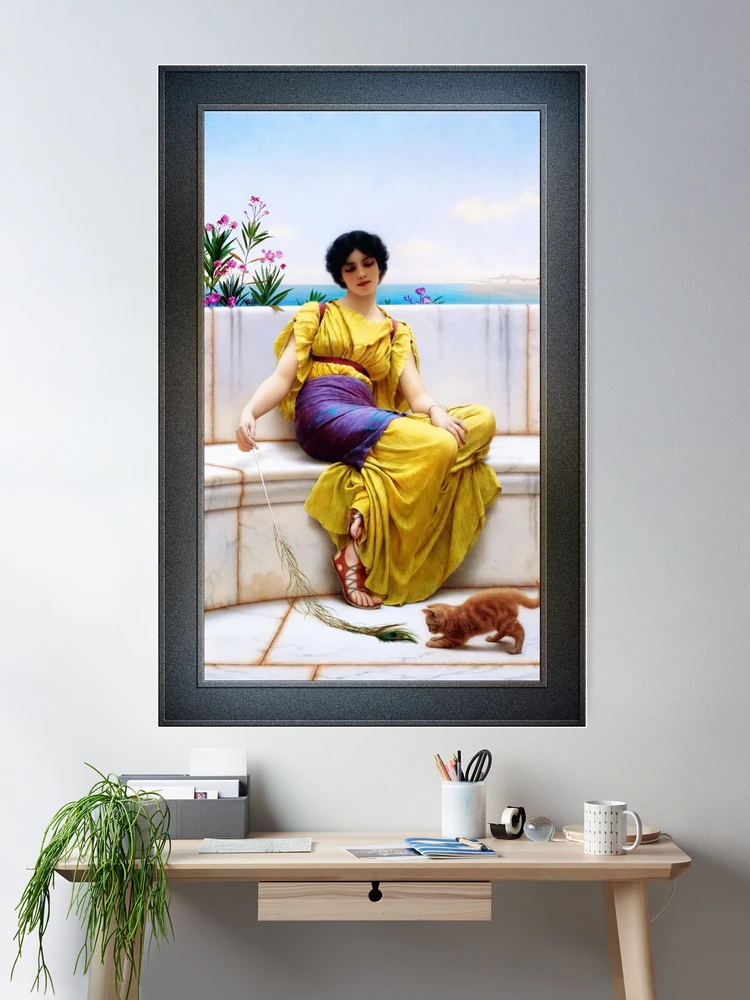
John William Godward, a prominent British painter known for his stunning depictions of the Classical world, created the artwork “Idleness” i 1900. Godward (1861 – 1922), celebrated for his mastery in portraying women in serene, timeless poses within classical and mythological settings, paints a poignant image of stillness and leisure in this particular work. The scene, though filled with vibrant color and serene composition, evokes a timeless mood that blends the antique with an almost dreamlike quality. Godward’s style, often associated with the Academic tradition, is on full display in this painting, where the skillful use of light, tekstur, and classical elements invites the viewer into a moment frozen in time.
Innholdsfortegnelse
Emnet
I hjertet av “Idleness” is the depiction of a young woman, sitting gracefully on a marble bench with a contemplative expression. Her delicate posture and the way she holds a long peacock feather, gently draped from her fingers, imply a quiet moment of repose, as she uses it to play with a kitten. Her body, draped in flowing garments of rich yellow and purple, suggests a figure both in the midst of relaxation and deep thought. The colors of her attire, set against the cool tones of the surrounding environment, add an ethereal quality to her figure, elevating her presence to that of an idealized beauty.
The woman’s dark, short hair contrasts with the golden hues of her clothing, creating a visual balance that complements the soft and inviting mood of the piece. Her facial expression is peaceful, with her gaze lowered as if lost in thought or perhaps in idle contemplation. It is an image of tranquility, drawing the viewer’s attention to the subject’s serene beauty. The slowness and grace of her movements are accentuated by the absence of any evident action or hurry in her pose, fitting the title “Idleness” perfectly. Her limbs, languidly arranged, exude a sense of stillness that enhances the theme of leisure.
Gjenstander og materialer
The bench on which the young woman rests is made of polished marble, its surface smooth and lustrous, contributing to the luxurious and timeless atmosphere of the artwork. The marble’s cool, pale tones contrast beautifully with the warmer hues of her attire. The surrounding scene includes delicate touches of floral elements, with vibrant pink flowers and green foliage sprouting from pots or planters that frame the scene. These natural elements serve to soften the otherwise pristine environment, adding a touch of liveliness to the otherwise tranquil setting.
The woman’s bare feet are visible, suggesting a connection to the earth beneath her, while her sandals are softly laced, further emphasizing her relaxed state. The twine she holds seems to gently cascade from her hand, a quiet object that contrasts with the elegance of her posture. The composition overall uses these subtle details, her clothing, the marble bench, the plants, and the twine, to evoke a sense of harmony between the subject and her environment, suggesting an idyllic escape from the demands of everyday life.
Terreng og bakgrunn
Bakteppet av “Idleness” features a coastal vista, with a soft blue sky and distant views of the sea. The horizon appears calm, with gentle ripples on the water’s surface that mirror the peaceful stillness of the scene. This landscape, while not highly detailed, is nonetheless a crucial element in conveying the sense of serenity and escape. The background serves as a visual reminder of the natural world and its role in providing the perfect setting for the woman’s contemplative repose.
The architecture surrounding the subject, though minimal, suggests an outdoor space—perhaps a garden or courtyard of some ancient villa. The use of white and light tones in the stonework is in harmony with the soft pastel colors of the sky, further enhancing the atmosphere of classical elegance and beauty. The gentle curves of the stonework lead the viewer’s eye towards the figure, focusing attention on the stillness of the subject amidst a tranquil, almost dreamlike, innstilling.
Stil og teknikk
Godward’s style is one rooted in the academic traditions of the 19th century, influenced by his early training under classical painters and his deep admiration for the ancient Roman and Greek worlds. I “Idleness,” his attention to detail is evident in the texture of the woman’s gown, the softness of her skin, and the lustrous quality of the marble. Each fold of the woman’s clothing is carefully modeled to convey the weight and flow of the fabric, while the skin is rendered with a soft glow that highlights the artist’s ability to capture the nuances of light.
The use of color is one of the defining features of Godward’s style. The warm yellow of the woman’s dress contrasts beautifully with the cooler blues of the sea and sky, creating a harmonious palette that exudes calm and contentment. The juxtaposition of purple and yellow further enhances the vibrant yet restrained mood of the painting. The choice of colors is not just aesthetically pleasing but serves to emphasize the classical theme of timeless beauty and the idea of idleness as an ideal state of mind.
Godward’s meticulous brushwork and mastery of light and shadow create a sense of depth and dimension within the composition. The sunlight that softly illuminates the woman’s face and the folds of her clothing enhances the sense of warmth in the scene. This soft rendering of light and shadow contrasts with the clarity of the background, making the figure appear almost ethereal in comparison. The careful application of paint, combined with Godward’s ability to capture the texture of different surfaces, such as the smooth marble, the softness of the woman’s skin, and the delicate fabric of her dress, demonstrates his exceptional skill as an artist.
Stemning og tema
Stemningen av “Idleness” is one of peacefulness, relaxation, and an almost reverent stillness. The figure of the young woman, with her contemplative pose and serene expression, captures the essence of the theme of idleness: a moment in time where nothing is required, and all that exists is the peaceful state of being. This sense of timeless leisure is further reinforced by the classical setting and the absence of any hurried motion in the scene. There is no sense of urgency or distraction in this moment, only the quiet, almost sacred, experience of simply being.
The theme of idleness, a concept often revered in classical art, suggests a harmonious balance between human beings and nature. It invites the viewer to reflect on the value of stillness and the simple pleasures of life. In this work, Godward celebrates the beauty of leisure, not as a fleeting or wasteful moment, but as an ideal state of existence that connects the human figure with nature and the timeless, classical world.
Idleness is a remastered digital art old masters reproduction of a public domain image that is available as a lerretstrykk online.
Denne digitale kunstkreasjonen, som med alle kunstverkene som finnes på Xzendor7-nettstedet, er det tilgjengelig for kjøp online i en rekke materialformater, inkludert lerretstrykk, akryltrykk, metalltrykk, treutskrifter, innrammede trykk, plakater, og som rullede lerret utskrifter i en rekke størrelser fra 12 tommer til 72 tommer avhengig av størrelsen på det faktiske kunstverket og print on demand-butikken du velger å kjøpe kunsten fra.
Kunstverket er også tilgjengelig på et bredt utvalg av herre- og dameklær, krus, totes, skjerf, notatbøker og journaler og mange hjemmeinnredningsprodukter.
Om kunstneren
Info nedenfor fra Wikipedia.org
John William Godward var den eldste av fem barn, og ble oppkalt etter faren John og bestefaren William.
Han stilte ut på Royal Academy fra 1887. Da han flyttet til Italia med en av modellene sine i 1912, familien hans brøt all kontakt med ham og kuttet til og med bildet hans fra familiebilder. Godward kom tilbake til England i 1921, døde i 1922, og er gravlagt på Brompton Cemetery, Vest-London.
Et av hans mest kjente malerier er Dolce far Niente (1904), som ble kjøpt for samlingen til Andrew Lloyd Webber i 1995. Som i tilfellet med flere andre malerier, Godward malte mer enn én versjon; i dette tilfellet, en tidligere (og mindre kjent) 1897 versjon med en ytterligere 1906 versjon.
Han begikk selvmord i en alder av 61 og skal ha skrevet i sitt selvmordsbrev at “the world is not big enough for [both] myself and a Picasso”.
His estranged family, who had disapproved of his becoming an artist, were ashamed of his suicide and burned his papers. Only one photograph of Godward is known to survive.
Godward var en viktoriansk nyklassisist, og derfor, i teorien, en tilhenger av Frederic Leighton. derimot, han er tettere alliert stilistisk med Sir Lawrence Alma-Tadema, med hvem han delte en forkjærlighet for gjengivelse av klassisk arkitektur - spesielt, statiske landskapstrekk konstruert av marmor.
The vast majority of Godward’s extant images feature women in classical dress posed against landscape features; although there are some semi-nude and fully nude figures included in his oeuvre, a notable example being “In The Tepidarium c1913”.
En tittel som deles med et kontroversielt Alma-Tadema-maleri av samme emne som ligger i “Lady Lever kunstgalleri”. Titlene gjenspeiler Godwards inspirasjonskilde; som var klassisk sivilisasjon, mest bemerkelsesverdig det fra det gamle Roma; et emne som knytter Godward nært til Alma-Tadema kunstnerisk.
Gitt at klassisk stipend var mer utbredt blant det potensielle publikummet for maleriene hans i løpet av hans levetid enn i dag, Nøye detaljforskning var viktig for å oppnå en anseelse som kunstner i denne sjangeren.
Alma-Tadema var arkeolog så vel som maler, som besøkte historiske steder og samlet gjenstander han senere brukte i maleriene sine: Godward, også, studerte detaljer som arkitektur og kjole, for å sikre at verkene hans bar autentisitetsstempel.
I tillegg, Godward painstakingly and meticulously rendered other important features in his paintings, animal skins of which the paintings “Noon Day Rest c1910” og “A Cool Retreat c1910” contains examples of such rendition as well as wildflowers “Nerissa c1906” og “Summer Flowers c1903”.
Utseendet til vakre kvinner i studerte positurer i så mange av Godwards lerreter får mange nykommere til verkene hans til å feilaktig kategorisere ham som prerafaelitt, spesielt ettersom paletten hans ofte er livlig fargerik. Valg av emne (gammel sivilisasjon kontra, for eksempel, Arthuriansk legende) er mer riktig den viktorianske nyklassisisten.
Til felles med en rekke malere som er samtidig med ham, Godward var en "høy viktoriansk drømmer", produsere bilder av en idealisert og romantisert verden som, når det gjelder både Godward og Alma-Tadema, kom til å bli kritisert som et verdensbilde av viktorianere i toga.
Godward “etablerte raskt et rykte for sine malerier av unge kvinner i en klassisk setting og hans evne til å formidle med følsomhet og teknisk mestring følelsen av kontrasterende teksturer av kjøtt, marmor, pels og stoffer.
Godwards forkjærlighet for å lage kunstverk satt i den klassiske perioden kom sannsynligvis fra den perioden han ble født; ettersom det var den siste fullskala klassiske vekkelsen i vestlige malerier, som blomstret i England fra 1860-tallet til 1890-tallet.