

Idleness c1900
John William Godward, a prominent British painter known for his stunning depictions of the Classical world, created the artwork “Idleness” i 1900. Godward (1861 – 1922), celebrated for his mastery in portraying women in serene, timeless poses within classical and mythological settings, paints a poignant image of stillness and leisure in this particular work. Scenen, though filled with vibrant color and serene composition, evokes a timeless mood that blends the antique with an almost dreamlike quality. Godward’s style, often associated with the Academic tradition, is on full display in this painting, where the skillful use of light, textur, and classical elements invites the viewer into a moment frozen in time.
Innehållsförteckning
Ämnet
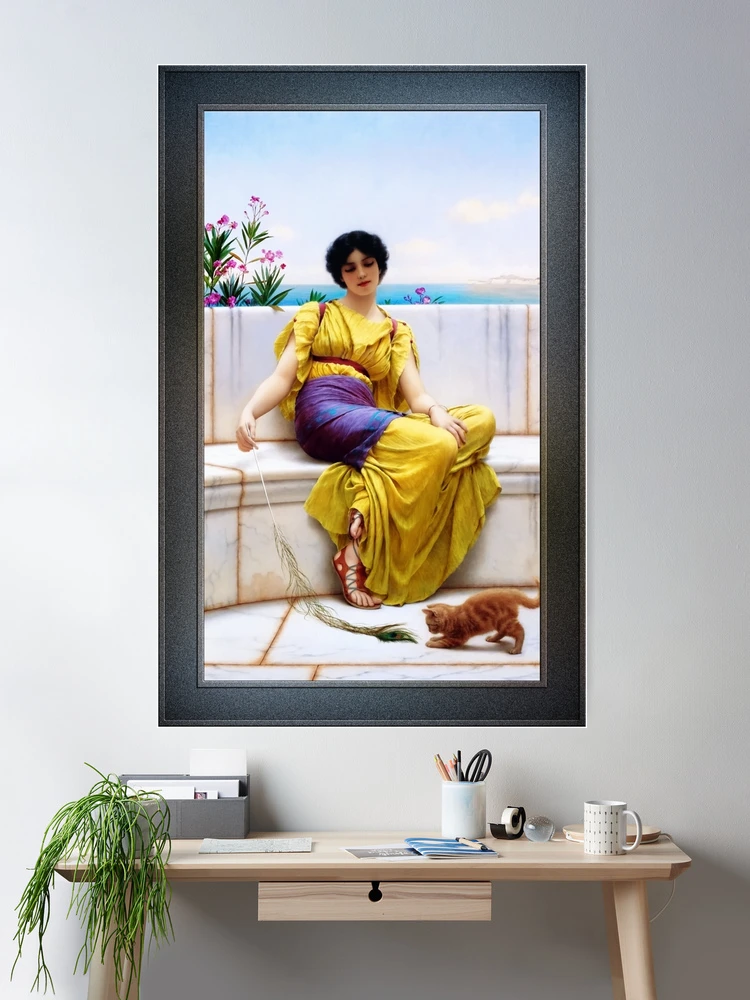
I hjärtat av “Idleness” is the depiction of a young woman, sitting gracefully on a marble bench with a contemplative expression. Her delicate posture and the way she holds a long peacock feather, gently draped from her fingers, imply a quiet moment of repose, as she uses it to play with a kitten. Hennes kropp, draped in flowing garments of rich yellow and purple, suggests a figure both in the midst of relaxation and deep thought. The colors of her attire, set against the cool tones of the surrounding environment, add an ethereal quality to her figure, elevating her presence to that of an idealized beauty.
The woman’s dark, short hair contrasts with the golden hues of her clothing, creating a visual balance that complements the soft and inviting mood of the piece. Her facial expression is peaceful, with her gaze lowered as if lost in thought or perhaps in idle contemplation. It is an image of tranquility, drawing the viewer’s attention to the subject’s serene beauty. The slowness and grace of her movements are accentuated by the absence of any evident action or hurry in her pose, fitting the title “Idleness” perfectly. Her limbs, languidly arranged, exude a sense of stillness that enhances the theme of leisure.
Föremål och material
The bench on which the young woman rests is made of polished marble, its surface smooth and lustrous, contributing to the luxurious and timeless atmosphere of the artwork. The marble’s cool, pale tones contrast beautifully with the warmer hues of her attire. The surrounding scene includes delicate touches of floral elements, with vibrant pink flowers and green foliage sprouting from pots or planters that frame the scene. These natural elements serve to soften the otherwise pristine environment, adding a touch of liveliness to the otherwise tranquil setting.
The woman’s bare feet are visible, suggesting a connection to the earth beneath her, while her sandals are softly laced, further emphasizing her relaxed state. The twine she holds seems to gently cascade from her hand, a quiet object that contrasts with the elegance of her posture. The composition overall uses these subtle details, her clothing, the marble bench, the plants, and the twine, to evoke a sense of harmony between the subject and her environment, suggesting an idyllic escape from the demands of everyday life.
Terräng och bakgrund
Bakgrunden av “Idleness” features a coastal vista, with a soft blue sky and distant views of the sea. The horizon appears calm, with gentle ripples on the water’s surface that mirror the peaceful stillness of the scene. This landscape, while not highly detailed, is nonetheless a crucial element in conveying the sense of serenity and escape. The background serves as a visual reminder of the natural world and its role in providing the perfect setting for the woman’s contemplative repose.
The architecture surrounding the subject, om än minimalt, suggests an outdoor space—perhaps a garden or courtyard of some ancient villa. The use of white and light tones in the stonework is in harmony with the soft pastel colors of the sky, further enhancing the atmosphere of classical elegance and beauty. The gentle curves of the stonework lead the viewer’s eye towards the figure, focusing attention on the stillness of the subject amidst a tranquil, nästan drömlikt, setting.
Stil och teknik
Godward’s style is one rooted in the academic traditions of the 19th century, influenced by his early training under classical painters and his deep admiration for the ancient Roman and Greek worlds. I “Idleness,” his attention to detail is evident in the texture of the woman’s gown, the softness of her skin, and the lustrous quality of the marble. Each fold of the woman’s clothing is carefully modeled to convey the weight and flow of the fabric, while the skin is rendered with a soft glow that highlights the artist’s ability to capture the nuances of light.
The use of color is one of the defining features of Godward’s style. The warm yellow of the woman’s dress contrasts beautifully with the cooler blues of the sea and sky, creating a harmonious palette that exudes calm and contentment. The juxtaposition of purple and yellow further enhances the vibrant yet restrained mood of the painting. The choice of colors is not just aesthetically pleasing but serves to emphasize the classical theme of timeless beauty and the idea of idleness as an ideal state of mind.
Godward’s meticulous brushwork and mastery of light and shadow create a sense of depth and dimension within the composition. The sunlight that softly illuminates the woman’s face and the folds of her clothing enhances the sense of warmth in the scene. This soft rendering of light and shadow contrasts with the clarity of the background, making the figure appear almost ethereal in comparison. The careful application of paint, combined with Godward’s ability to capture the texture of different surfaces, such as the smooth marble, the softness of the woman’s skin, and the delicate fabric of her dress, demonstrates his exceptional skill as an artist.
Humör och tema
Stämningen av “Idleness” is one of peacefulness, relaxation, and an almost reverent stillness. The figure of the young woman, with her contemplative pose and serene expression, captures the essence of the theme of idleness: a moment in time where nothing is required, and all that exists is the peaceful state of being. This sense of timeless leisure is further reinforced by the classical setting and the absence of any hurried motion in the scene. There is no sense of urgency or distraction in this moment, only the quiet, nästan heligt, experience of simply being.
The theme of idleness, a concept often revered in classical art, suggests a harmonious balance between human beings and nature. It invites the viewer to reflect on the value of stillness and the simple pleasures of life. I detta arbete, Godward celebrates the beauty of leisure, not as a fleeting or wasteful moment, but as an ideal state of existence that connects the human figure with nature and the timeless, classical world.
Idleness is a remastered digital art old masters reproduction of a public domain image that is available as a canvastavla online.
Detta digitala konstskapande, som med alla konstverk som kan hittas på Xzendor7-webbplatsen finns att köpa online i en mängd olika materialformat inklusive canvastavlor, akryltryck, metalltryck, trätryck, inramade tryck, affischer, och som rullade canvastryck i en mängd olika storlekar från 12 tum till 72 tum beroende på storleken på det faktiska konstverket och den print on demand-butik du väljer att köpa konsten från.
Konstverket är också tillgängligt på ett brett utbud av herr- och damkläder, muggar, väskor, halsdukar, anteckningsböcker och tidskrifter och många heminredningsprodukter.
Om konstnären
Info nedan från Wikipedia.org
John William Godward var den äldsta av fem barn, och namngavs efter hans far John och farfar William.
Han ställde ut på Royal Academy från 1887. När han flyttade till Italien med en av sina modeller i 1912, hans familj avbröt all kontakt med honom och klippte till och med hans bild från familjebilder. Godward återvände till England i 1921, dog i 1922, och är begravd på Brompton Cemetery, Västra London.
En av hans mest kända målningar är Dolce far Niente (1904), som köptes för samlingen av Andrew Lloyd Webber i 1995. Som i fallet med flera andra målningar, Godward målade mer än en version; I detta fall, en tidigare (och mindre kända) 1897 version med ytterligare en 1906 version.
Han begick självmord vid en ålder av 61 och sägs ha skrivit i sitt självmordsbrev det “världen är inte tillräckligt stor för [både] mig själv och en Picasso”.
Hans främmande familj, som hade ogillat att han skulle bli konstnär, skämdes över sitt självmord och brände hans papper. Endast ett fotografi av Godward är känt för att överleva.
Godward var en viktoriansk nyklassicist, och därför, i teorin, en anhängare av Frederic Leighton. i alla fall, han är närmare allierad stilistiskt med Sir Lawrence Alma-Tadema, med vilken han delade en förkärlek för återgivning av klassisk arkitektur - i synnerhet, statiska landskapsdrag konstruerade av marmor.
De allra flesta av Godwards nuvarande bilder visar kvinnor i klassisk klädsel som ställs mot landskapsdrag; även om det finns några halvnakna och helt nakna figurer som ingår i hans verk, ett anmärkningsvärt exempel “I The Tepidarium c1913”.
En titel som delas med en kontroversiell Alma-Tadema-målning av samma ämne som finns i “Lady Lever Art Gallery”. Titlarna speglar Godwards inspirationskälla; som var klassisk civilisation, framför allt det antika Rom; ett ämne som knyter Godward nära till Alma-Tadema konstnärligt.
Med tanke på att det klassiska stipendiet var mer utbrett bland den potentiella publiken för hans målningar under hans livstid än i dag, noggrann detaljforskning var viktig för att nå en ställning som artist i denna genre.
Alma-Tadema var såväl arkeolog som målare, som besökte historiska platser och samlade artefakter som han senare använde i sina målningar: Godward, för, studerade detaljer som arkitektur och klädsel, för att säkerställa att hans verk bär äkthetsstämpeln.
Dessutom, Godward återgav mödosamt och minutiöst andra viktiga drag i sina målningar, djurskinn varav målningarna “Middagsvila c1910” och “En cool reträtt c1910” innehåller exempel på sådan återgivning såväl som vildblommor “Nerissa c1906” och “Sommarblommor c1903”.
Framträdandet av vackra kvinnor i studerade poser i så många av Godwards dukar får många nykomlingar till hans verk att felaktigt kategorisera honom som prerafaelit, särskilt eftersom hans palett ofta är en levande färgstark. Val av ämne (forntida civilisation kontra, till exempel, Arthurisk legend) är mer korrekt den för den viktorianska nyklassicisten.
Gemensamt med många målare samtida med honom, Godward var en "hög viktoriansk drömmare", producera bilder av en idealiserad och romantiserad värld som, i fallet med både Godward och Alma-Tadema, kom att kritiseras som en världsbild av viktorianer i togas.
Godward “etablerade snabbt ett rykte för sina målningar av unga kvinnor i en klassisk miljö och hans förmåga att med känslighet och teknisk behärskning förmedla känslan av kontrasterande strukturer av kött, marmor, päls och tyger.
Godwards förkärlek för att skapa konstverk som utspelar sig i den klassiska perioden kom förmodligen från den tidsperiod då han föddes; eftersom det var den sista fullskaliga klassiska väckelsen i västerländska målningar, som blomstrade i England från 1860-talet fram till 1890-talet.