

In The Grove Of The Temple Of Isis
“In The Grove Of The Temple Of Isis” by the British artist John William Godward (1861 – 1922) captures an idyllic and timeless moment that transports the viewer to an ancient, classical world. Known for his expertise in depicting the serene beauty of women, classical architecture, and lush landscapes, Godward presents an image filled with grace and elegance. Godward was a prominent figure in the Neo-Classical movement, a style which focused on the revival of ancient Greek and Roman ideals, yet with an air of romanticism. This particular work, executed at the peak of his career in 1915, continues to reflect his admiration for the classical world while showcasing his mastery over texture, color, i forma.
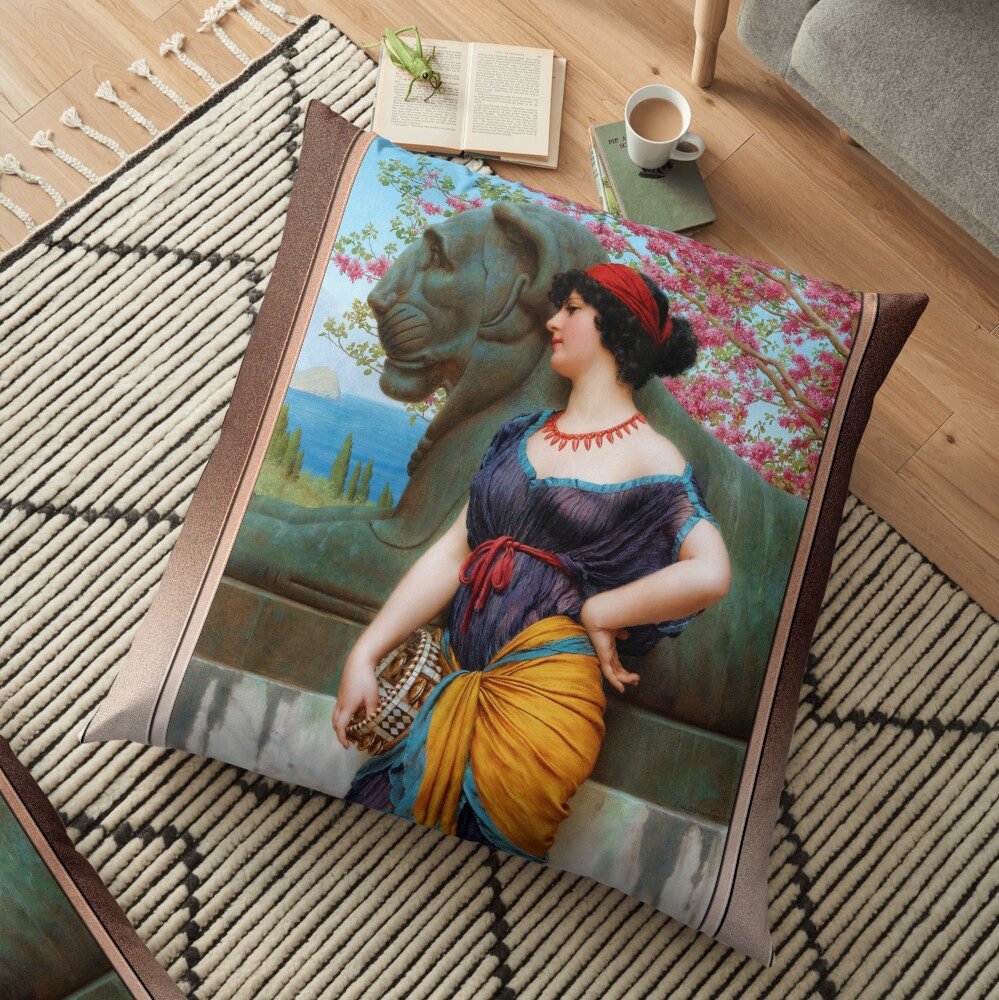
The painting features a woman poised in the shadows of a grove within the ruins of a temple dedicated to Isis, the ancient Egyptian goddess associated with fertility, magic, and motherhood. The backdrop of the temple ruins suggests the faded grandeur of antiquity, contrasting with the vibrant and alive portrayal of the woman. This juxtaposition between the lifeless stones of the temple and the youthful energy of the female figure is a testament to Godward’s ability to capture the passage of time while simultaneously celebrating beauty and vitality.
Taula de continguts
El subjecte: The Woman in the Grove
The central subject of Godward’s piece is a young woman draped in flowing classical attire, reminiscent of the Greco-Roman style. Her rich, layered robes of indigo and yellow silk cascade down her figure with an intricate sense of movement. The contrast between the dark purple of the gown and the bright golden hue of the sash offers a rich, luxurious color palette that highlights the sensuality of the fabric as it clings to the woman’s curves. The light catches the delicate folds of her clothing, which seem to shimmer, as though alive with movement. La seva postura, elegant yet relaxed, reflects the calm nature of the classical world that Godward is known for capturing in his works.
The woman’s face, turned slightly toward the viewer, reveals a serene expression. Els seus trets estan finament esculpits, emphasizing the idealized beauty of women that was characteristic of Godward’s style. The small details such as her jewelry, a simple, yet elegant necklace, add to the sense of wealth and refinement. Els seus cabells foscos, pulled back and adorned with a red ribbon, complements the surrounding landscape and further enforces the sense of timeless grace. The woman appears absorbed in her surroundings, her gaze cast slightly down as if contemplating the ancient temple behind her, or perhaps reflecting on the mysteries of the past.
A les seves mans, she holds a tambourine, which further connects her to the ritualistic and ceremonial life of the ancient world. This instrument, often associated with divine and sacred practices, hints at the religious or ritualistic theme of the painting, aligning with the temple’s association with Isis. The tambourine may also symbolize a connection to music and dance, which were intrinsic to the worship practices in ancient temples.
The Temple and The Setting
The painting’s background is dominated by the crumbling remnants of a classical temple, half-obscured by lush foliage. This juxtaposition between the temple ruins and the living woman symbolizes the enduring spirit of beauty amid the passing of time. The ruins, which likely once formed part of a grand structure dedicated to Isis, appear weathered and aged, with portions of the stonework barely visible through the verdant overgrowth. This setting evokes the passage of centuries, with nature slowly overtaking human creations, but it also serves as a reminder of the power and grandeur of the ancient world.
Flanking the temple ruins are flowering trees, their pink blossoms in full bloom, creating a stark contrast to the ancient stone. L'exuberant, almost dreamlike vegetation hints at a warm, Mediterranean climate, further connecting the work to the romanticized vision of antiquity. The flowers introduce a note of vitality, which not only enhances the visual beauty of the piece but also suggests the cyclical nature of life, with the blooming trees offering a sense of renewal in contrast to the decay of the temple. La llum, soft blues and greens of the distant landscape hint at the calm, peaceful existence of the classical world, a world where nature and humanity lived in harmony.
Materials i Tècnica
Godward’s technique is characterized by meticulous attention to detail, as evidenced in every brushstroke of the fabric, the woman’s skin, and the architecture. The use of oil paints gives the piece its depth and richness, allowing Godward to play with texture and light to create an almost photographic realism. The smooth finish of the woman’s skin contrasts with the rough texture of the stone, while the translucent quality of her clothing enhances the softness of her form. Godward’s handling of light in the composition is another striking feature; the sunlight filtering through the trees highlights the contours of the woman’s face and body, while also casting soft shadows that create a sense of depth and realism.
The Mood and Themes
The overall mood of the painting is one of serenity and tranquility. The woman’s calm demeanor and poised stance convey a sense of peace, as though she is at one with the ancient world surrounding her. This peacefulness is further emphasized by the gentle presence of nature, with the flowering trees and soft landscape inviting contemplation and reflection. Els colors, primarily rich purples, ors, and greens, create a harmonious balance that evokes a sense of timeless beauty and quietude.
Temàticament, the painting touches on the idealization of ancient cultures, particularly those of Egypt and Rome, and the reverence for beauty that characterized the Neo-Classical movement. Godward’s ability to merge the ancient with the living, the mythological with the natural, brings forth an appreciation for the eternal aspects of culture and humanity. The temple ruins, the woman, and the natural landscape together create a narrative of past grandeur and present serenity, reminding the viewer that beauty endures beyond the physical.
In The Grove Of The Temple Of Isis is a remastered digital art old masters reproduction of a public domain image that is available as metal, acrílic i impressions sobre tela en línia.
Aquesta creació d'art digital, com amb totes les obres d'art que es poden trobar al lloc web de Xzendor7, es poden comprar en línia en una varietat de formats de material, incloses impressions de llenç, impressions acríliques, estampes de metall, estampes de fusta, impressions emmarcades, cartells, i com impressions de llenços enrotllats en una varietat de mides de 12 polzades a 72 polzades depenent de la mida de l'obra d'art real i de la botiga d'impressió sota demanda on trieu comprar l'art.
L'obra d'art també està disponible en una àmplia gamma de roba d'home i dona, tasses, bosses, mocadors, quaderns i revistes i molts productes de decoració de la llar.
Artista Bio
Informació a continuació de Wikipedia.org
John William Godward era el més gran de cinc fills, i va rebre el nom del seu pare John i del seu avi William.
Va exposar a la Royal Academy des de 1887. Quan es va traslladar a Itàlia amb una de les seves models 1912, la seva família va trencar tot contacte amb ell i fins i tot va tallar la seva imatge de les imatges familiars. Godward va tornar a Anglaterra 1921, va morir en 1922, i està enterrat al cementiri de Brompton, Oest de Londres.
Un dels seus quadres més coneguts és Dolce far Niente (1904), que es va comprar per a la col·lecció d'Andrew Lloyd Webber a 1995. Com en el cas de diverses altres pintures, Godward va pintar més d'una versió; en aquest cas, un anterior (i menys coneguda) 1897 versió amb una altra 1906 versió.
Es va suïcidar als anys 61 i es diu que va escriure a la seva nota de suïcidi que “el món no és prou gran [tots dos] jo mateix i un Picasso”.
La seva família alienada, que havia desaprovat que esdevingués artista, es van avergonyir del seu suïcidi i van cremar els seus papers. Només se sap que sobreviu una fotografia de Godward.
Godward era un neoclàssic victorià, i per tant, en teoria, seguidor de Frederic Leighton. malgrat això, està més estretament aliat estilísticament a Sir Lawrence Alma-Tadema, amb qui va compartir una inclinació per la representació de l'arquitectura clàssica, en particular, característiques del paisatge estàtica construïdes amb marbre.
La gran majoria de les imatges actuals de Godward presenten dones amb vestits clàssics posades contra característiques del paisatge; encara que hi ha algunes figures seminues i totalment nues incloses a la seva obra, un exemple notable és “Al Tepidarium c1913”.
Un títol compartit amb un polèmic quadre d'Alma-Tadema del mateix tema que resideix en el “Galeria d'art Lady Lever”. Els títols reflecteixen la font d'inspiració de Godward; que era la civilització clàssica, sobretot el de l'antiga Roma; un tema que uneix Godward estretament amb Alma-Tadema artísticament.
Tenint en compte que la beca clàssica estava més estesa entre el públic potencial de les seves pintures durant la seva vida que en l'actualitat., La recerca meticulosa dels detalls era important per assolir una posició com a artista en aquest gènere.
Alma-Tadema va ser arqueòloga i també pintora, que va assistir a llocs històrics i va col·leccionar artefactes que més tard va utilitzar en les seves pintures: cap a Déu, també, va estudiar detalls com l'arquitectura i el vestit, per tal d'assegurar que les seves obres porten el segell d'autenticitat.
A més, Godward va representar minuciosament i meticulosament altres trets importants en les seves pintures, pells d'animals de les quals les pintures “Descans del migdia c1910” i “Un refugi fresc c1910” conté exemples d'aquesta interpretació, així com flors silvestres “Nerissa c1906” i “Flors d'estiu c1903”.
L'aparició de dones boniques en posicions estudiades en molts dels llenços de Godward fa que molts nouvinguts a les seves obres el classifiquen erròniament com a prerrafaelita., sobretot perquè la seva paleta és sovint de colors vibrants. L'elecció del tema (civilització antiga versus, per exemple, Llegenda artúrica) és més pròpiament la del neoclàssic victorià.
En comú amb nombrosos pintors contemporanis amb ell, Godward era un "somiador victorià alt", produint imatges d'un món idealitzat i romanticitzat que, tant en el cas de Godward com d'Alma-Tadema, va arribar a ser criticat com una visió del món dels victorians amb togues.
cap a Déu “Ràpidament es va fer una reputació per les seves pintures de dones joves en un entorn clàssic i la seva capacitat per transmetre amb sensibilitat i domini tècnic la sensació de textures contrastades de carn., marbre, pells i teixits.
La inclinació de Godward per crear obres d'art ambientades en el període clàssic probablement prové del període en què va néixer.; ja que va ser l'últim renaixement clàssic a gran escala de les pintures occidentals, que va florir a Anglaterra des de la dècada de 1860 fins a la de 1890.