

In The Grove Of The Temple Of Isis
“In The Grove Of The Temple Of Isis” by the British artist John William Godward (1861 – 1922) captures an idyllic and timeless moment that transports the viewer to an ancient, classical world. Known for his expertise in depicting the serene beauty of women, classical architecture, and lush landscapes, Godward presents an image filled with grace and elegance. Godward was a prominent figure in the Neo-Classical movement, a style which focused on the revival of ancient Greek and Roman ideals, yet with an air of romanticism. This particular work, executed at the peak of his career in 1915, continues to reflect his admiration for the classical world while showcasing his mastery over texture, farve, og form.
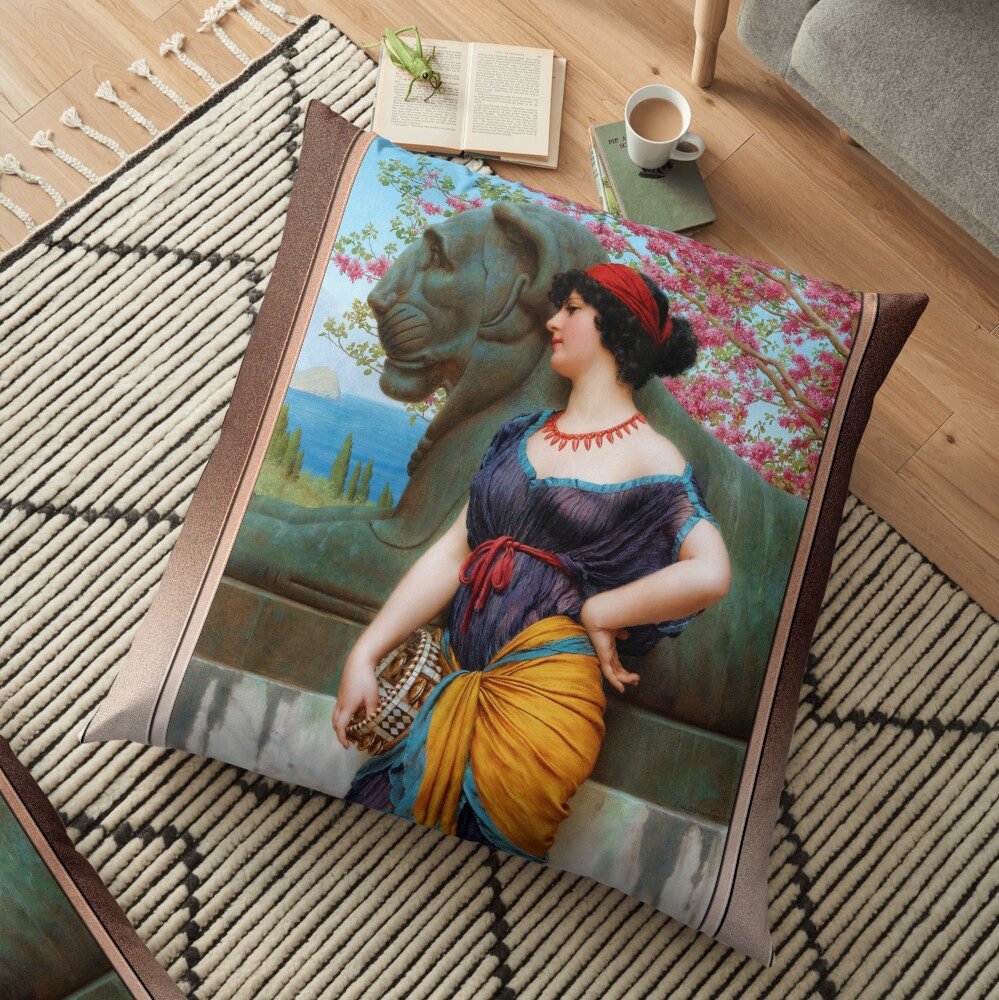
The painting features a woman poised in the shadows of a grove within the ruins of a temple dedicated to Isis, the ancient Egyptian goddess associated with fertility, magic, and motherhood. The backdrop of the temple ruins suggests the faded grandeur of antiquity, contrasting with the vibrant and alive portrayal of the woman. This juxtaposition between the lifeless stones of the temple and the youthful energy of the female figure is a testament to Godward’s ability to capture the passage of time while simultaneously celebrating beauty and vitality.
Indholdsfortegnelse
Emnet: The Woman in the Grove
The central subject of Godward’s piece is a young woman draped in flowing classical attire, reminiscent of the Greco-Roman style. Her rich, layered robes of indigo and yellow silk cascade down her figure with an intricate sense of movement. The contrast between the dark purple of the gown and the bright golden hue of the sash offers a rich, luxurious color palette that highlights the sensuality of the fabric as it clings to the woman’s curves. The light catches the delicate folds of her clothing, which seem to shimmer, as though alive with movement. Hendes holdning, elegant yet relaxed, reflects the calm nature of the classical world that Godward is known for capturing in his works.
The woman’s face, turned slightly toward the viewer, reveals a serene expression. Her features are finely sculpted, emphasizing the idealized beauty of women that was characteristic of Godward’s style. The small details such as her jewelry, a simple, yet elegant necklace, add to the sense of wealth and refinement. Her dark hair, pulled back and adorned with a red ribbon, complements the surrounding landscape and further enforces the sense of timeless grace. The woman appears absorbed in her surroundings, her gaze cast slightly down as if contemplating the ancient temple behind her, or perhaps reflecting on the mysteries of the past.
I hendes hænder, she holds a tambourine, which further connects her to the ritualistic and ceremonial life of the ancient world. This instrument, often associated with divine and sacred practices, hints at the religious or ritualistic theme of the painting, aligning with the temple’s association with Isis. The tambourine may also symbolize a connection to music and dance, which were intrinsic to the worship practices in ancient temples.
The Temple and The Setting
The painting’s background is dominated by the crumbling remnants of a classical temple, half-obscured by lush foliage. This juxtaposition between the temple ruins and the living woman symbolizes the enduring spirit of beauty amid the passing of time. The ruins, which likely once formed part of a grand structure dedicated to Isis, appear weathered and aged, with portions of the stonework barely visible through the verdant overgrowth. This setting evokes the passage of centuries, with nature slowly overtaking human creations, but it also serves as a reminder of the power and grandeur of the ancient world.
Flanking the temple ruins are flowering trees, their pink blossoms in full bloom, creating a stark contrast to the ancient stone. The lush, almost dreamlike vegetation hints at a warm, Mediterranean climate, further connecting the work to the romanticized vision of antiquity. The flowers introduce a note of vitality, which not only enhances the visual beauty of the piece but also suggests the cyclical nature of life, with the blooming trees offering a sense of renewal in contrast to the decay of the temple. Lyset, soft blues and greens of the distant landscape hint at the calm, peaceful existence of the classical world, a world where nature and humanity lived in harmony.
Materialer og teknik
Godward’s technique is characterized by meticulous attention to detail, as evidenced in every brushstroke of the fabric, the woman’s skin, and the architecture. The use of oil paints gives the piece its depth and richness, allowing Godward to play with texture and light to create an almost photographic realism. The smooth finish of the woman’s skin contrasts with the rough texture of the stone, while the translucent quality of her clothing enhances the softness of her form. Godward’s handling of light in the composition is another striking feature; the sunlight filtering through the trees highlights the contours of the woman’s face and body, while also casting soft shadows that create a sense of depth and realism.
The Mood and Themes
The overall mood of the painting is one of serenity and tranquility. The woman’s calm demeanor and poised stance convey a sense of peace, as though she is at one with the ancient world surrounding her. This peacefulness is further emphasized by the gentle presence of nature, with the flowering trees and soft landscape inviting contemplation and reflection. Farverne, primarily rich purples, guld, and greens, create a harmonious balance that evokes a sense of timeless beauty and quietude.
Thematically, the painting touches on the idealization of ancient cultures, particularly those of Egypt and Rome, and the reverence for beauty that characterized the Neo-Classical movement. Godward’s ability to merge the ancient with the living, the mythological with the natural, brings forth an appreciation for the eternal aspects of culture and humanity. The temple ruins, the woman, and the natural landscape together create a narrative of past grandeur and present serenity, reminding the viewer that beauty endures beyond the physical.
In The Grove Of The Temple Of Isis is a remastered digital art old masters reproduction of a public domain image that is available as metal, akryl og lærredstryk online.
Denne digitale kunstskabelse, som med alt det kunstværk, der kan findes på Xzendor7-webstedet, er det tilgængeligt for køb online i en række materialeformater, herunder lærredstryk, akryltryk, metaltryk, trætryk, indrammede tryk, plakater, og som rullede lærred udskriver i forskellige størrelser fra 12 tommer til 72 tommer afhængigt af størrelsen på det faktiske kunstværk og den print-on-demand-butik, du vælger at købe kunsten fra.
Kunstværket er også tilgængeligt på en bred vifte af mænds og kvinders beklædning, krus, totes, tørklæder, notesbøger og journaler og mange boligindretningsprodukter.
Kunstner Bio
Info nedenfor fra Wikipedia.org
John William Godward var den ældste af fem børn, og blev opkaldt efter hans far John og bedstefar William.
Han udstillede på Det Kongelige Akademi fra 1887. Da han flyttede til Italien med en af sine modeller i 1912, hans familie afbrød al kontakt med ham og klippede endda hans billede fra familiebilleder. Godward vendte tilbage til England i 1921, døde i 1922, og er begravet på Brompton Cemetery, Vest London.
Et af hans mest kendte malerier er Dolce far Niente (1904), som blev købt til samlingen af Andrew Lloyd Webber i 1995. Som i tilfældet med flere andre malerier, Godward malede mere end én version; I dette tilfælde, en tidligere (og mindre kendt) 1897 version med en yderligere 1906 version.
Han begik selvmord i en alder af 61 og siges at have skrevet i sit selvmordsbrev, at “verden er ikke stor nok til [begge] mig selv og en Picasso”.
Hans fremmedgjorte familie, som havde afvist, at han blev kunstner, skammede sig over sit selvmord og brændte hans papirer. Kun et fotografi af Godward vides at overleve.
Godward var en victoriansk nyklassicist, og derfor, i teorien, en tilhænger af Frederic Leighton. Imidlertid, han er mere stilistisk allieret med Sir Lawrence Alma-Tadema, med hvem han delte en forkærlighed for gengivelsen af klassisk arkitektur – i særdeleshed, statiske landskabstræk konstrueret af marmor.
Langt de fleste af Godwards eksisterende billeder viser kvinder i klassisk påklædning poseret mod landskabstræk; selvom der er nogle semi-nøgne og helt nøgne figurer inkluderet i hans oeuvre, et bemærkelsesværdigt eksempel “I Tepidarium c1913”.
En titel deles med et kontroversielt Alma-Tadema-maleri af samme emne, som findes i “Lady Lever kunstgalleri”. Titlerne afspejler Godwards inspirationskilde; som var klassisk civilisation, mest bemærkelsesværdigt det fra det gamle Rom; et emne, der kunstnerisk binder Godward tæt til Alma-Tadema.
I betragtning af at klassisk stipendium var mere udbredt blandt det potentielle publikum for hans malerier i hans levetid end i dag, omhyggelig undersøgelse af detaljer var vigtig for at opnå en position som kunstner i denne genre.
Alma-Tadema var både arkæolog og maler, som besøgte historiske steder og samlede artefakter, han senere brugte i sine malerier: Godward, også, studerede detaljer som arkitektur og kjole, for at sikre, at hans værker bar ægthedens præg.
Ud over, Godward gengav omhyggeligt og omhyggeligt andre vigtige træk i sine malerier, dyreskind, hvoraf malerierne “Middagshvile c1910” og “A Cool Retreat c1910” indeholder eksempler på en sådan gengivelse samt vilde blomster “Nerissa c1906” og “Sommerblomster c1903”.
Forekomsten af smukke kvinder i studerede positurer på så mange af Godwards lærreder får mange nybegyndere til hans værker til fejlagtigt at kategorisere ham som værende prærafaelit., Især da hans palette ofte er livligt farverig. Valget af emne (oldtidens civilisation versus, for eksempel, Arthuriansk legende) er mere korrekt den victorianske neo-klassicist.
Til fælles med talrige malere, der er samtidige med ham, Godward var en 'High Victorian Dreamer', producere billeder af en idealiseret og romantiseret verden, der, i tilfældet med både Godward og Alma-Tadema, kom til at blive kritiseret som et verdensbillede af victorianere i togaer.
Godward “etablerede hurtigt et ry for sine malerier af unge kvinder i klassiske omgivelser og hans evne til med følsomhed og teknisk beherskelse at formidle følelsen af kontrasterende teksturer af kød, marmor, pels og stoffer.
Godwards forkærlighed for at skabe kunstværker i den klassiske periode kom sandsynligvis fra den periode, hvor han blev født; da det var den sidste klassiske genoplivning i fuld skala i vestlige malerier, der blomstrede i England fra 1860'erne op til 1890'erne.