

Dans le bosquet du temple d'Isis
“Dans le bosquet du temple d'Isis” par l'artiste britannique John William Godward (1861 – 1922) captures an idyllic and timeless moment that transports the viewer to an ancient, monde classique. Known for his expertise in depicting the serene beauty of women, classical architecture, and lush landscapes, Godward presents an image filled with grace and elegance. Godward was a prominent figure in the Neo-Classical movement, a style which focused on the revival of ancient Greek and Roman ideals, yet with an air of romanticism. Ce travail particulier, executed at the peak of his career in 1915, continues to reflect his admiration for the classical world while showcasing his mastery over texture, Couleur, et forme.
The painting features a woman poised in the shadows of a grove within the ruins of a temple dedicated to Isis, the ancient Egyptian goddess associated with fertility, magic, and motherhood. The backdrop of the temple ruins suggests the faded grandeur of antiquity, contrasting with the vibrant and alive portrayal of the woman. This juxtaposition between the lifeless stones of the temple and the youthful energy of the female figure is a testament to Godward’s ability to capture the passage of time while simultaneously celebrating beauty and vitality.
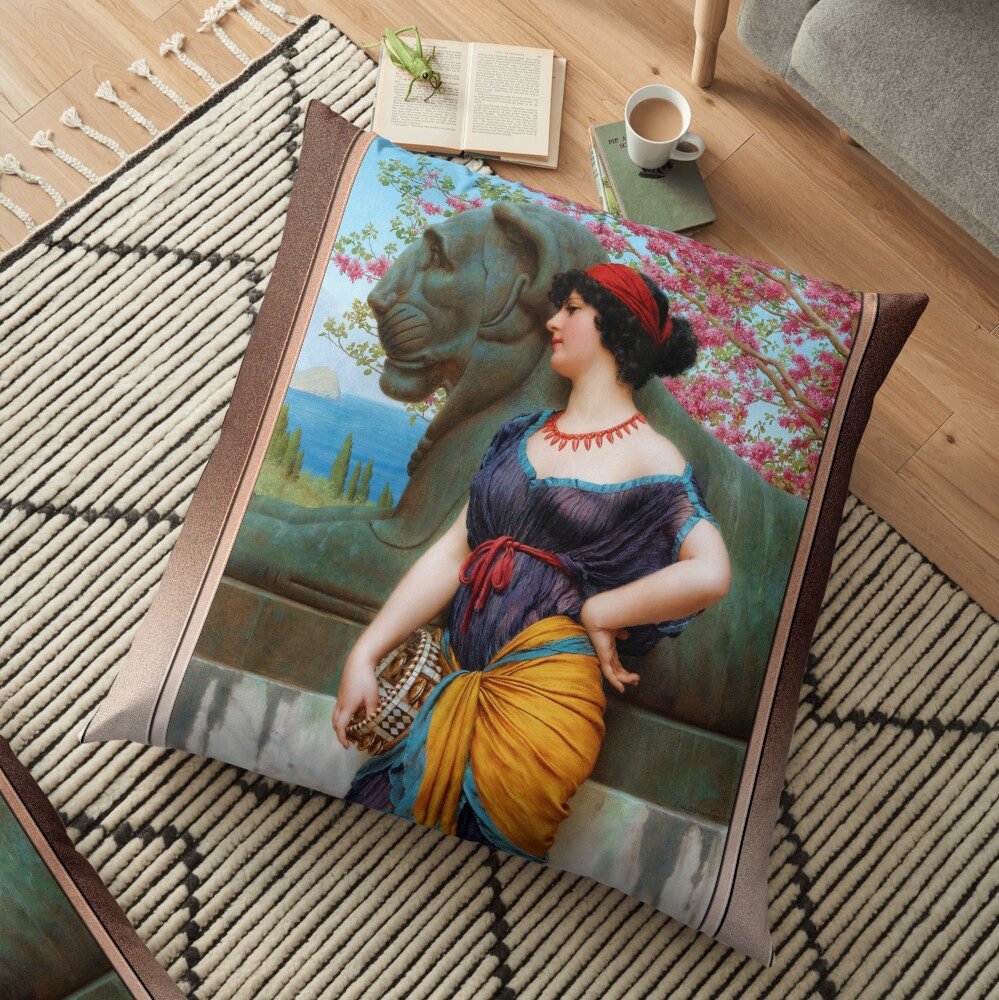
Table des matières
Le sujet: The Woman in the Grove
The central subject of Godward’s piece is a young woman draped in flowing classical attire, reminiscent of the Greco-Roman style. Her rich, layered robes of indigo and yellow silk cascade down her figure with an intricate sense of movement. The contrast between the dark purple of the gown and the bright golden hue of the sash offers a rich, luxurious color palette that highlights the sensuality of the fabric as it clings to the woman’s curves. The light catches the delicate folds of her clothing, which seem to shimmer, as though alive with movement. Sa posture, elegant yet relaxed, reflects the calm nature of the classical world that Godward is known for capturing in his works.
The woman’s face, turned slightly toward the viewer, reveals a serene expression. Her features are finely sculpted, emphasizing the idealized beauty of women that was characteristic of Godward’s style. The small details such as her jewelry, a simple, yet elegant necklace, add to the sense of wealth and refinement. Ses cheveux foncés, pulled back and adorned with a red ribbon, complements the surrounding landscape and further enforces the sense of timeless grace. The woman appears absorbed in her surroundings, her gaze cast slightly down as if contemplating the ancient temple behind her, or perhaps reflecting on the mysteries of the past.
Entre ses mains, she holds a tambourine, which further connects her to the ritualistic and ceremonial life of the ancient world. This instrument, often associated with divine and sacred practices, hints at the religious or ritualistic theme of the painting, aligning with the temple’s association with Isis. The tambourine may also symbolize a connection to music and dance, which were intrinsic to the worship practices in ancient temples.
The Temple and The Setting
The painting’s background is dominated by the crumbling remnants of a classical temple, half-obscured by lush foliage. This juxtaposition between the temple ruins and the living woman symbolizes the enduring spirit of beauty amid the passing of time. Les ruines, which likely once formed part of a grand structure dedicated to Isis, appear weathered and aged, with portions of the stonework barely visible through the verdant overgrowth. This setting evokes the passage of centuries, with nature slowly overtaking human creations, but it also serves as a reminder of the power and grandeur of the ancient world.
Flanking the temple ruins are flowering trees, their pink blossoms in full bloom, creating a stark contrast to the ancient stone. Le luxuriant, almost dreamlike vegetation hints at a warm, Mediterranean climate, further connecting the work to the romanticized vision of antiquity. The flowers introduce a note of vitality, which not only enhances the visual beauty of the piece but also suggests the cyclical nature of life, with the blooming trees offering a sense of renewal in contrast to the decay of the temple. La lumière, soft blues and greens of the distant landscape hint at the calm, peaceful existence of the classical world, a world where nature and humanity lived in harmony.
Matériaux et techniques
Godward’s technique is characterized by meticulous attention to detail, as evidenced in every brushstroke of the fabric, the woman’s skin, and the architecture. The use of oil paints gives the piece its depth and richness, allowing Godward to play with texture and light to create an almost photographic realism. The smooth finish of the woman’s skin contrasts with the rough texture of the stone, while the translucent quality of her clothing enhances the softness of her form. Godward’s handling of light in the composition is another striking feature; the sunlight filtering through the trees highlights the contours of the woman’s face and body, while also casting soft shadows that create a sense of depth and realism.
The Mood and Themes
The overall mood of the painting is one of serenity and tranquility. The woman’s calm demeanor and poised stance convey a sense of peace, as though she is at one with the ancient world surrounding her. This peacefulness is further emphasized by the gentle presence of nature, with the flowering trees and soft landscape inviting contemplation and reflection. Les couleurs, primarily rich purples, or, and greens, create a harmonious balance that evokes a sense of timeless beauty and quietude.
Thématiquement, the painting touches on the idealization of ancient cultures, particularly those of Egypt and Rome, and the reverence for beauty that characterized the Neo-Classical movement. Godward’s ability to merge the ancient with the living, the mythological with the natural, brings forth an appreciation for the eternal aspects of culture and humanity. The temple ruins, the woman, and the natural landscape together create a narrative of past grandeur and present serenity, reminding the viewer that beauty endures beyond the physical.
In The Grove Of The Temple Of Isis is a remastered digital art old masters reproduction of a public domain image that is available as metal, acrylique et impressions sur toile en ligne.
Cette création d'art numérique, comme toutes les œuvres d'art disponibles sur le site Web Xzendor7, elles sont disponibles à l'achat en ligne dans une variété de formats de matériaux, y compris des impressions sur toile., impressions acryliques, impressions métalliques, gravures sur bois, impressions encadrées, affiches, et sous forme d'impressions sur toile roulées dans une variété de tailles de 12 pouces à 72 pouces en fonction de la taille de l'œuvre d'art réelle et de la boutique d'impression à la demande auprès de laquelle vous choisissez d'acheter l'art.
L’œuvre d’art est également disponible sur une large gamme de vêtements pour hommes et femmes., tasses, fourre-tout, écharpes, cahiers et journaux et de nombreux produits de décoration intérieure.
Biographie de l'artiste
Info ci-dessous de Wikipedia.org
John William Godward était l'aîné de cinq enfants, et a été nommé d'après son père John et son grand-père William.
Il expose à la Royal Academy de 1887. Lorsqu'il a déménagé en Italie avec l'un de ses modèles en 1912, sa famille a rompu tout contact avec lui et a même coupé son image des photos de famille. Godward retourna en Angleterre en 1921, mort en 1922, et est enterré au cimetière de Brompton, Londres Ouest.
L'un de ses tableaux les plus connus est Dolce far Niente (1904), qui a été acheté pour la collection d'Andrew Lloyd Webber en 1995. Comme dans le cas de plusieurs autres peintures, Godward a peint plus d'une version; dans ce cas, un plus tôt (et moins connu) 1897 version avec un autre 1906 version.
Il s'est suicidé à l'âge de 61 et aurait écrit dans sa note de suicide que “le monde n'est pas assez grand pour [tous les deux] moi et un Picasso”.
Sa famille éloignée, qui avait désapprouvé qu'il devienne artiste, eu honte de son suicide et brûlé ses papiers. Une seule photographie de Godward est connue pour survivre.
Godward était un néo-classique victorien, et donc, en théorie, un disciple de Frederic Leighton. pourtant, il est plus étroitement lié stylistiquement à Sir Lawrence Alma-Tadema, avec qui il partageait un penchant pour le rendu de l'architecture classique - en particulier, éléments paysagers statiques construits en marbre.
La grande majorité des images existantes de Godward présentent des femmes en tenue classique posées contre des éléments du paysage; bien qu'il y ait des figures semi-nues et entièrement nues incluses dans son œuvre, un exemple notable étant “Dans le Tepidarium c1913”.
Un titre partagé avec une peinture controversée d'Alma-Tadema du même sujet qui réside dans le “Galerie d'art Lady Lever”. Les titres reflètent la source d'inspiration de Godward; qui était la civilisation classique, notamment celui de la Rome antique; un sujet liant Godward étroitement à Alma-Tadema artistiquement.
Étant donné que l'érudition classique était plus répandue parmi le public potentiel pour ses peintures de son vivant qu'aujourd'hui, une recherche méticuleuse des détails était importante pour atteindre une position d'artiste dans ce genre.
Alma-Tadema était archéologue et peintre, qui a visité des sites historiques et collecté des objets qu'il a ensuite utilisés dans ses peintures: Vers Dieu, trop, étudié des détails tels que l'architecture et la tenue vestimentaire, afin de garantir que ses œuvres portent le sceau de l'authenticité.
en plus, Godward a rendu minutieusement et méticuleusement d'autres éléments importants de ses peintures., peaux d'animaux dont les peintures “Repos de midi c1910” et “Une retraite fraîche c1910” contient des exemples d'une telle interprétation ainsi que des fleurs sauvages “Nerissa c1906” et “Fleurs d'été c1903”.
L’apparition de belles femmes dans des poses étudiées dans de nombreuses toiles de Godward amène de nombreux nouveaux venus dans ses œuvres à le classer à tort comme étant préraphaélite., d'autant plus que sa palette est souvent très colorée. Le choix du sujet (civilisation ancienne contre, par example, Légende arthurienne) est plus proprement celui du néo-classique victorien.
En commun avec de nombreux peintres contemporains de lui, Godward était un « grand rêveur victorien », produire des images d'un monde idéalisé et romancé qui, dans le cas de Godward et d'Alma-Tadema, est venu à être critiqué comme une vision du monde des Victoriens en toge.
Vers Dieu “rapidement établi une réputation pour ses peintures de jeunes femmes dans un cadre classique et sa capacité à transmettre avec sensibilité et maîtrise technique la sensation de textures contrastées de chair, marbre, fourrure et tissus.
Le penchant de Godward pour la création d’œuvres d’art se déroulant dans la période classique venait probablement de la période à laquelle il est né.; car ce fut la dernière renaissance classique à grande échelle dans les peintures occidentales, qui a prospéré en Angleterre des années 1860 aux années 1890.