

In The Grove Of The Temple Of Isis
“In The Grove Of The Temple Of Isis” by the British artist John William Godward (1861 – 1922) captures an idyllic and timeless moment that transports the viewer to an ancient, mondo classico. Known for his expertise in depicting the serene beauty of women, classical architecture, and lush landscapes, Godward presents an image filled with grace and elegance. Godward was a prominent figure in the Neo-Classical movement, a style which focused on the revival of ancient Greek and Roman ideals, yet with an air of romanticism. This particular work, executed at the peak of his career in 1915, continues to reflect his admiration for the classical world while showcasing his mastery over texture, colore, e forma.
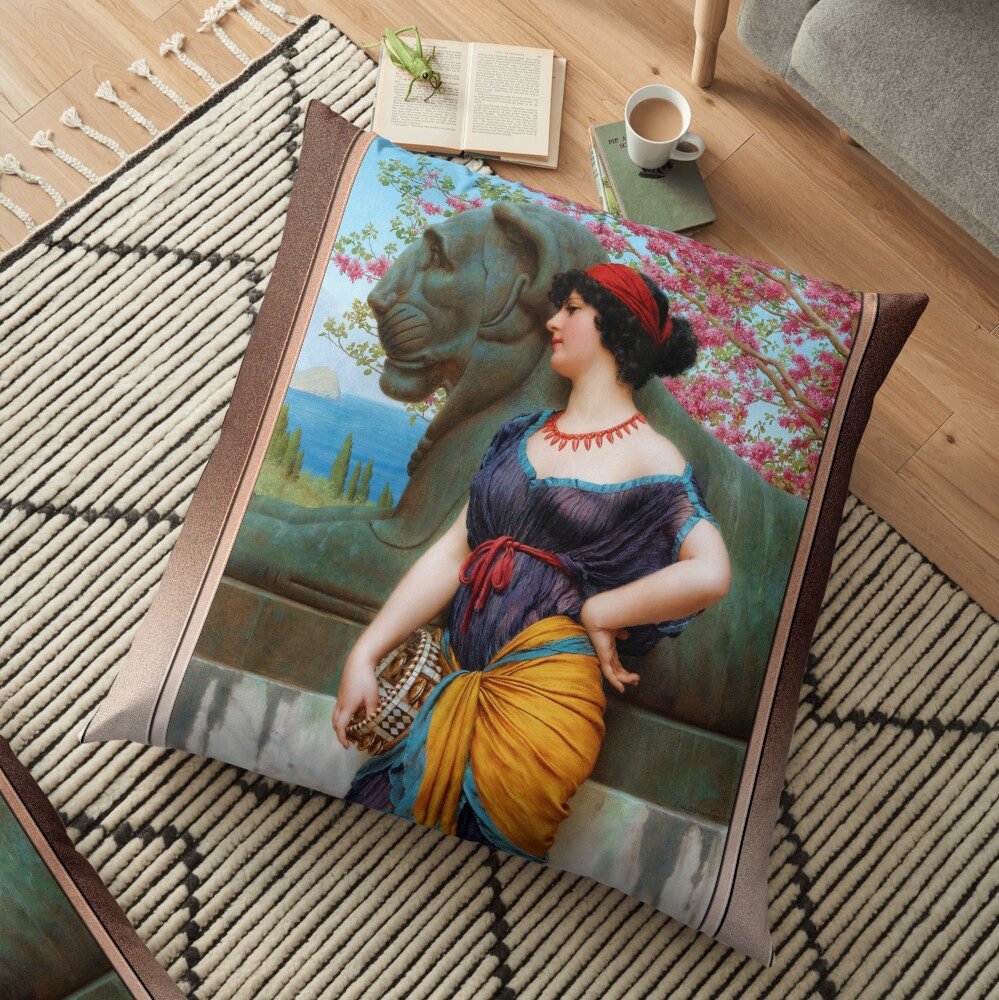
The painting features a woman poised in the shadows of a grove within the ruins of a temple dedicated to Isis, the ancient Egyptian goddess associated with fertility, magia, and motherhood. The backdrop of the temple ruins suggests the faded grandeur of antiquity, contrasting with the vibrant and alive portrayal of the woman. This juxtaposition between the lifeless stones of the temple and the youthful energy of the female figure is a testament to Godward’s ability to capture the passage of time while simultaneously celebrating beauty and vitality.
Sommario
Il soggetto: The Woman in the Grove
The central subject of Godward’s piece is a young woman draped in flowing classical attire, reminiscent of the Greco-Roman style. Her rich, layered robes of indigo and yellow silk cascade down her figure with an intricate sense of movement. The contrast between the dark purple of the gown and the bright golden hue of the sash offers a rich, luxurious color palette that highlights the sensuality of the fabric as it clings to the woman’s curves. The light catches the delicate folds of her clothing, which seem to shimmer, as though alive with movement. La sua postura, elegant yet relaxed, reflects the calm nature of the classical world that Godward is known for capturing in his works.
The woman’s face, turned slightly toward the viewer, reveals a serene expression. I suoi lineamenti sono finemente scolpiti, emphasizing the idealized beauty of women that was characteristic of Godward’s style. The small details such as her jewelry, un semplice, yet elegant necklace, add to the sense of wealth and refinement. I suoi capelli scuri, pulled back and adorned with a red ribbon, complements the surrounding landscape and further enforces the sense of timeless grace. The woman appears absorbed in her surroundings, her gaze cast slightly down as if contemplating the ancient temple behind her, or perhaps reflecting on the mysteries of the past.
In her hands, she holds a tambourine, which further connects her to the ritualistic and ceremonial life of the ancient world. This instrument, often associated with divine and sacred practices, hints at the religious or ritualistic theme of the painting, aligning with the temple’s association with Isis. The tambourine may also symbolize a connection to music and dance, which were intrinsic to the worship practices in ancient temples.
The Temple and The Setting
The painting’s background is dominated by the crumbling remnants of a classical temple, half-obscured by lush foliage. This juxtaposition between the temple ruins and the living woman symbolizes the enduring spirit of beauty amid the passing of time. Le rovine, which likely once formed part of a grand structure dedicated to Isis, appear weathered and aged, with portions of the stonework barely visible through the verdant overgrowth. This setting evokes the passage of centuries, with nature slowly overtaking human creations, but it also serves as a reminder of the power and grandeur of the ancient world.
Flanking the temple ruins are flowering trees, their pink blossoms in full bloom, creating a stark contrast to the ancient stone. Il lussureggiante, almost dreamlike vegetation hints at a warm, Mediterranean climate, further connecting the work to the romanticized vision of antiquity. The flowers introduce a note of vitality, which not only enhances the visual beauty of the piece but also suggests the cyclical nature of life, with the blooming trees offering a sense of renewal in contrast to the decay of the temple. La luce, soft blues and greens of the distant landscape hint at the calm, peaceful existence of the classical world, a world where nature and humanity lived in harmony.
Materiali e Tecnica
Godward’s technique is characterized by meticulous attention to detail, as evidenced in every brushstroke of the fabric, the woman’s skin, and the architecture. The use of oil paints gives the piece its depth and richness, allowing Godward to play with texture and light to create an almost photographic realism. The smooth finish of the woman’s skin contrasts with the rough texture of the stone, while the translucent quality of her clothing enhances the softness of her form. Godward’s handling of light in the composition is another striking feature; the sunlight filtering through the trees highlights the contours of the woman’s face and body, while also casting soft shadows that create a sense of depth and realism.
L'umore e i temi
The overall mood of the painting is one of serenity and tranquility. The woman’s calm demeanor and poised stance convey a sense of peace, as though she is at one with the ancient world surrounding her. This peacefulness is further emphasized by the gentle presence of nature, with the flowering trees and soft landscape inviting contemplation and reflection. I colori, primarily rich purples, ori, e verdi, create a harmonious balance that evokes a sense of timeless beauty and quietude.
Thematically, the painting touches on the idealization of ancient cultures, particularly those of Egypt and Rome, and the reverence for beauty that characterized the Neo-Classical movement. Godward’s ability to merge the ancient with the living, the mythological with the natural, brings forth an appreciation for the eternal aspects of culture and humanity. The temple ruins, the woman, and the natural landscape together create a narrative of past grandeur and present serenity, reminding the viewer that beauty endures beyond the physical.
In The Grove Of The Temple Of Isis is a remastered digital art old masters reproduction of a public domain image that is available as metal, acrilico e stampe su tela in linea.
Questa creazione di arte digitale, come tutte le opere d'arte che si possono trovare sul sito Web di Xzendor7 è disponibile per l'acquisto online in una varietà di formati di materiali, comprese le stampe su tela, stampe acriliche, stampe in metallo, stampe su legno, stampe incorniciate, manifesti, e come stampe su tela arrotolata in una varietà di formati da 12 pollici a 72 pollici a seconda delle dimensioni dell'opera d'arte effettiva e del negozio di stampa su richiesta da cui scegli di acquistare l'arte.
L'opera d'arte è disponibile anche su un'ampia gamma di abbigliamento da uomo e da donna, tazze, borse, sciarpe, quaderni e diari e tanti prodotti per l'arredamento della casa.
Biografia dell'artista
Informazioni sotto da Wikipedia.org
John William Godward era il maggiore di cinque figli, e prende il nome da suo padre John e dal nonno William.
Ha esposto alla Royal Academy da 1887. Quando si è trasferito in Italia con uno dei suoi modelli 1912, la sua famiglia ha interrotto ogni contatto con lui e ha persino tagliato la sua immagine dalle foto di famiglia. Godward tornò in Inghilterra nel 1921, morto nel 1922, ed è sepolto nel cimitero di Brompton, Londra ovest.
Uno dei suoi dipinti più noti è Dolce far niente (1904), che è stato acquistato per la collezione di Andrew Lloyd Webber in 1995. Come nel caso di molti altri dipinti, Godward ha dipinto più di una versione; in questo caso, un precedente (e meno noto) 1897 versione con un ulteriore 1906 versione.
Si è suicidato all'età di 61 e si dice che abbia scritto nella sua nota di suicidio che “il mondo non è abbastanza grande per [Entrambi] io e un Picasso”.
La sua famiglia separata, che aveva disapprovato che diventasse un artista, si vergognarono del suo suicidio e bruciarono le sue carte. Si sa che solo una fotografia di Godward è sopravvissuta.
Godward era un neoclassico vittoriano, e quindi, in teoria, un seguace di Frederic Leighton. tuttavia, è più strettamente legato stilisticamente a Sir Lawrence Alma-Tadema, con il quale ha condiviso un debole per la resa dell'architettura classica – in particolare, elementi statici del paesaggio costruiti in marmo.
La stragrande maggioranza delle immagini esistenti di Godward mostra donne in abiti classici in posa contro le caratteristiche del paesaggio; sebbene ci siano alcune figure seminude e completamente nude incluse nella sua opera, un esempio notevole essendo “Nel Tepidarium c1913”.
Un titolo condiviso con un controverso dipinto di Alma-Tadema dello stesso soggetto che risiede nel “Galleria d'arte Lady Lever”. I titoli riflettono la fonte di ispirazione di Godward; che era la civiltà classica, in particolare quello dell'antica Roma; un soggetto che lega strettamente Godward ad Alma-Tadema artisticamente.
Dato che la borsa di studio classica era più diffusa tra il potenziale pubblico dei suoi dipinti durante la sua vita che ai giorni nostri, la meticolosa ricerca dei dettagli era importante per raggiungere una posizione di artista in questo genere.
Alma-Tadema era un archeologo oltre che un pittore, che ha frequentato siti storici e raccolto manufatti che ha poi utilizzato nei suoi dipinti: verso Dio, pure, ha studiato dettagli come l'architettura e l'abbigliamento, per garantire che le sue opere portassero il timbro di autenticità.
Inoltre, Godward ha reso scrupolosamente e meticolosamente altre caratteristiche importanti nei suoi dipinti, pelli di animali di cui le vernici “Mezzogiorno di riposo c1910” e “Un fantastico ritiro c1910” contiene esempi di tali consegne così come fiori di campo “Nerissa c1906” e “Fiori estivi c1903”.
L'apparizione di belle donne in pose studiate in così tante tele di Godward induce molti nuovi arrivati alle sue opere a classificarlo erroneamente come preraffaellita, soprattutto perché la sua tavolozza è spesso vivacemente colorata. La scelta del soggetto (civiltà antica contro, Per esempio, Leggenda arturiana) è più propriamente quella del neoclassicista vittoriano.
In comune con numerosi pittori a lui contemporanei, Godward era un "alto sognatore vittoriano", producendo immagini di un mondo idealizzato e romanzato che, nel caso sia di Godward che di Alma-Tadema, finì per essere criticato come una visione del mondo dei vittoriani in toga.
verso Dio “rapidamente stabilito una reputazione per i suoi dipinti di giovani donne in un ambiente classico e la sua capacità di trasmettere con sensibilità e maestria tecnica la sensazione di trame contrastanti di carne, marmo, pellicce e tessuti.
La propensione di Godward per la creazione di opere d'arte ambientate nel periodo classico probabilmente proveniva dal periodo in cui era nato; poiché è stato l'ultimo revival classico su vasta scala nei dipinti occidentali, che fiorì in Inghilterra dal 1860 fino al 1890.