

Vue intérieure de la basilique Saint-Pierre c1750
La vue intérieure de la basilique Saint-Pierre est un magnifique tableau créé en 1750 du célèbre artiste italien Giovanni Paolo Pannini (1691 – 1765). Cette œuvre magistrale illustre l’extraordinaire capacité de Pannini à capturer la grandeur de architecture et l'esprit de l'antiquité classique.
À travers sa vision artistique, Pannini offre une vue intérieure de l'une des structures architecturales les plus emblématiques du monde; St. Basilique Saint-Pierre au Vatican. La composition illustre non seulement les merveilles architecturales de l'espace, mais plonge également le spectateur dans un récit détaillé de la vie quotidienne dans la grande cathédrale au XVIIIe siècle..
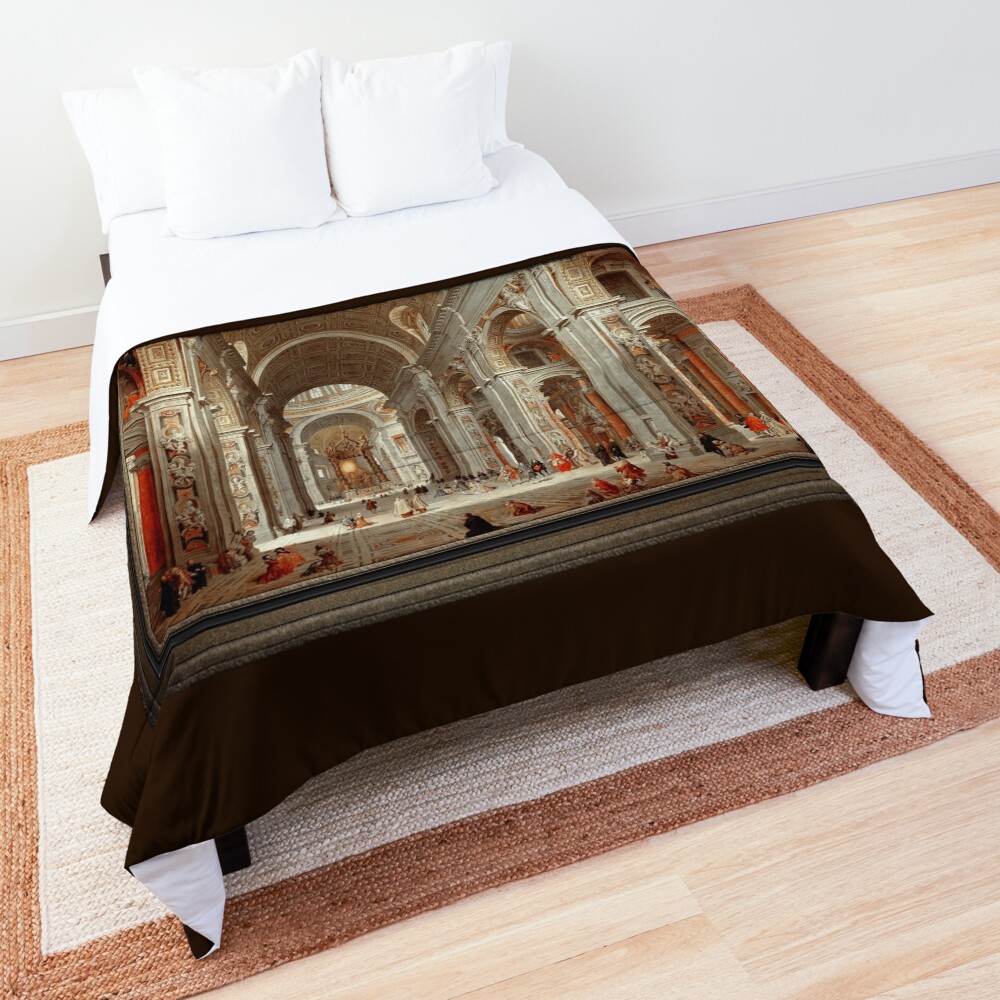
Table des matières
Sujet principal et composition
The painting’s primary subject is the interior of St. Basilique de Pierre, a symbol of both religious devotion and architectural excellence. Pannini presents a sweeping view of the basilica’s vast nave, with towering columns, intricate arches, and expansive ceilings, all rendered with great precision and grandeur.
The vaults and domes rise majestically toward the heavens, drawing the viewer’s gaze upward toward the light that seems to pour into the structure from above. Le grand, circular windows and the dome of the church create a contrast between the serene, soft illumination from the windows and the richly detailed interiors.
The layout of the painting mirrors the layout of the basilica itself, offering a perspective that guides the viewer’s eye from the foreground, filled with figures, toward the distant altar, which is adorned with golden rays of light. The vastness of the space is emphasized by the presence of numerous small figures scattered throughout the scene, some in worship, others in casual conversation, and still more engaged in quieter, reflective activities. This addition of human figures brings life to the artwork, making the monumental space feel more approachable, yet still awe-inspiring.
Détails architecturaux
The intricacy and magnificence of St. Peter’s Basilica are captured through Pannini’s detailed renderings of the basilica’s structural elements. The soaring columns of the nave are painted with sharp precision, giving the illusion of depth and grandeur. The artist incorporates exquisite details of the marble textures, particularly in the columns’ rich reddish hues and creamy veins, contributing to the sense of luxury and permanence that pervades the building. En arrière-plan, elaborate arches and coffered ceilings stretch endlessly, further emphasizing the vast scale of the space.
One of the most striking features in the painting is the dome designed by Michelangelo. Pannini captures the essence of the dome’s curvature and its sculptural form, which seems to soar beyond the limits of the canvas, filling the viewer with a sense of awe. The use of light and shadow in the painting gives a tangible texture to the surfaces, lending a three-dimensional quality to the architecture. The colors are rich yet subdued, avec des tons terreux de pierre et de marbre contrastant magnifiquement avec les accents dorés de l'autel et des icônes religieuses.
Human Figures and Interaction
Un aspect important du travail de Pannini est l’inclusion de figures humaines., qui ajoutent une impression d'échelle et d'activité à l'espace autrement statique. Ces individus sont représentés dans diverses poses, certains agenouillés en prière., d'autres discutaient ou marchaient dans la grande nef. L'attention de Pannini aux gestes et aux vêtements variés de ces personnages enrichit encore le récit.. Les hommes et les femmes élégamment habillés au premier plan offrent un aperçu de la vie sociale du XVIIIe siècle., mettant en valeur les vêtements et les coutumes de l'époque.
Les interactions entre les personnages de la scène suggèrent une coexistence pacifique au sein de l'espace sacré. Some figures seem to pause in contemplation before the altar, while others, perhaps tourists or pilgrims, look around with admiration. This human presence, though small in comparison to the vast architecture, serves to enhance the grandeur of the basilica. It also invites the viewer to reflect on the spiritual and cultural significance of the church as a gathering place for both the faithful and the curious.
Humeur et atmosphère
The mood of the painting is one of reverence and awe. The grandeur of the basilica’s interior creates a sense of tranquility and solemnity, while the human figures add a feeling of warmth and human presence. The use of light and shadow contributes to the overall atmosphere, with rays of light streaming through the large windows and casting a gentle glow on the figures and columns. The warm hues of the painting, combined with the serene figures in repose, create a peaceful, almost meditative environment.
There is also a sense of timelessness in the scene. The figures in the painting, while clearly of the 18th century, seem to be engaged in a kind of eternal ritual within the hallowed walls of the basilica. L'architecture, although representing the pinnacle of 17th-century Baroque design, also seems to transcend time, suggesting that the church has stood as a witness to countless generations of worshippers. The mood is contemplative and reverent, encouraging the viewer to reflect not only on the grandeur of the basilica but also on its significance as a place of religious and historical importance.
Conclusion
Giovanni Paolo Pannini’s “Vue intérieure de St. Basilique de Pierre” is a breathtaking portrayal of one of the most celebrated architectural marvels in the world. Through meticulous attention to architectural detail, careful rendering of light and shadow, and the inclusion of human figures, Pannini conveys the awe-inspiring scale and spiritual significance of the basilica.
The painting serves as both a historical record and a work of art that captures the essence of 18th-century religious life. The balance between grandeur and intimacy, between architecture and humanity, allows the viewer to experience St. Peter’s Basilica not just as a monumental structure, but as a living, breathing space where art, architecture, and faith converge.
Vue intérieure de St. La basilique Saint-Pierre est une reproduction d'art numérique retouchée d'une image du domaine public.
Biographie de l'artiste dérivée de Wikipedia.org
Giovanni Paolo Panini ou Giovanni Paolo Pannini était un peintre et architecte qui a travaillé à Rome et est principalement connu comme l'un des vedutisti (“voir les peintres”).
En tant que peintre, Pannini est surtout connu pour ses vues sur Rome, dans lequel il s'est particulièrement intéressé aux antiquités de la ville.
Parmi ses œuvres les plus célèbres, il y a sa vue de l'intérieur du Panthéon (au nom de Francesco Algarotti 1712 – 1764 – Un Polymath vénitien), et ses peintures vedute de galeries d'images contenant des vues de Rome.
La plupart de ses oeuvres, surtout ceux des ruines, ont une décoration fantaisiste et irréelle caractéristique des thèmes capriccio. En cela, ils ressemblent aux capricci du peintre et graveur italien Marco Ricci (1676 – 1730).
Panini a également peint des portraits, dont un du Pape Benoît XIV (né Prospero Lorenzo Lambertini 1675 – 1758 – Chef de l'Église catholique de 1740 – 1758).
À Rome, Panini s'est fait un nom en tant que décorateur de palais. Certaines de ses œuvres comprenaient la Villa Patrizi c1719 / 25, le Palazzo de Carolis c1720, et le Seminario Romano c1721 / 22).
Dans 1719, Panini a été admis à la Congrégation des Virtuoses al Panthéon. Il a enseigné à Rome à l'Accademia di San Luca et à l'Académie de France, où il aurait influencé Jean-Honoré Fragonard. Dans 1754, il a servi de prince (réalisateur) de l'Accademia di San Luca.