

Island Girl
“Island Girl” by the Peruvian artist Platzhalterbild für Alberto Vargas (1896 – 1982), created in the 1930s, presents a striking image of femininity through the portrayal of a woman in an exotic, tropical setting. As an iconic work in Vargas’s oeuvre, it exemplifies his distinctive pin-up style, which became synonymous with the golden age of American illustration. Vargas, known for his sultry depictions of women, was a key figure in the development of pin-up art during the 20th century. His work captured the essence of idealized beauty, combining elements of sensuality, Unschuld, und Reiz.
Inhaltsverzeichnis
Subjekt und Komposition
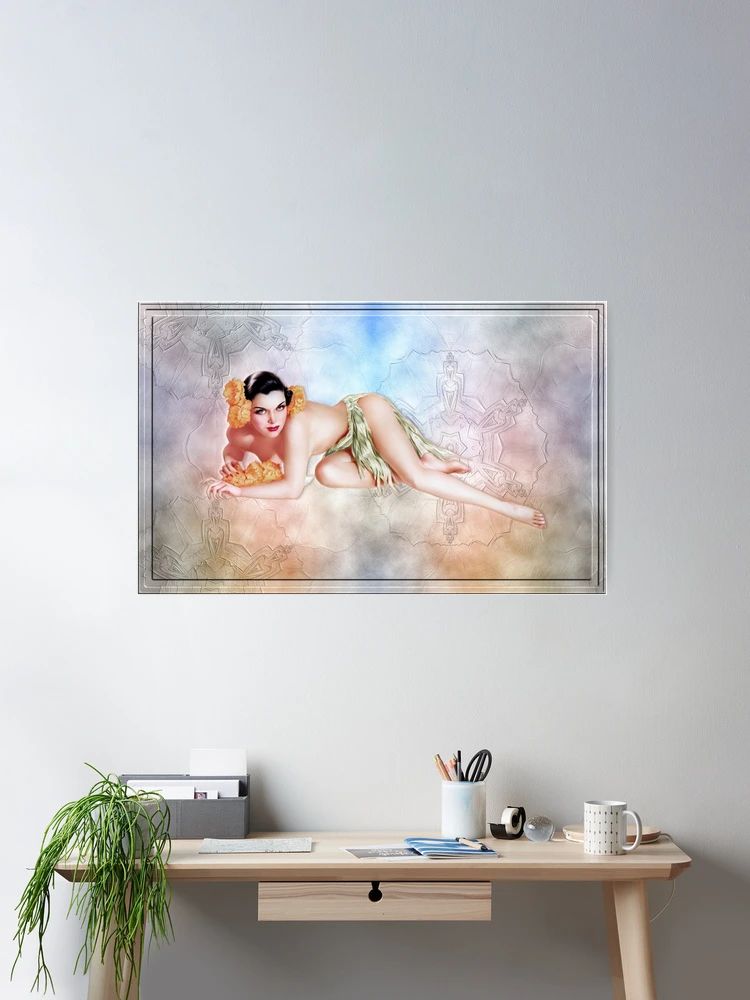
The central figure of “Island Girl” is a woman, delicately posed in a languid yet alluring manner. Ihre Pose, reclining on the ground, evokes a sense of both calm and vitality. The model’s soft, smooth skin contrasts with the exotic flora that adorns her, notably the vivid yellow hibiscus flowers that frame her hair. Ihre Haut, glowing and flawless, is an embodiment of idealized beauty, which is characteristic of Vargas’s subjects. Sie blickt den Betrachter direkt an, her eyes conveying both an invitation and a sense of mystery. The angle of her body, with one arm placed just beneath her chin and her head gently tilted to the side, suggests a natural yet staged sensuality that Vargas was known for.
In terms of attire, she wears a minimal tropical garb, consisting of a simple skirt of what appears to be palm leaves, which adds a touch of nature to the scene. The use of the natural elements emphasizes the theme of an island paradise, further enhancing the sensual appeal of the composition. The artist carefully balances the portrayal of the figure with the environmental elements, using them as mere accents to frame the subject without overshadowing her beauty.
Hintergrund und Einstellung
The background of the piece is an abstract yet atmospheric blend of pastel colors, with soft blues and pinks merging to form an almost ethereal landscape. This choice of colors invokes a sense of warmth, typical of tropical settings, while also enhancing the softness of the scene. The blurred, faded background serves to keep the focus entirely on the subject, allowing the viewer to feel as though they are in a dreamlike world where the subject and her surroundings are intimately connected.
The geometry of the background, with its mirrored and kaleidoscopic shapes, suggests a sense of otherworldliness, where the boundaries between the figure and the space seem to dissolve. This effect heightens the surreal atmosphere of the painting, making the viewer feel as though the woman is not merely a subject of a painting, but a living, breathing entity in a fantastical, secluded world.
Künstlerischer Stil und Einfluss
Alberto Vargas was heavily influenced by Art Deco, an aesthetic movement that emerged in the 1920s and flourished into the 1930s. “Island Girl” displays several hallmarks of the Art Deco style: Geometrische Muster, stylized lines, and an overall focus on elegance and glamour. The clean, sharp lines that define the model’s silhouette contrast beautifully with the softer, more fluid forms of the floral elements, highlighting Vargas’s ability to create a harmonious balance between realism and abstraction.
Vargas’s work also draws from his experience as an illustrator for magazines such as Esquire und Playboy, where he became known for creating some of the most famous pin-up illustrations of the era. The sensual yet elegant portrayal of the female form became a central theme of his work, und “Island Girl” is a quintessential example of how he merged realism with idealized beauty. The subject’s proportions, her delicate features, and the warm glow of her skin reflect the influence of the Hollywood glamour that was pervasive during the time.
The use of natural elements such as the hibiscus flowers and palm leaves further ties the painting to Vargas’s Latin American roots, infusing it with a sense of tropical exoticism. This connection to Vargas’s Peruvian heritage also lends the painting a certain authenticity, grounding it in a cultural context while allowing it to transcend geographical boundaries through its universal themes of beauty and allure.
Stimmung und Atmosphäre
Die Stimmung von “Island Girl” is one of serene yet inviting sensuality. The subject’s relaxed pose, combined with her soft, inviting expression, creates a sense of calm and intimacy. The combination of warm pastel colors in the background and the subtle floral accents imbues the scene with an aura of tropical beauty and quietude, evoking images of paradise and an idyllic escape from the mundane world. The gentle flow of the composition invites the viewer to linger on the image, absorbing the peaceful yet alluring atmosphere that Vargas masterfully created.
The overall tone of the painting is one of timeless femininity and grace. While the subject is undoubtedly depicted as a symbol of beauty and allure, there is also a sense of modesty in the way she is portrayed, reflecting Vargas’s skill in balancing sensuality with elegance. The composition evokes the idea of a mythical figure, one that belongs to a world both familiar and fantastical, where beauty reigns supreme, and nature complements the human form.
Materialien und Techniken
Vargas employed traditional painting techniques to create the lush, polished aesthetic for which he became famous. Der glatte, almost flawless quality of the model’s skin suggests meticulous brushwork, carefully layering tones to achieve a lifelike yet idealized finish. The texture of the palm leaves, the delicate flowers in her hair, and the soft blending of the background colors all point to Vargas’s attention to detail and his commitment to creating an immersive visual experience for the viewer.
The juxtaposition of solid, tangible elements, like the leaves and flowers, against the soft and flowing background creates a contrast that keeps the viewer’s eye moving throughout the composition, ensuring that the image remains dynamic yet peaceful. Vargas’s ability to use light and shadow to define the contours of the model’s body gives the work a sense of depth, making the figure appear almost three-dimensional.
Dies ist eine remasterte digitale Kunst-Reproduktion alter Meister eines gemeinfreien Bildes, das als verfügbar ist Leinwanddruck online.
Biografie des Künstlers
Info unten von Wikipedia.org
Geboren in Arequipa, Peru, er war der Sohn des bekannten peruanischen Fotografen Max T. Vargas. Alberto Vargas zog in die Vereinigten Staaten in 1916 nach dem Kunststudium in Europa, Zürich, und Genf vor dem Ersten Weltkrieg.
Während seines Aufenthalts in Europa stieß er auf die französische Zeitschrift La Vie Parisienne, mit einem Cover von Raphael Kirchner, was, wie er sagte, einen großen Einfluss auf seine Arbeit hatte.
Seine frühe Karriere in New York umfasste Arbeiten als Künstler für die Ziegfeld Follies und für viele Hollywood-Studios. Ziegfeld hat sein Gemälde von Olive Thomas im Theater aufgehängt, und sie galt als eine der frühesten Vargas Girls.
Vargas’ berühmteste filmarbeit war für das poster des 1933 Film Die Sünde von Nora Moran, die eine fast nackte Zita Johann in einer Pose der Verzweiflung zeigt. Das Poster wird häufig als eines der besten Filmplakate aller Zeiten bezeichnet.
Er wurde in den 1940er Jahren als Schöpfer der ikonischen Pin-ups aus der Zeit des Zweiten Weltkriegs für das Esquire-Magazin bekannt als “Vargas-Mädchen.” Zwischen 1940 und 1946 Vargas produziert 180 Bilder für das Magazin.
Die Nasenkunst vieler amerikanischer und alliierter Flugzeuge aus dem Zweiten Weltkrieg wurde von diesen Esquire-Pin-ups inspiriert und angepasst, sowie die von George Petty, und andere Künstler.