

Nighean an Eilein
“Nighean an Eilein” by the Peruvian artist Ìomhaigh neach-àite Alberto Vargas (1896 – 1982), created in the 1930s, presents a striking image of femininity through the portrayal of a woman in an exotic, tropical setting. As an iconic work in Vargas’s oeuvre, it exemplifies his distinctive pin-up style, which became synonymous with the golden age of American illustration. Vargas, known for his sultry depictions of women, was a key figure in the development of pin-up art during the 20th century. His work captured the essence of idealized beauty, combining elements of sensuality, neo-chiontach, agus Uachdalachd.
Clàr-innse
Cuspair agus sgrìobhadh
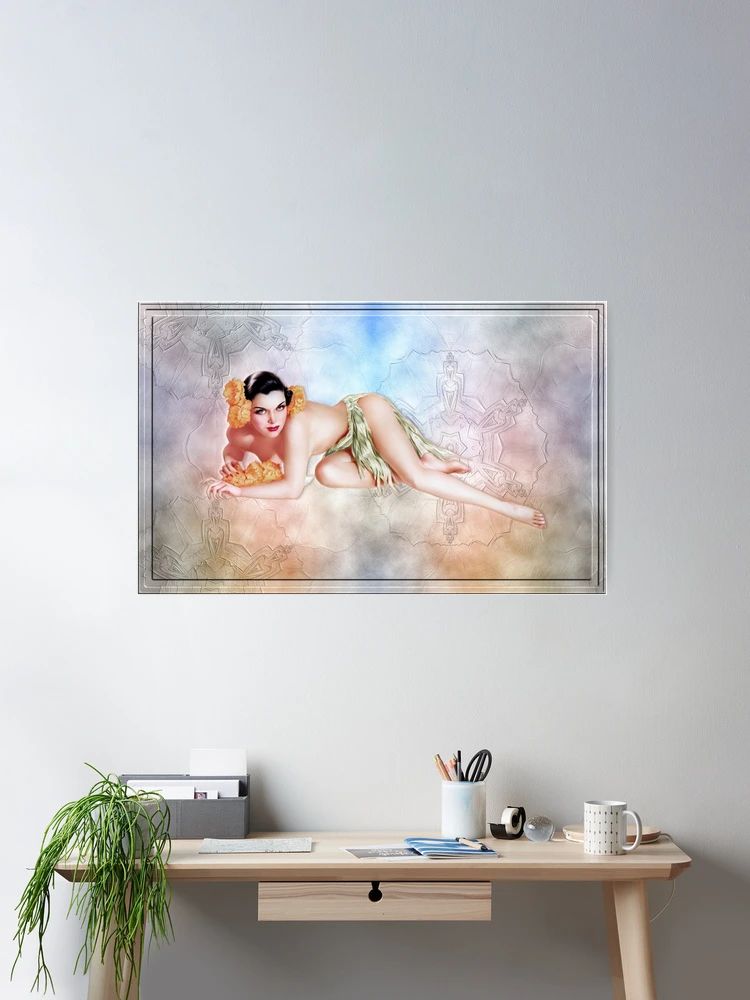
Am figear sa mheadhan de “Nighean an Eilein” is a woman, delicately posed in a languid yet alluring manner. An suidheachadh aice, reclining on the ground, evokes a sense of both calm and vitality. The model’s soft, smooth skin contrasts with the exotic flora that adorns her, notably the vivid yellow hibiscus flowers that frame her hair. A craiceann, glowing and flawless, is an embodiment of idealized beauty, which is characteristic of Vargas’s subjects. She gazes directly at the viewer, her eyes conveying both an invitation and a sense of mystery. The angle of her body, with one arm placed just beneath her chin and her head gently tilted to the side, suggests a natural yet staged sensuality that Vargas was known for.
In terms of attire, she wears a minimal tropical garb, consisting of a simple skirt of what appears to be palm leaves, which adds a touch of nature to the scene. The use of the natural elements emphasizes the theme of an island paradise, further enhancing the sensual appeal of the composition. The artist carefully balances the portrayal of the figure with the environmental elements, using them as mere accents to frame the subject without overshadowing her beauty.
Cùl-fhiosrachadh agus suidheachadh
The background of the piece is an abstract yet atmospheric blend of pastel colors, with soft blues and pinks merging to form an almost ethereal landscape. This choice of colors invokes a sense of warmth, typical of tropical settings, while also enhancing the softness of the scene. An doilleir, faded background serves to keep the focus entirely on the subject, allowing the viewer to feel as though they are in a dreamlike world where the subject and her surroundings are intimately connected.
The geometry of the background, with its mirrored and kaleidoscopic shapes, a’ nochdadh mothachadh air saoghal eile, far a bheil coltas gu bheil na crìochan eadar an fhigear agus an t-àite a’ sgaoileadh. Tha a’ bhuaidh seo ag àrdachadh faireachdainn surreal an deilbh, toirt air an neach-coimhead a bhith a’ faireachdainn mar nach e dìreach cuspair dealbh a th’ anns a’ bhoireannach, ach beò, eintiteas anail ann an fantastical, saoghal dìomhair.
Stoidhle ealain agus buaidh
Thug Art Deco buaidh mhòr air Alberto Vargas, gluasad esthetigeach a nochd anns na 1920n agus a shoirbhich gu sna 1930an. “Nighean an Eilein” a’ nochdadh grunn chomharran-tìre ann an stoidhle Art Deco: pàtrain geoimeatrach, loidhnichean stoidhle, agus fòcas iomlan air eireachdas agus glamour. An glan, Tha loidhnichean biorach a tha a 'mìneachadh sgàil-dhealbh a' mhodail gu math eadar-dhealaichte bhon fheadhainn as buige, foirmean nas siùbhlach de na h-eileamaidean flùra, a’ soilleireachadh comas Vargas air cothromachadh co-chòrdail a chruthachadh eadar reul-eòlas agus tarraing às.
Vargas’s work also draws from his experience as an illustrator for magazines such as Esquire agus Playboy, where he became known for creating some of the most famous pin-up illustrations of the era. The sensual yet elegant portrayal of the female form became a central theme of his work, agus “Nighean an Eilein” is a quintessential example of how he merged realism with idealized beauty. The subject’s proportions, her delicate features, and the warm glow of her skin reflect the influence of the Hollywood glamour that was pervasive during the time.
The use of natural elements such as the hibiscus flowers and palm leaves further ties the painting to Vargas’s Latin American roots, infusing it with a sense of tropical exoticism. This connection to Vargas’s Peruvian heritage also lends the painting a certain authenticity, grounding it in a cultural context while allowing it to transcend geographical boundaries through its universal themes of beauty and allure.
Mood agus faireachdainn
Faireachdainn de “Nighean an Eilein” is one of serene yet inviting sensuality. The subject’s relaxed pose, combined with her soft, inviting expression, creates a sense of calm and intimacy. The combination of warm pastel colors in the background and the subtle floral accents imbues the scene with an aura of tropical beauty and quietude, evoking images of paradise and an idyllic escape from the mundane world. The gentle flow of the composition invites the viewer to linger on the image, absorbing the peaceful yet alluring atmosphere that Vargas masterfully created.
Tha tòna iomlan an deilbh mar aon de bhoireannachd agus gràs gun ùine. Ged a tha an cuspair gun teagamh air a shealltainn mar shamhla air bòidhchead agus tarraing, tha cuideachd modhalachd anns an dòigh anns a bheil i air a riochdachadh, a’ nochdadh sgil Vargas ann a bhith a’ cothromachadh faireachdainneachd le eireachdas. Tha an sgrìobhadh a’ toirt am beachd air figear miotasach, fear a bhuineas do shaoghal an dà chuid eòlach agus iongantach, far a bheil bòidhchead a’ riaghladh os cionn, agus tha nàdar a’ cur ri cruth an duine.
Stuthan agus dhòighean
Chleachd Vargas dòighean peantaidh traidiseanta gus an lus a chruthachadh, bòidhchead snasail air an do dh'fhàs e ainmeil. An rèidh, Tha càileachd cha mhòr gun smal de chraiceann a ’mhodail a’ nochdadh obair bhruis mhionaideach, a’ còmhdach tònaichean gu faiceallach gus crìoch a tha coltach ri beatha ach air leth freagarrach a choileanadh. Tha inneach nan duilleagan pailme, na flùraichean fìnealta na falt, and the soft blending of the background colors all point to Vargas’s attention to detail and his commitment to creating an immersive visual experience for the viewer.
The juxtaposition of solid, tangible elements, like the leaves and flowers, against the soft and flowing background creates a contrast that keeps the viewer’s eye moving throughout the composition, ensuring that the image remains dynamic yet peaceful. Vargas’s ability to use light and shadow to define the contours of the model’s body gives the work a sense of depth, making the figure appear almost three-dimensional.
Is e seo ath-riochdachadh seann mhaighstirean ealain didseatach ath-leasaichte de ìomhaigh raon poblach a tha ri fhaighinn mar a clò-bhualadh canabhas air-loidhne.
Neach-ealain Bio
Fiosrachadh gu h-ìosal bho Wikipedia.org
Rugadh e ann an Arequipa, Peru, bha e na mhac leis an dealbhadair ainmeil Peruach Max T.. Vargas. Ghluais Alberto Vargas dha na Stàitean Aonaichte a-steach 1916 às deidh dha sgrùdadh a dhèanamh air ealain san Roinn Eòrpa, Zurich, agus Geneva ron Chiad Chogadh.
Fhad ‘s a bha e san Roinn Eòrpa thàinig e air an iris Frangach La Vie Parisienne, le còmhdach le Raphael Kirchner, a thuirt e a thug buaidh mhòr air an obair aige.
Bha a dhreuchd tràth ann an New York a ’toirt a-steach obair mar neach-ealain airson na Ziegfeld Follies agus airson mòran stiùidio Hollywood. Chroch Ziegfeld an dealbh aige de Olive Thomas aig an taigh-cluiche, agus bhathas den bheachd gur i aon de na caileagan Vargas as tràithe.
Vargas’ bha am pìos film as ainmeil airson postair an 1933 film The Sin of Nora Moran, a tha a ’sealltainn Zita Johann a tha cha mhòr lomnochd ann an suidheachadh dòrainn. Tha am postair air ainmeachadh gu tric mar aon de na postairean film as motha a chaidh a dhèanamh a-riamh.
Bha e ainmeil fad is farsaing anns na 1940an mar neach-cruthachaidh ìomhaighean ainmeil àm an Dàrna Cogaidh airson an iris Esquire ris an canar “Nigheanan Vargas.” Eadar 1940 agus 1946 Vargas air a thoirt a-mach 180 dealbhan airson an iris.
Chaidh ealain sròin mòran de phlèanaichean Ameireagaidh agus an Dàrna Cogadh a bhrosnachadh agus atharrachadh bho na h-iomairtean prìne Esquire sin, a bharrachd air an fheadhainn aig Seòras Petty, agus luchd-ealain eile.