

Island Girl
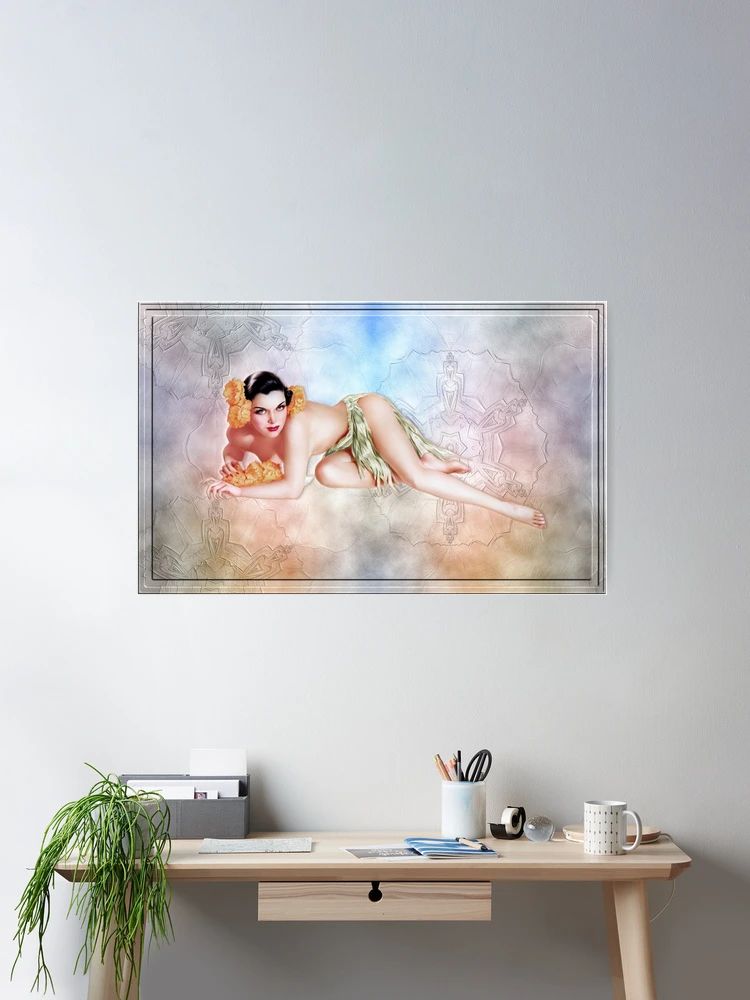
“Island Girl” by the Peruvian artist Alberto Vargas 자리 표시자 이미지 (1896 – 1982), created in the 1930s, presents a striking image of femininity through the portrayal of a woman in an exotic, tropical setting. As an iconic work in Vargas’s oeuvre, it exemplifies his distinctive pin-up style, which became synonymous with the golden age of American illustration. 바르가스, known for his sultry depictions of women, was a key figure in the development of pin-up art during the 20th century. His work captured the essence of idealized beauty, combining elements of sensuality, 무죄, 그리고 유혹하다.
목차
주제와 구성
The central figure of “Island Girl” is a woman, delicately posed in a languid yet alluring manner. 그녀의 포즈, reclining on the ground, evokes a sense of both calm and vitality. The model’s soft, smooth skin contrasts with the exotic flora that adorns her, notably the vivid yellow hibiscus flowers that frame her hair. 그녀의 피부, glowing and flawless, is an embodiment of idealized beauty, which is characteristic of Vargas’s subjects. 그녀는 시청자를 직접 응시합니다., her eyes conveying both an invitation and a sense of mystery. The angle of her body, with one arm placed just beneath her chin and her head gently tilted to the side, suggests a natural yet staged sensuality that Vargas was known for.
In terms of attire, she wears a minimal tropical garb, consisting of a simple skirt of what appears to be palm leaves, which adds a touch of nature to the scene. The use of the natural elements emphasizes the theme of an island paradise, further enhancing the sensual appeal of the composition. The artist carefully balances the portrayal of the figure with the environmental elements, using them as mere accents to frame the subject without overshadowing her beauty.
배경과 설정
The background of the piece is an abstract yet atmospheric blend of pastel colors, with soft blues and pinks merging to form an almost ethereal landscape. This choice of colors invokes a sense of warmth, typical of tropical settings, while also enhancing the softness of the scene. The blurred, faded background serves to keep the focus entirely on the subject, allowing the viewer to feel as though they are in a dreamlike world where the subject and her surroundings are intimately connected.
The geometry of the background, with its mirrored and kaleidoscopic shapes, suggests a sense of otherworldliness, where the boundaries between the figure and the space seem to dissolve. This effect heightens the surreal atmosphere of the painting, making the viewer feel as though the woman is not merely a subject of a painting, 하지만 생활, breathing entity in a fantastical, secluded world.
예술적 스타일과 영향
Alberto Vargas was heavily influenced by Art Deco, an aesthetic movement that emerged in the 1920s and flourished into the 1930s. “Island Girl” displays several hallmarks of the Art Deco style: 기하학적 패턴, stylized lines, and an overall focus on elegance and glamour. 깨끗한, sharp lines that define the model’s silhouette contrast beautifully with the softer, more fluid forms of the floral elements, highlighting Vargas’s ability to create a harmonious balance between realism and abstraction.
Vargas’s work also draws from his experience as an illustrator for magazines such as 귀하 과 Playboy, where he became known for creating some of the most famous pin-up illustrations of the era. The sensual yet elegant portrayal of the female form became a central theme of his work, 과 “Island Girl” is a quintessential example of how he merged realism with idealized beauty. The subject’s proportions, her delicate features, and the warm glow of her skin reflect the influence of the Hollywood glamour that was pervasive during the time.
The use of natural elements such as the hibiscus flowers and palm leaves further ties the painting to Vargas’s Latin American roots, infusing it with a sense of tropical exoticism. This connection to Vargas’s Peruvian heritage also lends the painting a certain authenticity, grounding it in a cultural context while allowing it to transcend geographical boundaries through its universal themes of beauty and allure.
분위기와 분위기
분위기 “Island Girl” is one of serene yet inviting sensuality. The subject’s relaxed pose, combined with her soft, inviting expression, creates a sense of calm and intimacy. The combination of warm pastel colors in the background and the subtle floral accents imbues the scene with an aura of tropical beauty and quietude, evoking images of paradise and an idyllic escape from the mundane world. The gentle flow of the composition invites the viewer to linger on the image, absorbing the peaceful yet alluring atmosphere that Vargas masterfully created.
The overall tone of the painting is one of timeless femininity and grace. While the subject is undoubtedly depicted as a symbol of beauty and allure, there is also a sense of modesty in the way she is portrayed, reflecting Vargas’s skill in balancing sensuality with elegance. The composition evokes the idea of a mythical figure, one that belongs to a world both familiar and fantastical, where beauty reigns supreme, and nature complements the human form.
재료 및 기술
Vargas employed traditional painting techniques to create the lush, polished aesthetic for which he became famous. 매끄러운, almost flawless quality of the model’s skin suggests meticulous brushwork, carefully layering tones to achieve a lifelike yet idealized finish. The texture of the palm leaves, the delicate flowers in her hair, and the soft blending of the background colors all point to Vargas’s attention to detail and his commitment to creating an immersive visual experience for the viewer.
The juxtaposition of solid, tangible elements, like the leaves and flowers, against the soft and flowing background creates a contrast that keeps the viewer’s eye moving throughout the composition, ensuring that the image remains dynamic yet peaceful. Vargas’s ability to use light and shadow to define the contours of the model’s body gives the work a sense of depth, making the figure appear almost three-dimensional.
이것은 공개 도메인 이미지의 리마스터링된 디지털 아트 올드 마스터 복제입니다. Boucher는 Guay의 작품으로 일련의 그림을 그리고 Madame de Pompadour가 조각하여 호의를 받는 궁정에게 잘 묶인 책으로 배포했습니다..
아티스트 약력
아래 정보 Wikipedia.org
아레키파 출생, 페루, 그는 유명한 페루 사진 작가 Max T의 아들이었습니다.. 바르가스. 알베르토 바르가스(Alberto Vargas) 1916 유럽에서 미술을 공부한 후, 취리히, 제1차 세계 대전 이전의 제네바.
그는 유럽에 있는 동안 프랑스 잡지 La Vie Parisienne를 접했습니다., Raphael Kirchner의 표지와 함께, 그의 작품에 큰 영향을 끼쳤다고 합니다..
뉴욕에서의 그의 초기 경력에는 Ziegfeld Follies 및 많은 할리우드 스튜디오의 예술가로서의 작업이 포함되었습니다.. Ziegfeld는 극장에 올리브 토마스의 그림을 걸었습니다., 그리고 그녀는 초기 Vargas Girls 중 한 명으로 생각되었습니다..
바르가스’ 가장 유명한 영화 작품은 '포스터'였다. 1933 영화 노라 모란의 죄, 나체에 가까운 지타 요한이 절망적인 포즈를 취하고 있는 모습을 보여줍니다.. 포스터는 종종 역사상 가장 위대한 영화 포스터 중 하나로 선정됩니다..
그는 1940년대에 Esquire 매거진의 상징적인 제2차 세계 대전 시대 핀업의 창시자로 널리 알려졌습니다. “바르가스 걸스.” 사이 1940 과 1946 바르가스 생산 180 잡지를 위한 그림.
많은 미국 및 연합군 항공기의 노즈 아트는 이러한 Esquire 핀업에서 영감을 받아 적용되었습니다., 조지 페티(George Petty)와 마찬가지로, 그리고 다른 예술가들.