

Det är inget att nysa åt
Det är inget att nysa åt förbi Gil Elvgren (1914 – 1980), en av de mest hyllade amerikanska illustratörerna under 1900-talet. Det här stycket exemplifierar den livfulla och engagerande stilen som gjorde Elvgren känd, kombinera humor, sensualitet, och en touch av glamour.
Född i 1914, Elvgrens karriär sträckte sig över en stor del av 1900-talet, och han är mest känd för sin pin-up-konst, en genre som definierade mycket av mitten av århundradets amerikanska illustration. Hans användning av färg, ljus, och lekfulla berättelser i hans verk sätter ett kännetecken för annonser, tidningar, och kalendrar genom hela eran.
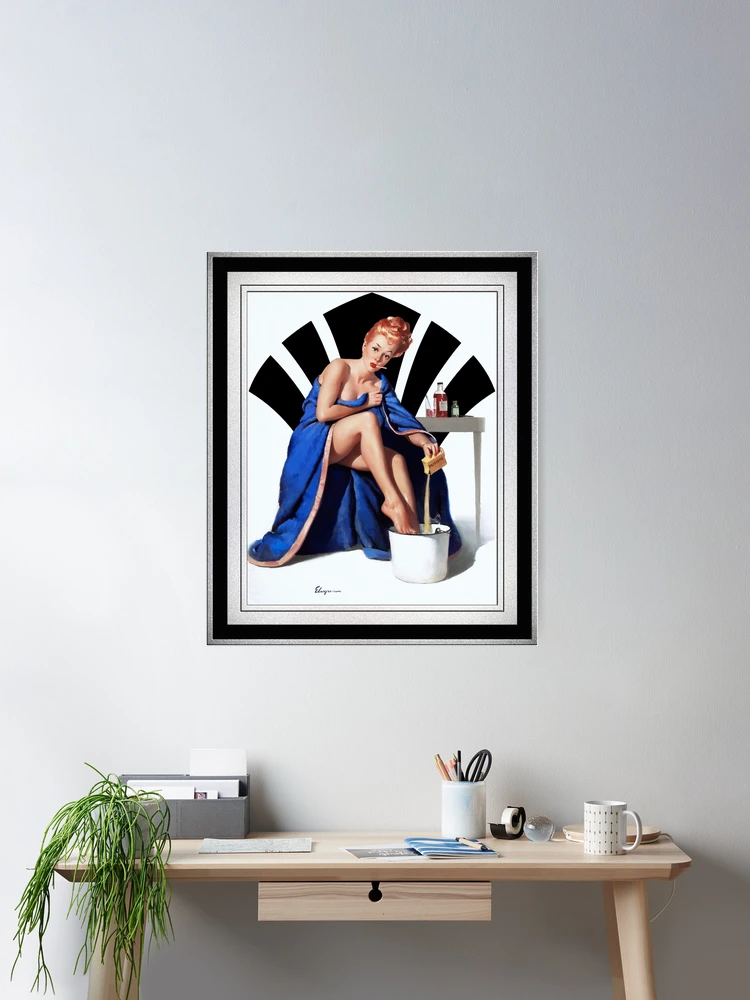
Målningen porträtterar en ung kvinna som sitter med fötterna i en senapsfat, a remedy that would have been familiar to many of Elvgren’s audience as a common cure for ailments such as colds or aches. i alla fall, this domestic scene is not without a touch of humor and playful irony.
The woman’s facial expression suggests both frustration and curiosity about the situation, amplifying the lighthearted tone of the artwork. Hennes pose, with one knee raised and the other foot submerged in the mustard bath, directs the viewer’s attention to the woman’s figure in an elegant yet comical way.
Innehållsförteckning
Huvudämnet
Den centrala figuren i It’s Nothing To Sneeze At is a young woman dressed in a vibrant blue robe. Manteln, adorned with a delicate pink trim, is loosely draped over her form, adding an element of seductiveness without being overtly revealing. Her strawberry blonde hair is styled in a vintage updo, giving her an air of classic 1950s beauty, further emphasizing her timeless femininity.
Her posture is slightly awkward, adding to the narrative of the scene: she is trying to find relief from an ailment, and her uncertain expression, combined with the mundane but uncomfortable treatment, invites both empathy and humor from the viewer. The angle at which she sits, with her legs crossed and one foot submerged, creates an intimate yet comical moment in a domestic setting.
The Setting and Objects
Behind the figure, a table is placed, atop which rests a small collection of items: a bottle of whiskey, a glass, and what seems to be a medicinal bottle, perhaps a cure or tonic to accompany her treatment.
These objects reinforce the domestic, private nature of the scene, but they also point to the time period’s typical imagery, where relaxation and health remedies were often portrayed as part of a woman’s role in maintaining a household. The bottle of whiskey also suggests the idea of indulgence or comfort, playing into the classic visual codes of 1950s Americana.
The most significant object, i alla fall, is the mustard box in the woman’s hand. She is in the process of pouring mustard into the basin of water, an action that is at once comical and relatable. Mustard baths were considered an old-fashioned remedy, but its inclusion here is both playful and nostalgic, reinforcing the humorous undertones of the painting. The mustard itself is represented in rich, bold yellow, providing a striking contrast to the otherwise soft color palette of the scene.
The backdrop of the painting features an abstract fan-like design, reminiscent of a 1950s Art Deco influence. This geometric pattern not only frames the figure but also adds a sense of dynamism to the otherwise calm scene. The fan-like design could be interpreted as a subtle nod to the popular aesthetic of the mid-20th century, reinforcing the painting’s roots in its time period.
Stämningen och temat
It’s Nothing To Sneeze At is a study in juxtaposition. On the surface, it portrays a typical domestic scene: a woman at home, relaxing, and attending to her health. i alla fall, Elvgren infuses the painting with humor and lightheartedness, turning an ordinary moment into something more playful and inviting. The title itself suggests a double entendre, “sneeze” evoking the common cold or sickness, but also potentially pointing to the comical situation the woman finds herself in.
The mood is decidedly light and fun. The woman’s facial expression, a mix of slight bemusement and embarrassment, encourages the viewer to smile in sympathy, as if sharing in her mild misfortune. The use of bright colors, such as the woman’s blue robe and the yellow mustard, creates a lively contrast that enhances the playful nature of the scene. There is a sense of immediacy in the moment, as if the viewer has just walked into this woman’s world and is witnessing a brief, humorous episode in her daily life.
Style and Materials
In terms of artistic style, Elvgren’s brushwork is smooth and refined, with a clear focus on realism. The rendering of the woman’s skin, hår, and robe is done with great attention to detail, creating a lifelike quality that makes the scene all the more relatable. His use of lighting is strategic, highlighting the woman’s figure and bringing out the warmth in her skin tone.
Shadows are carefully placed to suggest volume and depth, adding to the overall realism of the piece. Bakgrunden, by contrast, is more simplified and abstract, allowing the figure to stand out as the primary focal point.
The materials used in the painting are typical of Elvgren’s oeuvre: oil paints, applied in layers to build texture and richness. The medium’s fluidity allows for a smooth, polished finish that enhances the glamour of the subject while allowing for subtle details like the gloss of the mustard and the reflective surfaces of the bottles on the table.
It’s Nothing To Sneeze At is a remastered digital art old masters reproduction of a public domain image that is available as a canvastavla online.
Artist Bio härledd från Wikipedia.org
Gillette A.. Elvgren föddes i St.. Paul, Minnesota, och gick på University High School. Efter studenten, han började studera konst vid Minneapolis Institute of Arts.
Senare flyttade han till Chicago för att studera vid American Academy of Art, och tog examen från akademin under den stora depressionen, vid 22 års ålder.
Efter examen gick Elvgren med i konstnärens stall i Stevens och Gross, Chicagos mest prestigefyllda reklambyrå, och blev en protegé av konstnären Haddon Sundblom.
I 1937, Gil började måla pin-ups i kalendern för Louis F. Dow, ett av USA: s ledande förlag, under vilken tid han skapade ungefär 60 pin-up girl arbetar på 22 ″ × 28 ″ duk och utmärkte dem med en tryckt signatur.
Många av hans pin-ups reproducerades som näskonst på militära flygplan under andra världskriget; och det var vid den här tiden 1944, att Elvgren kontaktades av Brown and Bigelow Publishing Company; ett företag som fortfarande dominerar fältet när det gäller att ta fram kalendrar, reklamspecialiteter och reklamartiklar.
Nästa år från 1945 fram tills 1972, Elvgren var associerad med Brown & Bigelow förlag, och började arbeta med 24 tum förbi 30 tum dukar, ett format som han skulle använda för nästa 30 år, och undertecknade sitt arbete i kursiv.
Elvgren var en kommersiell framgång. Han bodde på olika platser, och var aktiv från 1930-talet till 1970-talet. I 1951 han började måla i en studio i sitt hem, sedan i Winnetka, Illinois, med hjälp av en assistent för att ställa in belysning, bygg rekvisita och scener, fotograferar uppsättningar, och förbereda sina färger.
Hans kunder inkluderade välkända företag som Brown och Bigelow, Koks, General Electric och Sealy Madrass Company, för att nämna några. Dessutom, under 1940- och 1950 -talen illustrerade han berättelser för en mängd tidskrifter, som The Saturday Evening Post och Good Housekeeping.
Bland modellerna och Hollywoodlegenderna som Elvgren målade under sin karriär inkluderade Myrna Hansen, Donna Reed, Barbara Hale, Arlene Dahl, Lola Albright och Kim Novak.