

Joan of Arc Death at the Stake c1843
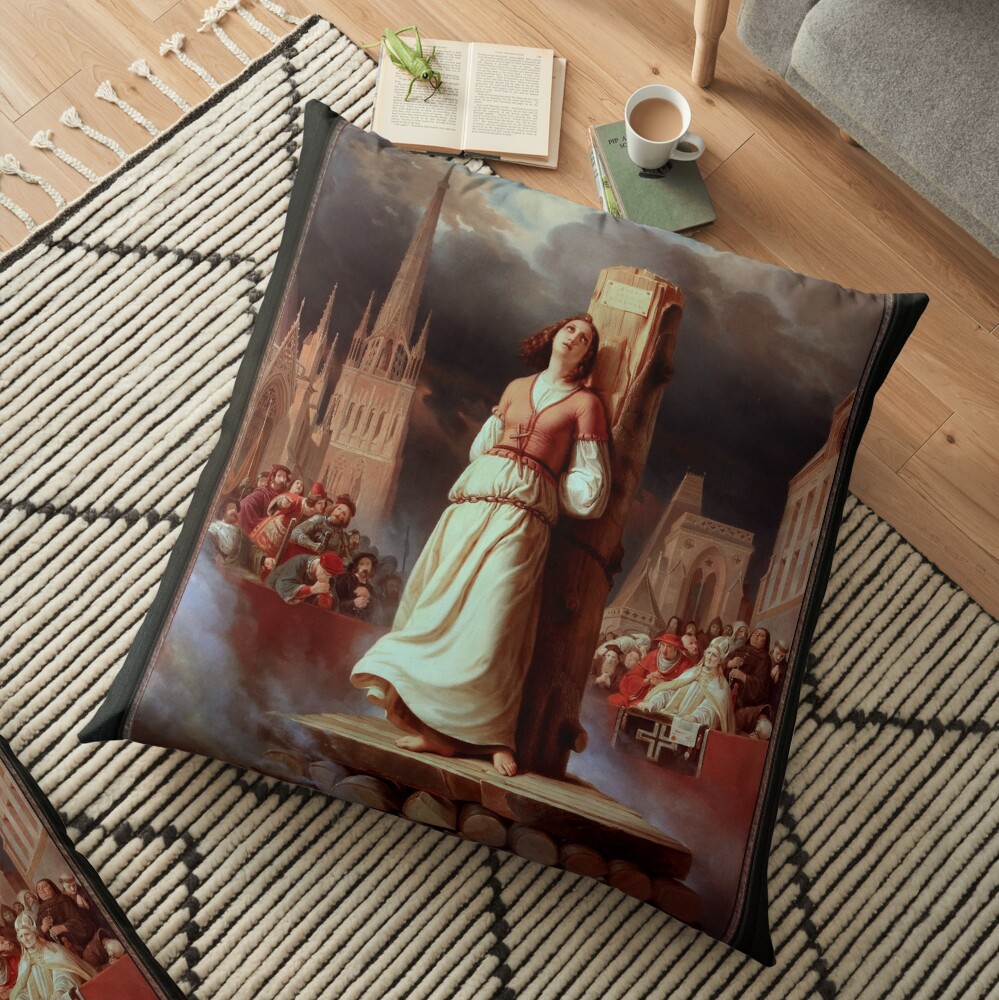
“Joan of Arc Death at the Stake,” oanmakke yn 1843 by the German painter Hermann Stilke (1803 – 1860), depicts a pivotal moment in the life of one of history’s most courageous figures, Joan of Arc. The painting is part of the larger cycle of works that capture the life of the French heroine. Stilke, known for his historical scenes and deep attention to detail, evokes a solemn atmosphere with his masterful treatment of light and texture, skillfully portraying the emotional gravity of Joan’s final moments. The artwork presents a dramatic and vivid scene, encapsulating the historical and religious significance of Joan of Arc’s martyrdom during the Hundred Years’ Oarloch.
Ynhâldsopjefte
It haadûnderwerp
The central figure of the painting is Joan of Arc herself, portrayed in a moment of both physical and emotional distress. She stands bound to a wooden post, which is the execution stake, awaiting her fate. Har wite jurk, symbolic of purity and martyrdom, contrasts with the fiery setting that surrounds her. The way her arms are outstretched and bound with ropes is a stark reminder of her helplessness, yet there is an undeniable strength in her posture and gaze. Joan’s eyes are lifted towards the heavens, her expression a mixture of defiance and serenity, as though she is seeking solace or divine intervention.
Despite the imminent danger, her figure retains an aura of dignity and resilience. The facial features are finely rendered, showing a young woman who, despite the horror she faces, holds on to her faith and conviction. Joan’s expression and posture encapsulate the complex emotion of someone who, while suffering physically, holds a deep spiritual connection that transcends the earthly realm. She is both a victim of unjust persecution and a symbol of unwavering belief.
Eftergrûn en ynstelling
The background of the painting is just as essential to the narrative as Joan’s figure. A dark and dramatic sky looms overhead, clouds swirling ominously above her, which heightens the tension and urgency of the scene. The cityscape in the distance reflects the historical context of the scene, Joan’s execution took place in Rouen, Frankryk, where she was burned at the stake. The architecture of the surrounding buildings, though slightly blurred and distant, is Gothic, with pointed arches and towering spires that lend a sense of grandeur and tragedy to the composition.
The presence of a large crowd gathered in the background serves to highlight Joan’s public execution. The people are shown as spectators, some in grim contemplation, others in various states of anger and mockery. A few figures stand out more prominently, dressed in religious or official attire, reflecting the power structures that sentenced her to death. Their presence adds to the somber tone of the painting, emphasizing the role of the church and political forces in her condemnation.
Symbolyk en stimming
The mood of the painting is undeniably somber, evoking a sense of tragedy, helplessness, en morele kompleksiteit. It tsjuster, swirljende wolken yn 'e loft symbolisearje de tumultueuze aard fan 'e tiden en de ynderlike ûnrêst fan it konflikt. It kontrast tusken de heldere, hast gloeiende figuer fan Joan en de tsjustere eftergrûn beynfloedet it skilderij in geastlike diminsje. Har blik, nei boppen rjochte, is ien fan stille resignaasje en geastlike transcendinsje, it bieden fan in glim fan hope te midden fan it oerweldigjende tsjuster om har hinne. De mannichte, wylst fariearjend yn emoasje, bringt foar in grut part de kjeld en ûnferskilligens fan 'e wrâld oer oan har lijen.
De útfiering stake, sels in objekt fan histoaryske betsjutting, is makke mei yntins realisme. De tekstuer fan it hout, it detail yn 'e touwen dy't it lichem fan Joan bine, en de rûchhûne aard fan it platfoarm fan 'e beul drage allegear by oan it realisme fan it toaniel. Dizze skerpe foarstelling fan 'e houten stek fersterket de brutaliteit fan' e dea fan Joan, wylst se har opstiging yn it martlerdom ek oangripender makket.
It kleurpalet fan it skilderij is ûnderdrukt, dominearre troch brún, griis, en donkere blues. De sêfte, hast etheryske ferljochting dy't Joan's figuer ferljochtet, kontrast mei de swiere skaden om de rest fan it toaniel hinne. Dit effekt markearret de sintrale figuer op in manier dy't de oandacht fan 'e sjogger folslein op Joan rjochtet, har as middelpunt te pleatsen fan sawol de komposysje as it gruttere histoaryske ferhaal.
Execution and Artistic Style
Stilke syn styl yn dit skilderij slút oan by de histoaryske romantyk fan de 19e ieu. De dramatyske ferbylding fan Jeanne d'Arc is karakteristyk foar de klam fan 'e beweging op emoasje, skiednis, en de heldhaftige. Syn oandacht foar detail, particularly in the rendering of textures such as the fabric of Joan’s dress and the rough surface of the wooden stake, exemplifies his skill as a historical painter. His use of light and shadow creates a dynamic atmosphere that contrasts the divine serenity of Joan’s face with the tumultuous environment surrounding her.
Stilke’s brushwork, though meticulous, remains loose enough in the background to create a sense of movement, as if the scene is unfolding in real time. The figures in the crowd, while smaller and more indistinct, are rendered with enough detail to convey their various reactions to the event. Some are focused on Joan, while others seem indifferent, emphasizing the public nature of the execution and the apathy that surrounds it.
Konklúzje
Hermann Stilke’s “Joan of Arc Death at the Stake” is a powerful, emotional portrayal of the final moments of a national hero and martyr. Troch syn gebrûk fan ljocht, komposysje, en symbolyk, Stilke encapsulates the themes of faith, opoffering, and political injustice. The somber atmosphere of the painting invites the viewer to reflect on the broader historical and spiritual significance of Joan of Arc’s death and her unwavering belief in her divine mission, even in the face of death. The work stands as a testament to the courage of a young woman who, in her final moments, became an enduring symbol of bravery and conviction.
Dit is in retouched digitale keunst âlde masters reproduksje fan in publike domein ôfbylding dat is beskikber online as in rôle print.
Artist Bio ôflaat fan Wikipedia.org
Anton Hermann Stilke was born in Berlin the Kingdom of Prussia on January 29, 1803 he was a German Painter studying at the Berlin Academy of Fine Arts and then in 1821 studying at the Munich Academy of Fine Arts under German Master Professor Peter von Cornelius (1783 – 1867).
From there he went to study at the Academy of Fine Arts in Düsseldorf; where he painted along with German Painter Karl Stürmer (1803 – 1881) the unfinished fresco The Last Judgment in the Assisensaal in Koblenz.
Yn 1827 Anton traveled through Northern Italy on a study trip, arriving in Rome in 1828. Dan yn 1833 he returned to the Düsseldorf Academy, where he taught from 1839 – 1843.
Fan 1842 – 1846 Anton worked in the Knight’s Hall at Stolzenfels Castle near Koblenze on the banks of the Rhine River; en yn 1850 he settled in Berlin where he died at the age of 57 on September 22, 1860.