

Jeanne d'Arc in der Schlacht um 1843
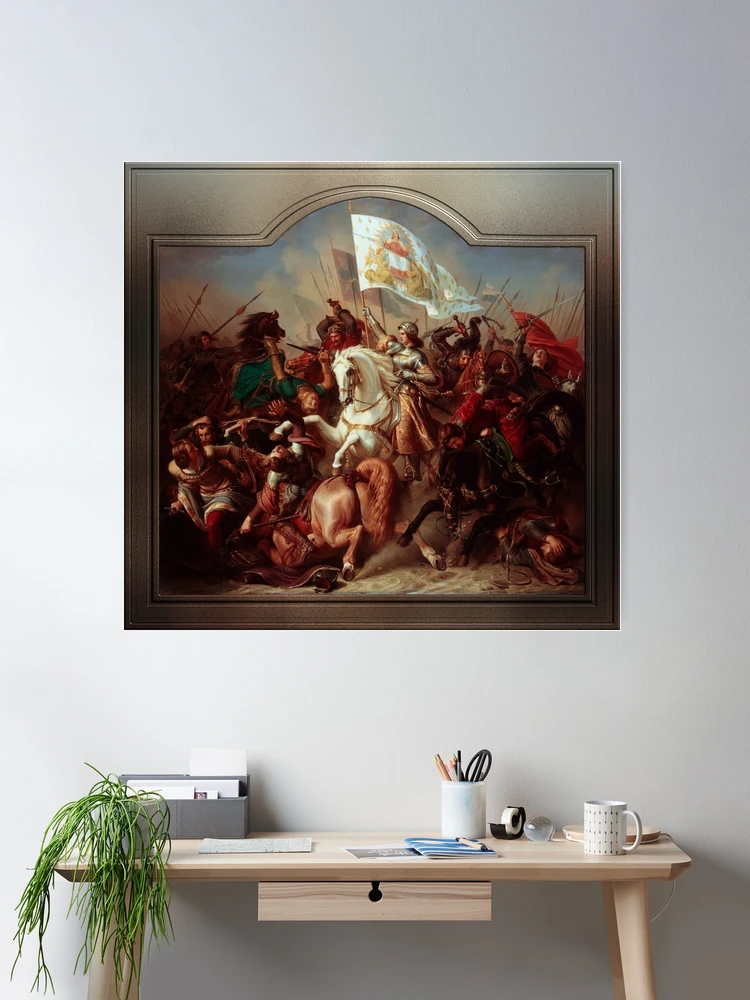
Das Gemälde Jeanne d'Arc im Kampf, erstellt in 1843 vom deutschen Künstler Hermann Stilke (1803 – 1860), ist eine meisterhafte Darstellung eines der ikonischsten und heroischsten Momente der französischen Geschichte. Als zentraler Teil des größeren Triptychons mit dem Titel positioniert Das Leben von Jeanne d'Arc, Dieses Werk verkörpert den intensiven Mut und die Leidenschaft, die die legendäre Figur von Jeanne d’Arc während ihres Feldzugs auszeichnete.
Das Gemälde fängt den Moment ein, als Joan, auf einem weißen Ross montiert, wird gesehen, wie er in der Hitze des Gefechts eine Flagge schwingt, ein Symbol göttlicher Führung und unerschütterlichen Mutes. Stilkes Komposition bringt auf brillante Weise sowohl das Chaos des Krieges als auch die unerschütterliche Entschlossenheit Johannas auf den Punkt, Sie betont den Kontrast zwischen ihrer spirituellen Mission und der Brutalität der mittelalterlichen Kriegsführung.
Inhaltsverzeichnis
Zusammensetzung und Kennzahlen
Die zentrale Figur des Gemäldes ist Jeanne d'Arc selbst, gekleidet in glänzende Rüstung, Ihr Gesicht ist entschlossen und ihre Haltung ist gebieterisch, während sie das Banner hochhält. Das Bild von Joan zu Pferd, vor einem turbulenten Schlachtfeld positioniert, spricht sowohl über ihre physische als auch über ihre symbolische Rolle im Konflikt.
Ihr weißes Ross, der als Leuchtfeuer der Reinheit inmitten des Chaos steht, steht im Kontrast zur dunklen und düsteren Atmosphäre der Schlacht um sie herum. Die Flagge, die sie hält, ist mit Bildern geschmückt, die ihren göttlichen Auftrag symbolisieren, Stärkung des zentralen Themas der göttlichen Vorsehung und des Heldentums.
Um Joan herum stehen verschiedene Soldaten, sowohl zu Pferd als auch zu Fuß, in den hektischen Kampf der mittelalterlichen Kriegsführung verwickelt. Ihre Gesichter zeigen einen Ausdruck der Anstrengung, Furcht, und Aggression, während sie im Hintergrund aufeinanderprallen, mit erhobenen Schwertern und schützenden Schilden. Das Chaos der Schlacht wird durch das Wirrwarr der Körper anschaulich dargestellt, Pferde, und Waffen, die zusammen die Brutalität und Verwirrung vermitteln, die diese historischen Engagements kennzeichneten.
Gelände und Umgebung
Das Schlachtfeld wird als riesige und offene Fläche dargestellt, mit über den Tatort verstreuten Soldaten. Der Boden ist übersät mit gefallenen Kämpfern, während andere in brutale Nahkämpfe verwickelt sind. Die Landschaft selbst ist etwas unscharf, Dabei wird die Unmittelbarkeit des Geschehens betont, anstatt einen detaillierten Blick auf die Umgebung zu bieten.
Diese Technik ermöglicht es dem Zuschauer, sich ganz auf die chaotische Energie der Schlacht zu konzentrieren, das als Hintergrund für Joans göttliche Mission dient. Der Himmel oben, mit dunklen Wolken gefärbt, deutet auf die bedrückende und gewalttätige Natur des Konflikts hin, Es dient aber auch als visuelle Metapher für die unsicheren und turbulenten Zeiten, mit denen Joan konfrontiert war.
Stimmung und Symbolik
Die Stimmung von Jeanne d'Arc im Kampf ist ein Film voller intensiver Dramen, unterstrichen durch die turbulente Umgebung und die fokussierte Figur von Joan selbst. Stilkes Wiedergabe der Kampfszene ist dynamisch, voller Bewegung und Dringlichkeit, Dennoch bleibt Joan eine stetige und unnachgiebige Präsenz im Mittelpunkt. Der Kontrast zwischen Joans Gelassenheit und dem sie umgebenden Chaos ist frappierend.
Ihr Gesichtsausdruck ist von stiller Entschlossenheit geprägt, fast so, als wäre sie von den Schrecken der Schlacht um sie herum unberührt. Dies unterstreicht ihre Rolle als spirituelle und militärische Führerin, die standhaft an ihrem Glauben und ihrer Mission festhält.
Die von ihr gehaltene Flagge ist ein zentrales Symbol der Arbeit, repräsentiert nicht nur die militärische Sache, sondern auch die göttliche Gunst. Das komplizierte Design der Flagge, mit seinen himmlischen Motiven, bestärkt die Vorstellung, dass Joans Mission von einer höheren Macht angeordnet wurde. Der Konflikt zwischen der natürlichen Brutalität des Krieges und der übernatürlichen Macht, die Joan repräsentiert, ist ein zentrales Thema des Gemäldes, symbolisiert die Spannung zwischen irdischen Kämpfen und göttlicher Führung.
Künstlerischer Stil und Technik
Hermann Stilkes Stil spiegelt in diesem Gemälde den akademischen Ansatz der Historienmalerei wider, der im 19. Jahrhundert vorherrschend war. Der Einsatz klassischer Techniken, wie Hell-Dunkel (der Kontrast zwischen hell und dunkel), detaillierte anatomische Studien, und präzise Wiedergabe von Texturen, bringt ein Gefühl von Realismus in die Szene.
Die Zahlen, besonders Joan, werden mit viel Liebe zum Detail umgesetzt, Es zeigt Stilkes Fähigkeit, menschliche Ausdrucksformen und Bewegungen einzufangen. Die von Joan und den Soldaten getragenen Rüstungen sind sorgfältig dargestellt, mit den reflektierenden Metalloberflächen und den bis ins kleinste Detail wiedergegebenen Stofffalten.
Stilkes Einsatz von Licht und Schatten lenkt den Blick des Betrachters besonders wirkungsvoll. Joan, von einem sanften Licht beleuchtet, hebt sich vom Dunklen ab, turbulenterer Hintergrund. Dies erzeugt einen Halo-ähnlichen Effekt um sie herum, symbolisiert ihre göttliche Rolle in den dargestellten Ereignissen. Die dunkleren Töne im Hintergrund unterstreichen die gewalttätige und chaotische Natur der Schlacht, während die helleren Töne um Joan herum ein Gefühl von Hoffnung und spiritueller Klarheit vermitteln.
Abschluss
Jeanne d'Arc im Kampf ist ein bemerkenswertes Beispiel für Historienmalerei, das nicht nur die dramatische Essenz eines entscheidenden Moments der Geschichte einfängt, sondern ihm auch tiefe Symbolik und emotionale Resonanz verleiht.
Durch seine präzise und detaillierte Technik, Stilke erweckt den komplexen Charakter von Jeanne d'Arc zum Leben, Sie porträtiert sie nicht nur als mutige Kriegerin, sondern auch als eine Figur göttlicher Stärke und Überzeugung. Das Nebeneinander des Gewalttätigen, Der chaotische Kampf mit der gelassenen Entschlossenheit von Joan beleuchtet den zentralen Konflikt ihres Lebens und ihrer Mission, Dies macht dieses Kunstwerk zu einer kraftvollen Darstellung ihres Erbes.
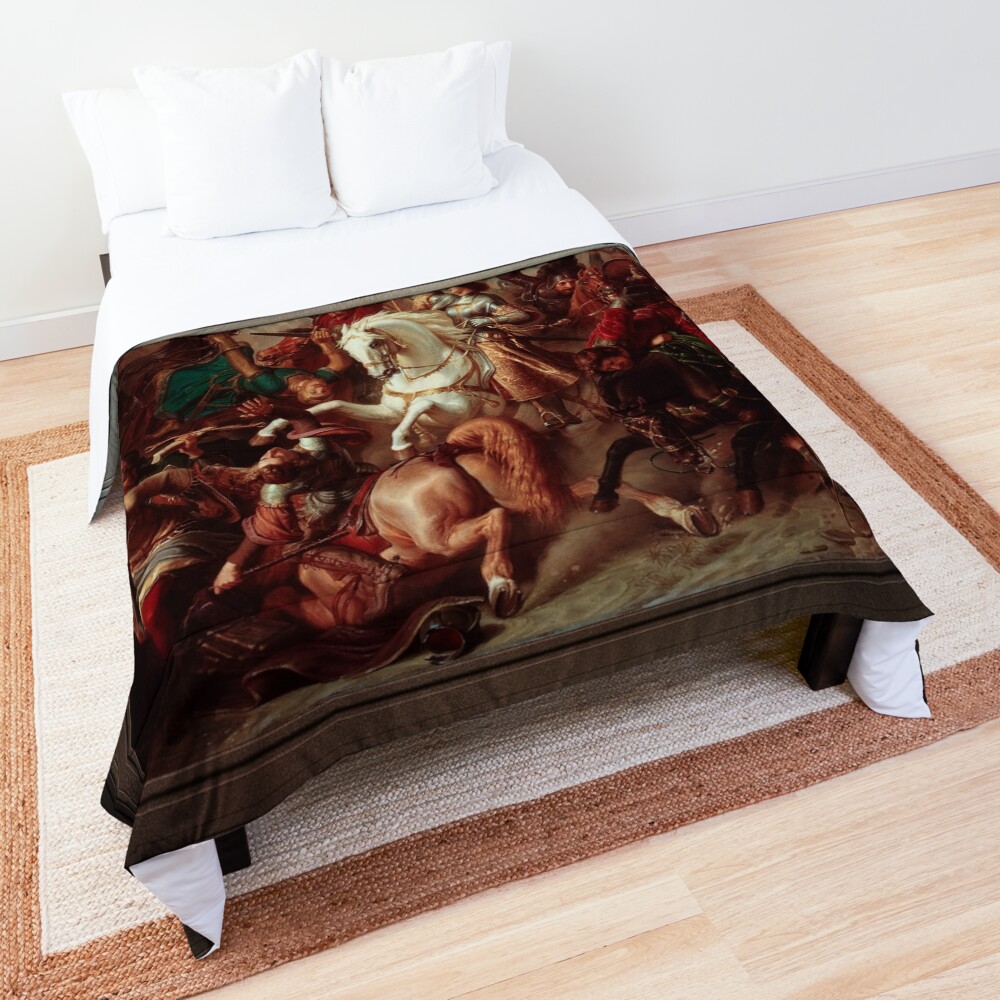
Dies ist eine retuschierte Reproduktion eines gemeinfreien Bildes durch digitale Meister alter Meister, Und wie bei allen Kunstwerken, die auf der Xzendor7 -Website zu finden sind, Acryldrucke, Metalldrucke, Holzdrucke, gerahmte Drucke, Plakate, und wie gerollte Leinwanddrucke in verschiedenen Größen von 12 Zoll zu 72 Zoll, abhängig von der Größe des tatsächlichen Kunstwerks und dem Print-on-Demand-Shop, in dem Sie das Kunstwerk kaufen möchten.
Künstler Bio abgeleitet von Wikipedia.org
Anton Hermann Stilke wurde im Januar in Berlin im Königreich Preußen geboren 29, 1803 er war ein deutscher Maler, studierte an der Berliner Akademie der bildenden Künste und dann in 1821 Studium an der Akademie der Bildenden Künste München bei deutschem Meister Professor Peter von Cornelius (1783 – 1867).
Von dort ging er zum Studium an die Akademie der Bildenden Künste in Düsseldorf; wo er zusammen mit dem deutschen Maler Karl Stürmer malte (1803 – 1881) das unvollendete Fresko Das Jüngste Gericht im Assisensaal in Koblenz.
Im 1827 Anton reiste auf einer Studienreise durch Norditalien, Ankunft in Rom in 1828. Dann in 1833 er kehrte an die Düsseldorfer Akademie zurück, wo er lehrte 1839 – 1843.
Von 1842 – 1846 Anton arbeitete im Rittersaal auf Schloss Stolzenfels bei Koblenze am Rheinufer; und in 1850 er ließ sich in Berlin nieder, wo er im Alter von starb 57 Im September 22, 1860.