

Jóhanna af Örk í bardaga c1843
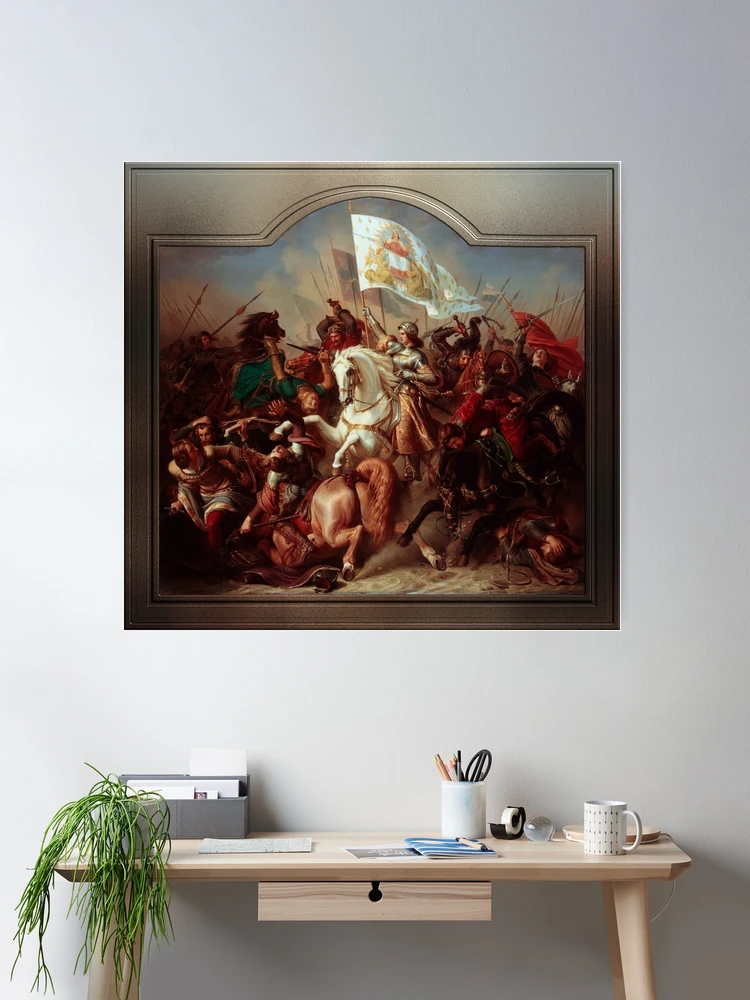
Málverkið Jóhanna af Örk í bardaga, búið til í 1843 eftir þýska listamanninn Hermann Stilke (1803 – 1860), er meistaraleg lýsing á einu helgimyndalegasta og hetjulegasta augnabliki franskrar sögu. Staðsett sem miðhluti stærri þrítjaldsins sem heitir Líf Jóhönnu af Örk, þetta verk felur í sér mikla hugrekki og eldmóð sem skilgreindi goðsagnakennda mynd Jóhönnu af Örk í herferð hennar.
Málverkið fangar augnablikið þegar Joan, festur á hvítum hesti, sést veifa fána í hita bardaga, tákn um guðlega forystu og óbilandi hugrekki. Tónverk Stilke umlykur á snilldarlegan hátt bæði óreiðu stríðsins og staðföst einbeitni Joan, leggur áherslu á andstæðuna á milli andlegs hlutverks hennar og hrottalegs eðlis miðaldastríðs.
Efnisyfirlit
Samsetning og lykiltölur
Aðalpersóna málverksins er sjálf Jóhanna af Örk, klæddur í skínandi herklæði, andlit hennar var ákveðið og stellingin er skipandi þegar hún ber borðann hátt. Myndin af Joan á hestbaki, staðsettur á móti stormasamum vígvelli, talar bæði um líkamlegt og táknrænt hlutverk hennar í átökunum.
Hvíti hesturinn hennar, sem stendur sem leiðarljós hreinleika í ringulreiðinni, stangast á við dimmt og grátlegt andrúmsloft bardagans í kringum hana. Fáninn sem hún heldur á er skreyttur myndmáli sem táknar guðlegt umboð hennar, reinforcing the central theme of divine providence and heroism.
Surrounding Joan are various soldiers, both on horseback and on foot, engaged in the frantic combat of medieval warfare. Their faces display expressions of exertion, fear, and aggression as they clash in the background, with swords raised and shields protecting them. The chaos of battle is vividly depicted through the tangled mass of bodies, hesta, and weaponry, which together convey the brutality and confusion that marked these historical engagements.
Landslag og umgjörð
The battlefield is depicted as a vast and open expanse, with soldiers dispersed across the scene. The ground is littered with fallen combatants, while others are locked in brutal hand-to-hand combat. The landscape itself is somewhat blurred, emphasizing the immediacy of the action rather than offering a detailed view of the surroundings.
This technique allows the viewer to focus entirely on the chaotic energy of the battle, which serves as a backdrop to Joan’s divine mission. Himinninn fyrir ofan, tinged with dark clouds, suggests the oppressive and violent nature of the conflict, but it also serves as a visual metaphor for the uncertain and tumultuous times that Joan faced.
Stemning og táknmál
Stemningin á Jóhanna af Örk í bardaga is one of intense drama, underscored by the tumultuous environment and the focused figure of Joan herself. Stilke’s rendering of the battle scene is dynamic, filled with movement and urgency, yet Joan remains a steady and unyielding presence at the center. The contrast between Joan’s serenity and the chaos surrounding her is striking.
Svipur hennar er rólegur ákveðni, næstum eins og hún sé ósnortin af hryllingi bardaga í kringum hana. Þetta undirstrikar hlutverk hennar sem andlegur og hernaðarlegur leiðtogi sem er staðfastur í trú sinni og hlutverki.
Fáninn sem hún heldur á er aðaltákn í verkinu, táknar ekki bara hernaðarmálið heldur líka guðlega hylli. Flókin hönnun fánans, með himneskum mótífum sínum, styrkir þá hugmynd að verkefni Jóhönnu hafi verið vígð af æðri mætti. Áreksturinn milli náttúrulegrar grimmd stríðsins og yfirnáttúrulega kraftsins sem Joan stendur fyrir er lykilþema í málverkinu, táknar spennuna milli jarðneskrar baráttu og guðlegrar leiðsagnar.
Listrænn stíll og tækni
Hermann Stilke’s style in this painting reflects the academic approach to historical painting that was prevalent in the 19th century. The use of classical techniques, such as chiaroscuro (andstæða ljóss og dökks), detailed anatomical studies, and precise rendering of textures, brings a sense of realism to the scene.
The figures, particularly Joan, are rendered with great attention to detail, showcasing Stilke’s skill in capturing human expression and movement. The armor worn by Joan and the soldiers is meticulously depicted, with the reflective surfaces of metal and the folds of fabric rendered in exquisite detail.
Stilke’s use of light and shadow is particularly effective in guiding the viewer’s eye. Joan, illuminated by a soft light, stands out against the darker, more turbulent background. This creates a halo-like effect around her, symbolizing her divine role in the events depicted. The darker tones in the background serve to emphasize the violent and chaotic nature of the battle, while the lighter tones around Joan convey a sense of hope and spiritual clarity.
Niðurstaða
Jóhanna af Örk í bardaga is a remarkable example of historical painting that not only captures the dramatic essence of a pivotal moment in history but also imbues it with deep symbolism and emotional resonance.
Through his precise and detailed technique, Stilke brings to life the complex character of Joan of Arc, portraying her not only as a courageous warrior but also as a figure of divine strength and conviction. The juxtaposition of the violent, chaotic battle with the serene determination of Joan highlights the central conflict of her life and mission, making this artwork a powerful representation of her legacy.
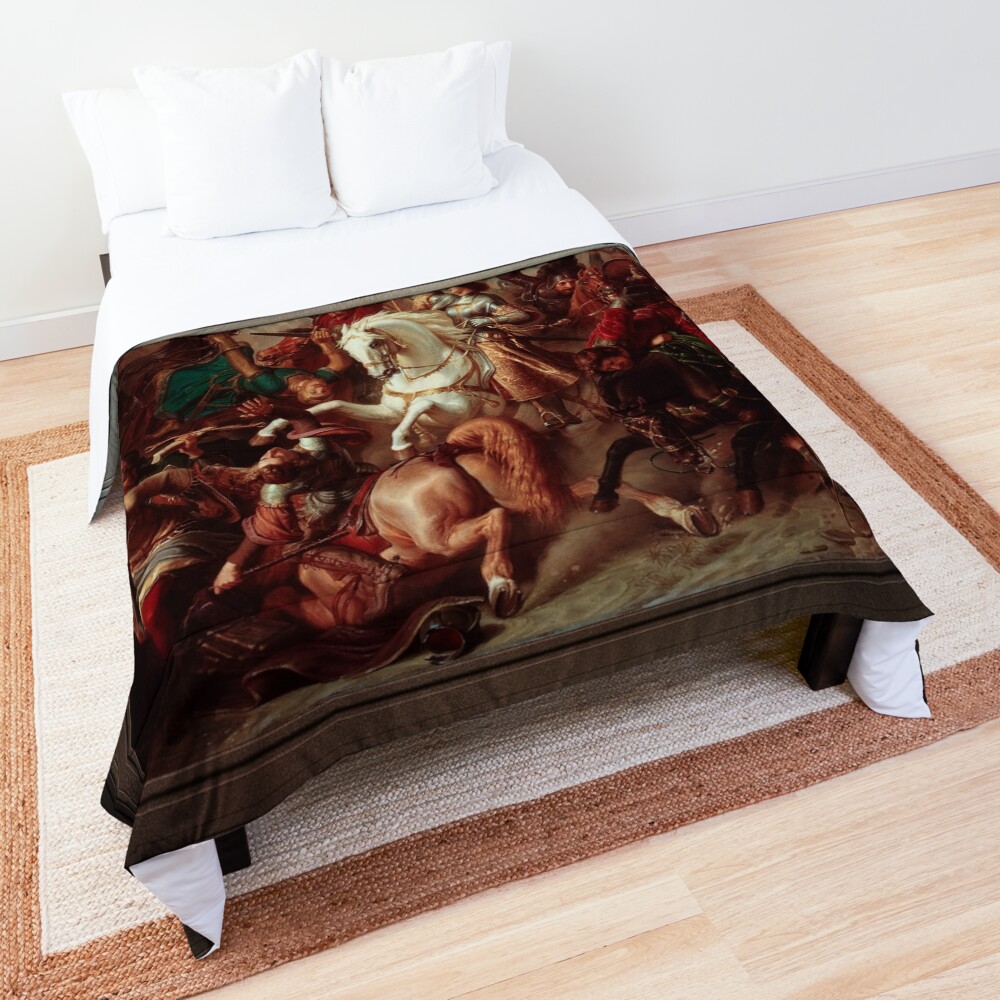
Þetta er lagfærð stafræn list af gömlum meistara eftirgerð af mynd í almenningseign, and as with all the artwork that can be found on the Xzendor7 website is available for purchase online in a variety of material formats including canvas prints, akrýl prentun, málmprentun, viðarprentanir, innrömmuð prentun, veggspjöld, og sem upprúlluð strigaprentun í ýmsum stærðum frá 12 tommur til 72 tommur eftir stærð raunverulegu listaverksins og prentunarversluninni sem þú velur að kaupa listina frá.
Listamaður Bio fenginn frá Wikipedia.org
Anton Hermann Stilke was born in Berlin the Kingdom of Prussia on January 29, 1803 he was a German Painter studying at the Berlin Academy of Fine Arts and then in 1821 studying at the Munich Academy of Fine Arts under German Master Professor Peter von Cornelius (1783 – 1867).
From there he went to study at the Academy of Fine Arts in Düsseldorf; where he painted along with German Painter Karl Stürmer (1803 – 1881) the unfinished fresco The Last Judgment in the Assisensaal in Koblenz.
Í 1827 Anton traveled through Northern Italy on a study trip, arriving in Rome in 1828. Síðan inn 1833 he returned to the Düsseldorf Academy, where he taught from 1839 – 1843.
Frá 1842 – 1846 Anton worked in the Knight’s Hall at Stolzenfels Castle near Koblenze on the banks of the Rhine River; og inn 1850 he settled in Berlin where he died at the age of 57 on September 22, 1860.