

Juno žádá Aeola, aby uvolnil větry
Juno žádá Aeolus, aby uvolnil větry c1769 od French Painter Francois Boucher (1703 – 1770), Jupiter v masce Diany a Callisto od Françoise Bouchera. Jupiter v masce Diany a Callisto od Françoise Bouchera, Jupiter v masce Diany a Callisto od Françoise Bouchera.
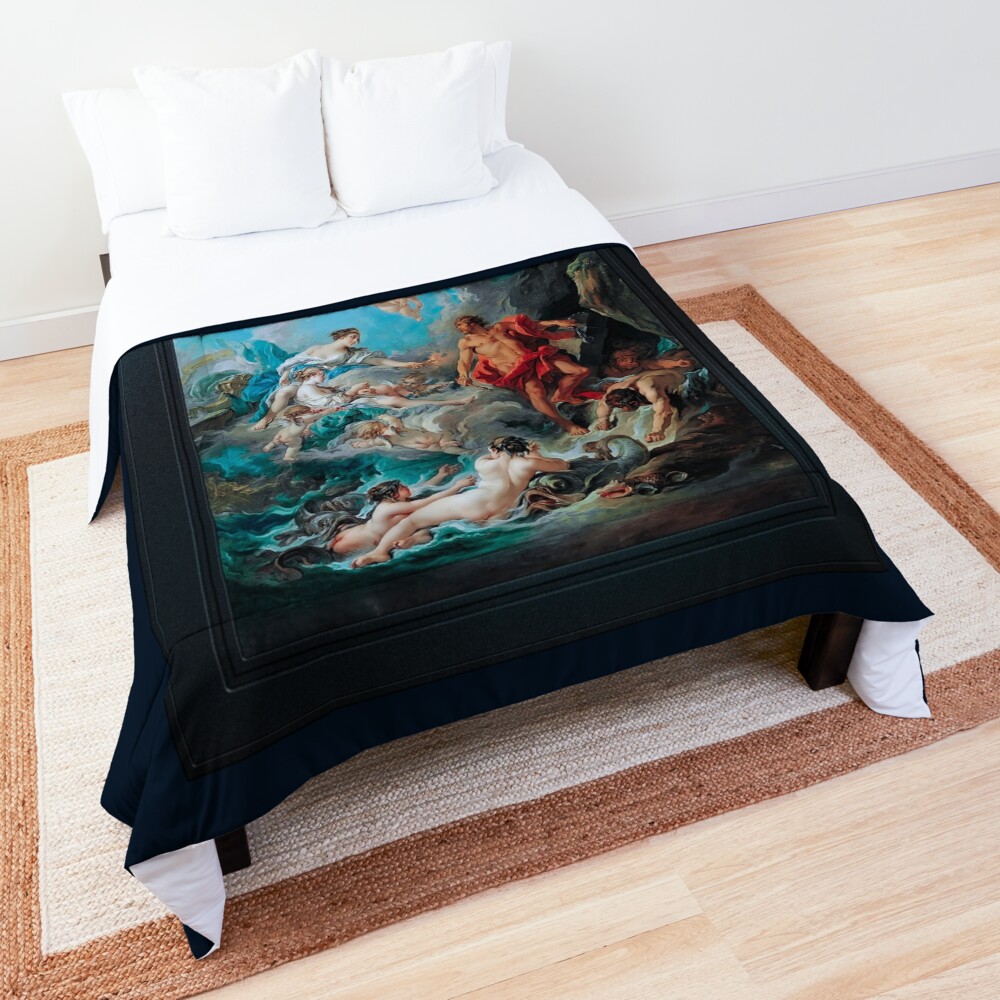
This is a depiction of the Greek-Roman Mythological tale of Juno (Chief Goddess akin to the Greek Hera) visiting Aeolus (King of the mythical, floating island of Aiolia or Aeolia), who is the keeper of the winds and urging him to release these mythological creatures so that their fury and might, may provoke a violent storm at sea, which would result in the destruction of the Aeneas’s Fleet.
Things don’t turn out as Juno expects, even though she has offered Aeolus her most beautiful nymph Deiopea in marriage; and aiming her torch strait at his heart, the love struck Aeolus does as she ask.
Then Cupid unsheathes an arrow to target the compliant nymph Deiopea, that has her wrist bound with pearls; but the power God of the Sea Neptune interferes and prevails over the winds that were released from the cavernous island interior, by rendering the waters of the sea into a calm state.
To complete the scene we find cherubs flying in the air and some floating on a cloud above the water and two other sea nymphs in the water surround by very large gulping fish.
Juno Asking Aeolus To Release The Winds is a remastered digital art old masters reproduction of a public domain image that is available as a tisk na plátno online.
Níže uvedené informace jsou odvozeny z Wikipedia.org
I když existuje několik protichůdných verzí mýtu, Francois Boucher was the son of a lesser known painter Nicolas Boucher, I když existuje několik protichůdných verzí mýtu. I když existuje několik protichůdných verzí mýtu, I když existuje několik protichůdných verzí mýtu. I když existuje několik protichůdných verzí mýtu, I když existuje několik protichůdných verzí mýtu, I když existuje několik protichůdných verzí mýtu.

v 1720, vyhrál elitní Grand Prix de Rome za malbu, vyhrál elitní Grand Prix de Rome za malbu, vyhrál elitní Grand Prix de Rome za malbu[1] Po návratu ze studia v Itálii byl přijat na refounded Académie de peinture et de sochařství na 24 listopad 1731. Jeho přijímací kus (přijímací kus) byl jeho Rinaldo a Armida z 1734.
Boucher si vzal Marie-Jeanne Buzeau v 1733. Pár měl spolu tři děti. Boucher se stal členem fakulty v 1734 a jeho kariéra se od tohoto okamžiku zrychlila, když byl povýšen na profesora, poté rektora akademie, stává inspektorem v Royal Gobelins Manufactory a nakonec Premier Peintre du Roi (První malíř krále) v 1765. Portrét Marie-Louise O'Murphyho c. 1752
Boucher zemřel dne 30 Smět 1770 v rodné Paříži. Jeho jméno, spolu s patronkou jeho madame de Pompadour, se stal synonymem pro francouzský rokokový styl, vede bratry Goncourty k psaní: “Boucher je jedním z těch mužů, kteří představují vkus století, kteří vyjadřují, personifikovat a ztělesnit to.”
Boucher je známý tím, že říká, že příroda je “příliš zelené a špatně osvětlené” (příliš zelené a špatně osvětlené).
Boucher byl spojován s rytec drahokamů Jacques Guay, kterého učil kreslit. Mentoroval také moravsko-rakouského malíře Martina Ferdinanda Quadala a neoklasického malíře Jacquese-Louis Davida v r. 1767.[4] Později, Boucher vytvořil sérii kreseb Guayových děl, které madame de Pompadour poté vyryl a distribuoval jako pohledně svázaný svazek oblíbeným dvořanům