

Zrození Venuše: A Celebration of Classical Beauty
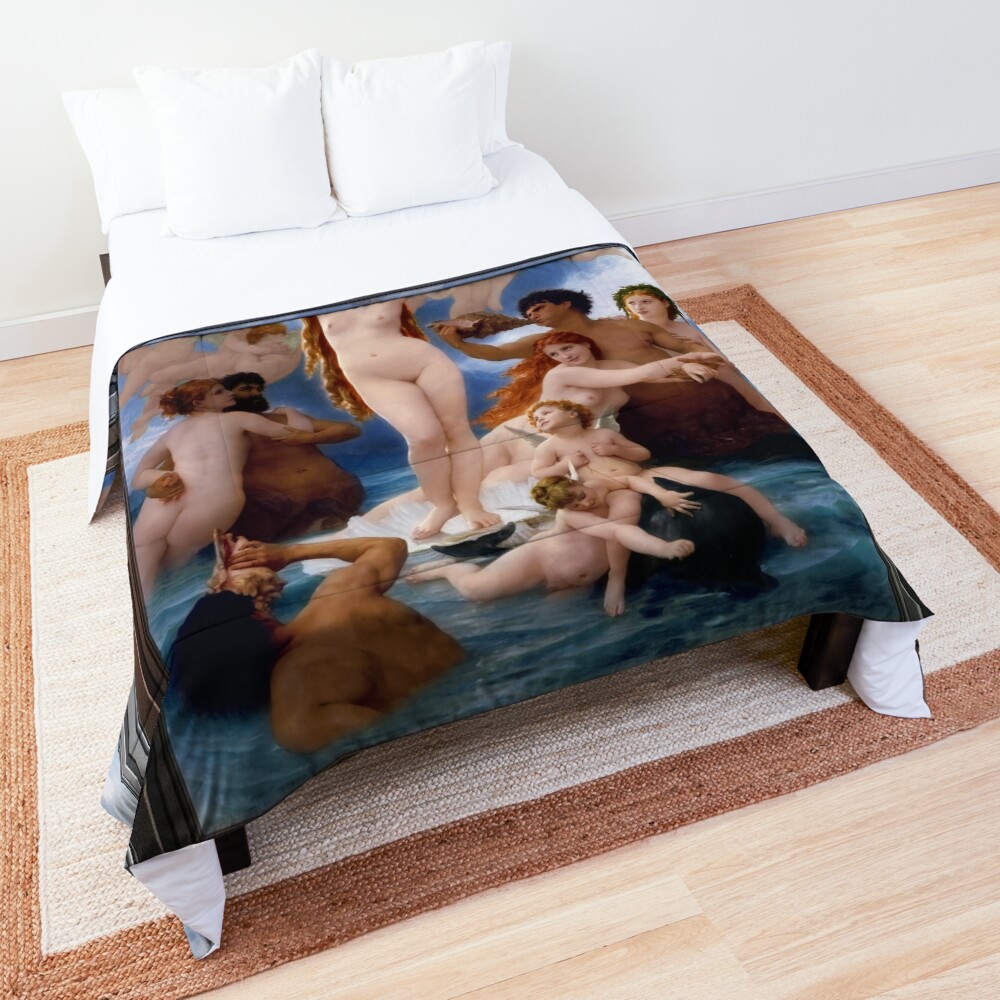
Zrození Venuše c1879 by French Painter William-Adolphe Bouguereau (1825 – 1905), stands as a quintessential example of Academic art, embodying the principles of idealized beauty and technical mastery prevalent in mid-19th century France. This large-scale oil painting draws heavily from classical mythology, depicting the arrival of the goddess Venus (Aphrodite to the Greeks) upon the shores of Cyprus. nicméně, Bouguereau’s interpretation is far removed from earlier depictions; instead of a dramatic or tempestuous emergence, he presents a scene of serene grace and gentle unfolding.
Obsah
Složení struktury & Narativní tok
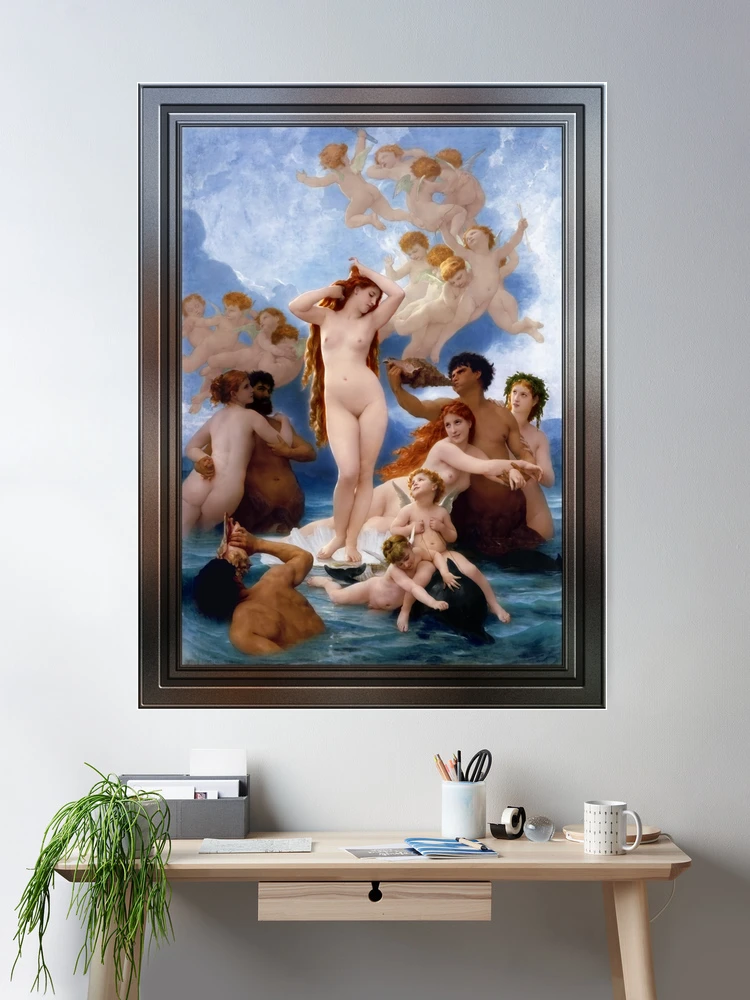
The composition is meticulously structured around Venus herself, positioned centrally within the canvas. She stands upon a massive scallop shell, which serves as her floating pedestal, gently approaching the shoreline. The arrangement isn’t haphazard; it’s carefully orchestrated to guide the viewer’s eye. To her left, a figure representing Zephyr, the west wind, and his consort Chloris, blow Venus towards the shore, their bodies intertwined in a dynamic pose that conveys movement and gentle force. On the right, a nymph, likely Hora, awaits with a floral garland, ready to welcome the goddess. The figures surrounding Venus are not merely decorative; they contribute to the narrative flow, illustrating the forces that brought her into being and the welcoming reception she receives.
Anatomical Precision & Idealized Form
Bouguereau’s reputation rested on his exceptional skill in depicting the human form with anatomical accuracy. v “Zrození Venuše,” this is evident in every curve and contour of the figures. The bodies are rendered with a smooth, almost porcelain-like quality, showcasing an idealized beauty that adheres to classical standards. There’s no attempt at realism in the sense of portraying imperfections; místo toho, Bouguereau elevates the human form to a state of perfect harmony and proportion. Venus’s pose is particularly striking – she stands with one foot slightly raised, creating a sense of poised elegance and effortless grace. The subtle modeling of her flesh, achieved through delicate gradations of light and shadow, further enhances the illusion of three-dimensionality and tactile realism.
Paleta barev & Atmosférické efekty
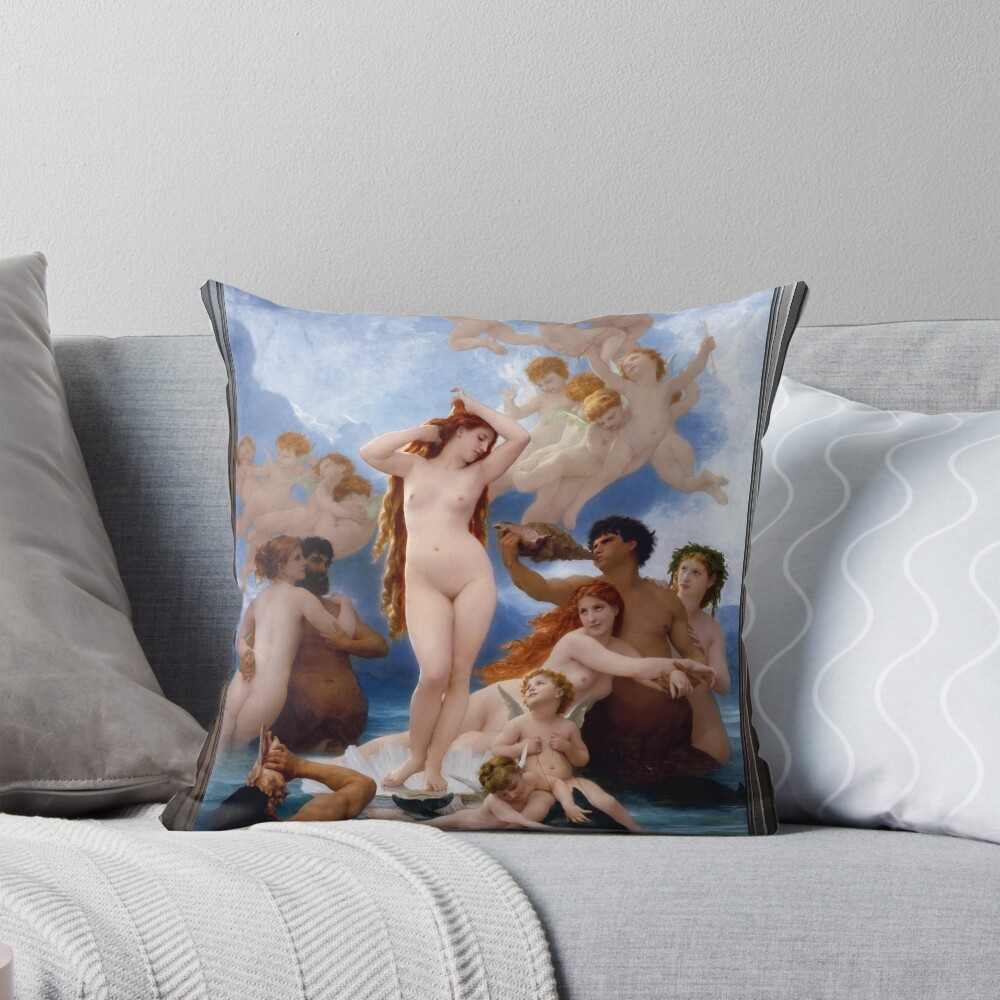
The color palette employed in “Zrození Venuše” is predominantly soft and harmonious. Pale blues and greens dominate the seascape, creating a sense of tranquility and ethereal beauty. The sky is rendered with swirling clouds, suggesting a gentle breeze and an atmosphere of otherworldly calm. Venus’s skin tones are luminous, contrasting beautifully with her flowing auburn hair, which cascades down her shoulders in loose waves. The warm hues of the flesh tones are balanced by the cooler colors of the surrounding environment, creating a visually pleasing contrast that draws attention to the central figure. Bouguereau masterfully uses light and shadow to create depth and volume, enhancing the overall sense of realism and beauty.
Symbolismus & Classical Allusions
Beyond its aesthetic appeal, “Zrození Venuše” is rich in symbolism and classical allusions. The scallop shell upon which Venus stands is a recurring motif associated with her birth in mythology – born from sea foam (Greek: aphros), hence her name Aphrodite. Zephyr and Chloris represent the gentle forces of nature that guide Venus’s arrival, while Hora symbolizes welcome and celebration. The floral garland offered by the nymph signifies beauty and fertility. These symbolic elements contribute to the painting’s overall meaning, reinforcing its connection to classical mythology and celebrating the goddess as a symbol of love, krása, a obnovy.
Bouguereau’s Artistic Legacy & Academic Tradition
Bouguereau was a leading figure in the Academic art movement, which emphasized technical skill, idealized forms, and adherence to established artistic conventions. “Zrození Venuše” exemplifies these principles perfectly. The painting’s popularity during its time reflects the public’s appreciation for classical themes and the mastery of traditional techniques. While later generations would critique Academic art for its perceived lack of originality and emotional depth, Bouguereau’s work remains admired for its technical brilliance and enduring beauty. “Zrození Venuše” continues to captivate viewers with its serene atmosphere, idealized forms, and celebration of classical mythology. It stands as a testament to the power of artistic skill and the enduring appeal of timeless themes.
Artist Bio Courtesy Wikipedia.org
William-Adolphe Bouguereau se narodil v La Rochelle, Francie, na 30 listopad 1825, do rodiny obchodníků s vínem a olivovým olejem.[4] Syn Théodora Bouguereaua (narozený 1800) a Marie Bonninová (1804), známá jako Adeline, William byl vychován jako katolík. Měl staršího bratra, Alfréd, a mladší sestru, Marie (známá jako Hanna), která zemřela, když jí bylo sedm.
V roce se rodina přestěhovala do Saint-Martin-de-Ré 1832. V roce se narodil další sourozenec 1834, Koťátko. Ve věku 12, Bouguereau odešel do Mortagne, aby zůstal u svého strýce Eugèna, kněz a vyvinul lásku k přírodě, náboženství a literatura.
v 1839, byl poslán studovat kněžství na katolickou kolej v Pons. Zde ho naučil kreslit a malovat Louis Sage, který studoval pod Ingresem. Bouguereau neochotně opustil studia, aby se vrátil ke své rodině, nyní bydlí v Bordeaux.
Tam potkal místního umělce, Charles Marionneau, a zahájena na Městské škole kreslení a malby v listopadu 1841. Bouguereau také pracoval jako prodavač, ruční kolorování litografií a vytváření malých maleb, které byly reprodukovány pomocí chromolitografie.
Brzy byl nejlepším žákem ve své třídě, a rozhodl se stát se umělcem v Paříži. Na financování stěhování, prodával portréty - 33 oleje za tři měsíce. Všechny byly nepodepsané a pouze jeden byl vysledován. Do Paříže dorazil ve věku 20 v březnu 1846.
Rovnost před smrtí (Rovnost před smrtí), 1848, olej na plátně, 141 × 269 cm (55.5 × 105.9 v), Muzeum Orsay, Paříž. Rovnost je Bouguereauův první velký obraz, produkoval po dvou letech na École des Beaux-Arts de Paris ve věku let 23.
Bouguereau se stal studentem na École des Beaux-Arts.[4] Aby si doplnil formální výcvik v kreslení, navštěvoval anatomické pitvy a studoval historické kostýmy a archeologii.
Byl přijat do ateliéru Françoise-Édouarda Picota, kde studoval malbu v akademickém stylu. Dante a Virgil v pekle (1850) byl raným příkladem jeho neoklasicistních děl.
Akademické malířství kladlo nejvyšší postavení na historická a mytologická témata, a Bouguereau odhodlaný vyhrát Prix de Rome, což by mu vyneslo tříleté sídlo ve Villa Medici v Římě, Itálie, kde kromě formálních lekcí mohl z první ruky studovat renesanční umělce a jejich mistrovská díla, stejně jako řečtina, etruské, a římské starožitnosti.
The Birth Of Venus is a retouched digital art old masters reproduction of a public domain image that is available online as a rolovaný tisk na plátno.