

Juno Asking Aeolus To Release The Winds
Juno Asking Aeolus To Release The Winds c1769 by French Painter Francois Boucher (1703 – 1770), kiu ankaŭ estis plenumebla desegnisto kaj gravuristo. Li laboris en la Rokoko-Stilo kaj estas konata pro siaj idiliaj klasikaj temoj, paŝtistaj scenoj kaj dekoraciaj alegorioj.
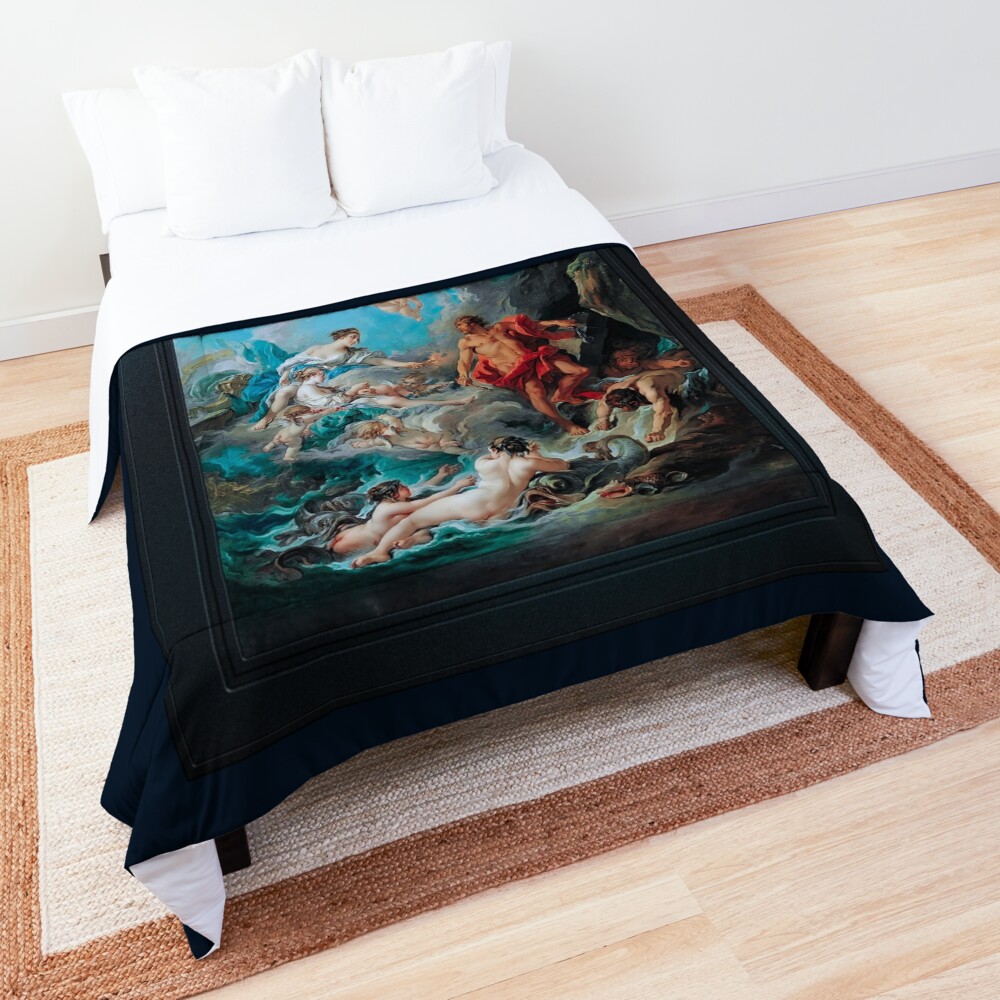
This is a depiction of the Greek-Roman Mythological tale of Juno (Chief Goddess akin to the Greek Hera) visiting Aeolus (King of the mythical, floating island of Aiolia or Aeolia), who is the keeper of the winds and urging him to release these mythological creatures so that their fury and might, may provoke a violent storm at sea, which would result in the destruction of the Aeneas’s Fleet.
Things don’t turn out as Juno expects, even though she has offered Aeolus her most beautiful nymph Deiopea in marriage; and aiming her torch strait at his heart, the love struck Aeolus does as she ask.
Then Cupid unsheathes an arrow to target the compliant nymph Deiopea, that has her wrist bound with pearls; but the power God of the Sea Neptune interferes and prevails over the winds that were released from the cavernous island interior, by rendering the waters of the sea into a calm state.
To complete the scene we find cherubs flying in the air and some floating on a cloud above the water and two other sea nymphs in the water surround by very large gulping fish.
Juno Asking Aeolus To Release The Winds is a remastered digital art old masters reproduction of a public domain image that is available as a tolo presaĵo rete.
Informoj Malsupre Derivita De Vikipedio.org
Hejmanto de Parizo, Francois Boucher was the son of a lesser known painter Nicolas Boucher, kiu donis al li sian unuan artan trejnadon. En la aĝo de dek sep, pentraĵo de Boucher estis admirita de la pentristo François Lemoyne. Lemoyne poste nomumis Boucher kiel sia metilernanto, sed post nur tri monatoj, li iris labori por la gravuristo Jean-François Cars.

En 1720, li gajnis la elitan Grand Prix de Rome por pentrado, sed ne prenis la konsekvencan ŝancon studi en Italio ĝis kvin jaroj poste, pro financaj problemoj ĉe la Reĝa Akademio de Pentrarto kaj Skulptaĵo.[1] Sur lia reveno de studado en Italio li estis konfesita la refonditan Académie de peinture et de sculpture on 24 novembro 1731. Lia akceptpeco (akcepta peco) Estis lia Rinaldo kaj Armida de 1734.
Boucher geedziĝis kun Marie-Jeanne Buzeau en 1733. La paro havis tri infanojn kune. Boucher iĝis fakultatano en 1734 kaj lia kariero akcelis de tiu punkto kiam li estis promociita Profesoro tiam Rektoro de la Akademio, iĝante inspektisto ĉe la Reĝa Gobelins Manufactory kaj finfine ĉefministro Peintre du Roi (Unua Pentristo de la Reĝo) en 1765. Portreto de Marie-Louise O'Murphy ĉ. 1752
Boucher mortis plu 30 majo 1770 en sia naskiĝa Parizo. Lia nomo, kune kun tiu de lia patrono Madame de Pompadour, fariĝis sinonima kun la franca rokoka stilo, kondukante la fratojn Goncourt skribi: “Boucher estas unu el tiuj viroj, kiuj reprezentas la guston de jarcento, kiuj esprimas, personigi kaj enkorpigi ĝin.”
Boucher estas fama pro diri ke naturo estas “tro verda kaj malbone lumigita” (tro verda kaj malbone lumigita).
Boucher estis asociita kun la gemogravuristo Jacques Guay, kiun li instruis desegni. Li ankaŭ mentores la morav-aŭstran farbiston Martin Ferdinand Quadal same kiel la novklasikan farbiston Jacques-Louis David en 1767.[4] Poste, Boucher faris serion de desegnaĵoj de verkoj de Guay kiujn sinjorino de Pompadour tiam gravuris kaj distribuis kiel bele ligita volumeno al favoritaj korteganoj.