

La Naskiĝo de Venuso: A Celebration of Classical Beauty
The Birth Of Venus c1879 by French Painter William-Adolphe Bouguereau (1825 – 1905), stands as a quintessential example of Academic art, embodying the principles of idealized beauty and technical mastery prevalent in mid-19th century France. This large-scale oil painting draws heavily from classical mythology, depicting the arrival of the goddess Venus (Aphrodite to the Greeks) upon the shores of Cyprus. Tamen, Bouguereau’s interpretation is far removed from earlier depictions; instead of a dramatic or tempestuous emergence, he presents a scene of serene grace and gentle unfolding.

Enhavtabelo
Kompozicia Strukturo & Narrative Flow
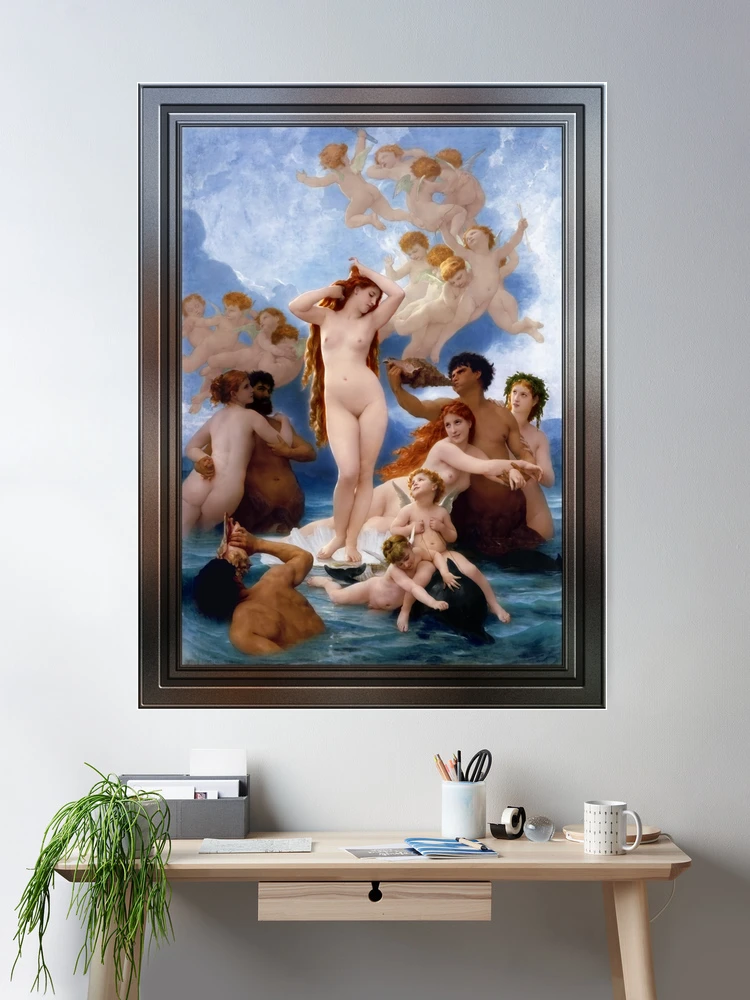
The composition is meticulously structured around Venus herself, positioned centrally within the canvas. She stands upon a massive scallop shell, which serves as her floating pedestal, gently approaching the shoreline. The arrangement isn’t haphazard; it’s carefully orchestrated to guide the viewer’s eye. Al ŝi maldekstre, a figure representing Zephyr, the west wind, and his consort Chloris, blow Venus towards the shore, their bodies intertwined in a dynamic pose that conveys movement and gentle force. Dekstre, a nymph, likely Hora, awaits with a floral garland, ready to welcome the goddess. The figures surrounding Venus are not merely decorative; they contribute to the narrative flow, illustrating the forces that brought her into being and the welcoming reception she receives.
Anatomical Precision & Idealized Form
Bouguereau’s reputation rested on his exceptional skill in depicting the human form with anatomical accuracy. En “La Naskiĝo de Venuso,” this is evident in every curve and contour of the figures. The bodies are rendered with a smooth, almost porcelain-like quality, showcasing an idealized beauty that adheres to classical standards. There’s no attempt at realism in the sense of portraying imperfections; Anstataŭe, Bouguereau elevates the human form to a state of perfect harmony and proportion. Venus’s pose is particularly striking – she stands with one foot slightly raised, creating a sense of poised elegance and effortless grace. The subtle modeling of her flesh, achieved through delicate gradations of light and shadow, further enhances the illusion of three-dimensionality and tactile realism.
Kolora Paletro & Atmosferaj Efektoj
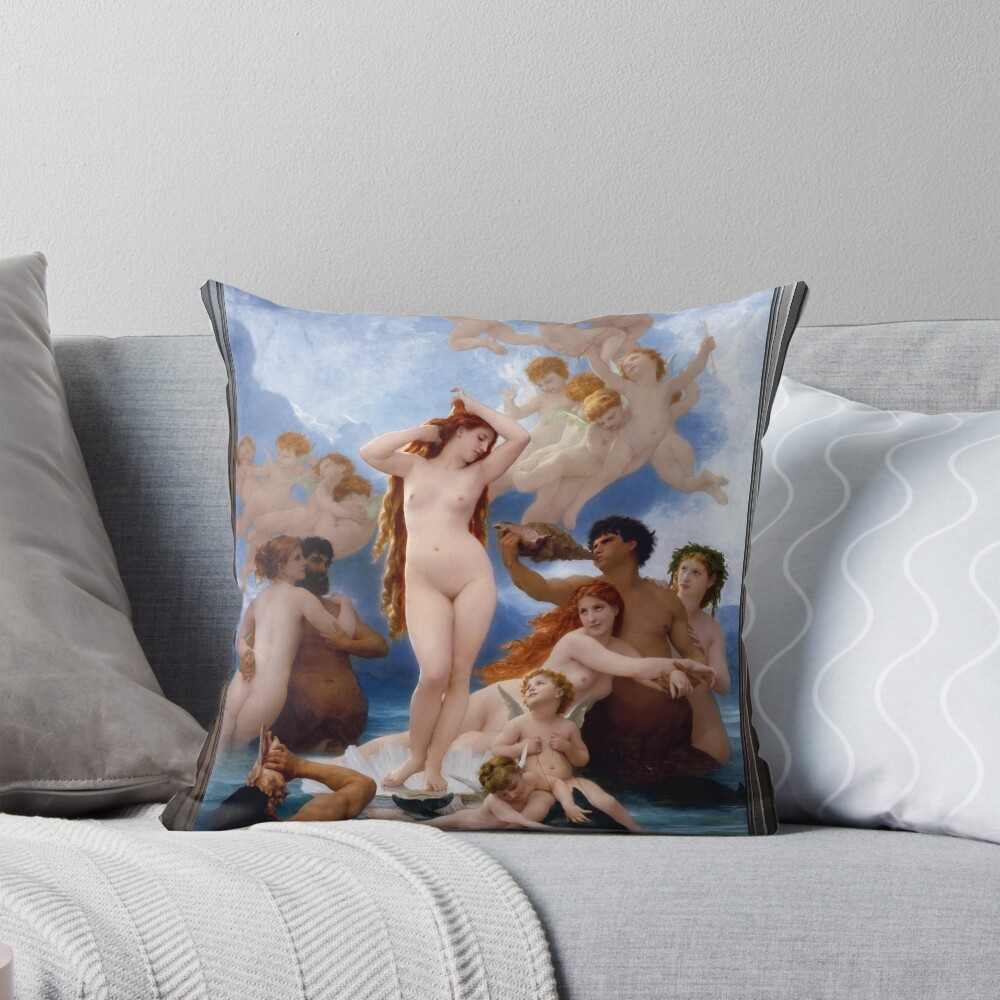
The color palette employed in “La Naskiĝo de Venuso” is predominantly soft and harmonious. Pale blues and greens dominate the seascape, creating a sense of tranquility and ethereal beauty. The sky is rendered with swirling clouds, suggesting a gentle breeze and an atmosphere of otherworldly calm. Venus’s skin tones are luminous, contrasting beautifully with her flowing auburn hair, which cascades down her shoulders in loose waves. The warm hues of the flesh tones are balanced by the cooler colors of the surrounding environment, creating a visually pleasing contrast that draws attention to the central figure. Bouguereau masterfully uses light and shadow to create depth and volume, enhancing the overall sense of realism and beauty.
Simboleco & Classical Allusions
Beyond its aesthetic appeal, “La Naskiĝo de Venuso” is rich in symbolism and classical allusions. The scallop shell upon which Venus stands is a recurring motif associated with her birth in mythology – born from sea foam (Greek: aphros), hence her name Aphrodite. Zephyr and Chloris represent the gentle forces of nature that guide Venus’s arrival, while Hora symbolizes welcome and celebration. The floral garland offered by the nymph signifies beauty and fertility. These symbolic elements contribute to the painting’s overall meaning, reinforcing its connection to classical mythology and celebrating the goddess as a symbol of love, beleco, kaj renovigo.
Bouguereau’s Artistic Legacy & Academic Tradition
Bouguereau was a leading figure in the Academic art movement, kiu emfazis teknikan lertecon, idealized forms, and adherence to established artistic conventions. “La Naskiĝo de Venuso” exemplifies these principles perfectly. The painting’s popularity during its time reflects the public’s appreciation for classical themes and the mastery of traditional techniques. While later generations would critique Academic art for its perceived lack of originality and emotional depth, Bouguereau’s work remains admired for its technical brilliance and enduring beauty. “La Naskiĝo de Venuso” continues to captivate viewers with its serene atmosphere, idealized forms, and celebration of classical mythology. It stands as a testament to the power of artistic skill and the enduring appeal of timeless themes.
Artist Bio Courtesy Vikipedio.org
William Adolphe Bouguereau estis naskita en La Rochelle, Francio, on 30 novembro 1825, into a family of wine and olive oil merchants.[4] The son of Théodore Bouguereau (born 1800) and Marie Bonnin (1804), konata kiel Adeline, William was brought up a Catholic. Li havis pli aĝan fraton, Alfred, kaj pli juna fratino, Marie (konata kiel Hanna), who died when she was seven.
La familio translokiĝis al Saint-Martin-de-Ré en 1832. Alia gefrato estis naskita en 1834, Kitty. En la aĝo de 12, Bouguereau iris al Mortagne por resti kun sia onklo Eugène, pastro kaj disvolvis amon al la naturo, religio kaj literaturo.
En 1839, li estis sendita por studi por la pastraro en katolika kolegio en Pons. Here he was taught to draw and paint by Louis Sage, kiu studis sub Ingres. Bouguereau kontraŭvole forlasis siajn studojn por reveni al sia familio, nun loĝante en Bordeaux.
There he met a local artist, Charles Marioneau, and commenced at the Municipal School of Drawing and Painting in November 1841. Bouguereau ankaŭ laboris kiel butikisto, mankolorigi litografiojn kaj farante malgrandajn pentraĵojn kiuj estis reproduktitaj per kromlitografio.
Li baldaŭ estis la plej bona lernanto en sia klaso, kaj decidis fariĝi artisto en Parizo. Por financi la movon, he sold portraits – 33 oils in three months. All were unsigned and only one has been traced. He arrived in Paris aged 20 en marto 1846.
Égalité devant la mort (Egaleco Antaŭ Morto), 1848, oil on canvas, 141 × 269 cm (55.5 × 105.9 en), Musée d’Orsay, Parizo. Equality is Bouguereau’s first major painting, produced after two years at the École des Beaux-Arts de Paris at the age of 23.
Bouguereau became a student at the École des Beaux-Arts.[4] To supplement his formal training in drawing, li ĉeestis anatomiajn dissekciojn kaj studis historiajn kostumojn kaj arkeologion.
He was admitted to the studio of François-Édouard Picot, kie li studis pentraĵon en la akademia stilo. Dante and Virgil in Hell (1850) was an early example of his neo-classical works.
Academic painting placed the highest status on historical and mythological subjects, and Bouguereau determined to win the Prix de Rome, which would gain him a three-year residence at the Villa Medici in Rome, Italio, where in addition to formal lessons he could study first-hand the Renaissance artists and their masterpieces, as well as Greek, Etruscan, and Roman antiquities.
The Birth Of Venus is a retouched digital art old masters reproduction of a public domain image that is available online as a ruliĝinta tolo presaĵo.