

Justice Disarmed by Innocence and Applauded by Prudence
Justice Yielding to Innocence: A Lagrenee Masterpiece
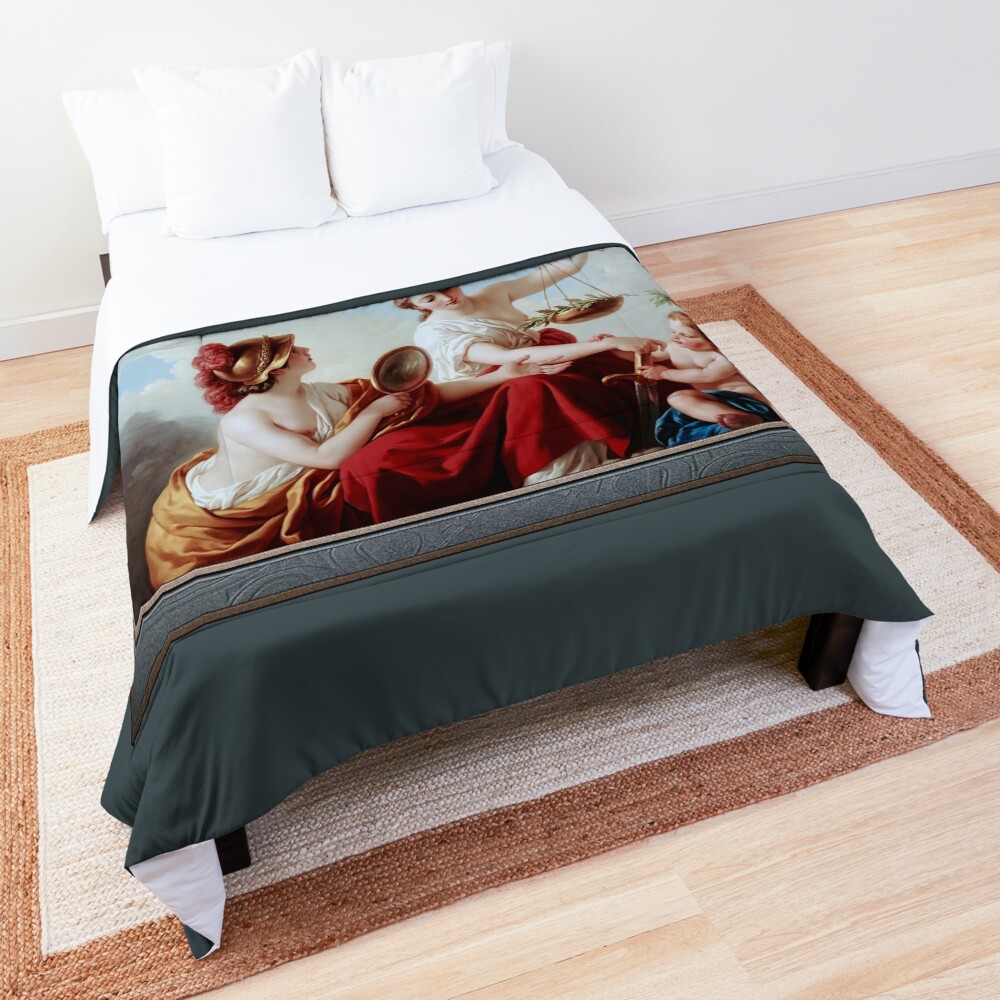
Louis-Jean-François Lagrenee’s “Justice Disarmed by Innocence and Applauded by Prudence,” malet rundt 1766, exemplifies the Rococo style prevalent in French art of the mid-18th century. This allegorical painting, currently housed within a private collection, presents a captivating scene brimming with classical references and symbolic meaning. Lagrenee, known for his graceful figures and vibrant color palettes, masterfully depicts a moment of transition where established order encounters youthful purity. The artwork’s enduring appeal lies in its harmonious composition, delicate brushwork, and the compelling interplay between its personified virtues.
Indholdsfortegnelse
Kompositorisk harmoni & Rococo Aesthetics
The painting’s structure is carefully balanced, employing a pyramidal arrangement that draws the viewer’s eye towards the central figure of Justice. This compositional technique was common during the period, lending stability and grandeur to the scene. The background features a soft, atmospheric landscape with billowing clouds and hints of distant foliage, creating depth and enhancing the ethereal quality of the subject matter. Lagrenee’s Rococo style is evident in the painting’s emphasis on elegance, lightness, and decorative detail. The flowing drapery, the gentle curves of the figures, and the overall sense of movement contribute to this aesthetic.
Personification of Virtues: Justice, Uskyld & Prudence
The core narrative revolves around three personified virtues: Justice, Uskyld, and Prudence. Justice, traditionally depicted as a blindfolded woman holding scales, is shown relinquishing her sword – a symbol of legal authority – to a youthful figure representing Innocence. This act signifies the triumph of purity and naiveté over established systems.
Uskyld, portrayed as a fair-skinned young man with flowing hair, gently guides Justice’s hand, his expression conveying tenderness and reassurance. To the right, Prudence, an older woman adorned in rich fabrics, observes the scene with a knowing smile, offering her silent approval. Her presence underscores the wisdom inherent in embracing innocence and adapting to changing circumstances.
Symbolic Details & Kunstnerisk Teknik
Lagrenee’s meticulous attention to detail enhances the painting’s symbolic richness. The scales held by Justice are perfectly balanced, suggesting impartiality and fairness. The laurel wreath adorning Innocence alludes to victory and honor. Prudence’s attire, rich in color and texture, speaks to her experience and discernment. Lagrenee’s technique is characterized by a delicate application of paint, creating soft transitions between colors and highlighting the figures’ smooth skin tones. He skillfully uses light and shadow to model forms and create a sense of depth, further enhancing the painting’s visual appeal. The artist’s use of warm hues – golds, creams, and rosy pinks – contributes to the overall feeling of warmth and serenity.
Historisk kontekst & Lagrenee’s Legacy
Lagrenee was a prominent figure in the French art world during the reign of Louis XV. His work often reflected the prevailing philosophical currents of the Enlightenment, emphasizing reason, dyd, and humanism. “Justice Disarmed by Innocence and Applauded by Prudence” can be interpreted as an allegory for societal change and the potential for renewal through embracing new perspectives.
Lagrenee’s legacy extends beyond his individual works; he influenced a generation of artists with his elegant style and skillful depiction of classical subjects. His paintings remain highly regarded for their beauty, teknisk beherskelse, and insightful commentary on human nature. The painting is an excellent example of how allegorical art was used to convey complex ideas in a visually engaging manner during the 18th century.
A Timeless Representation of Virtue
“Justice Disarmed by Innocence and Applauded by Prudence” remains a captivating work of art, inviting viewers to contemplate the enduring power of virtue and the importance of embracing change. Lagrenee’s masterful execution and thoughtful symbolism ensure that this painting continues to resonate with audiences centuries after its creation. It stands as a testament to the artist’s skill and the enduring appeal of allegorical art within the Rococo tradition.
Kunstner bio afledt fra Wikipedia.org
Louis blev født i Paris, Frankrig i 1724, og var den ældste af to brødre, begge bestemt til at blive kendte franske malere; og fra en tidlig alder demonstrerede en evne til at tegne og male.
Louis startede sit kunstneriske gennem Royal School of Protected Pupils eller Royal School for Protected Pupils, som blev etableret i 1748 under ledelse af Charles Antoine Coypel (1694 – 1752) af kongen af Frankrig Ludvig XV.
Malermestrene fra det franske kongelige akademi tilbød kunstneriske kurser til offentligheden mod et nominelt gebyr i tegning og kunstens principper og teknikker; dette ville give masterne mulighed for at vælge blandt dem, der tilmeldte sig kurset, seks af de mest begavede personer på årsbasis, der ville blive tilbudt gratis undervisning og et lille stipendium i tre år; og forberede eleverne til Prix de Rome konkurrencerne.
Efter at han blev udvalgt til programmet, Louis begyndte sin uddannelse under vejledning af Carle van Loo (1705 – 1765); og på sit første forsøg i 1749 vandt Prix de Rome med sit bibelske maleri “Josef tolker Faraos drømme”.
I løbet af sin tid på det franske akademi i Rom ville Louis dedikere sin tid til barokmaleriet; som var inspireret af Bologneseskolen og de italienske malere Francesco Albanis værker (1578 – 1660) og Guido Reni (1575–1642).
Fire år senere ville han vende tilbage til Frankrig, og begyndte arbejdet med The Abduction of Dejaneira af Kentauren Nessus; efter at have afsluttet stykket 2 år senere i 1755, det skaffede ham med enstemmighed, medlemskab af Akademiet for Maleri og Skulptur; etablerede ham som en fremtrædende maler.
Fra dette tidspunkt af ville Louis modtage mange opgaver fra fremtrædende lånere, medlemmer af det voksende finansielle samfund, samt kongelige; da han fangede Elizabeth Petrovnas opmærksomhed, Kejserinde af Rusland, WHO, i 1760, udnævnte ham til hofmaler og direktør for Akademiet ved St. Petersburg.
Dette er en remastered digital art old masters reproduktion af et offentligt domæne billede, der er tilgængeligt som en rullet lærred print online.