

Justice Disarmed by Innocence and Applauded by Prudence
Justice Yielding to Innocence: A Lagrenee Masterpiece
Louis-Jean-François Lagrenee’s “Justice Disarmed by Innocence and Applauded by Prudence,”Herumgemalt 1766, exemplifies the Rococo style prevalent in French art of the mid-18th century. This allegorical painting, currently housed within a private collection, presents a captivating scene brimming with classical references and symbolic meaning. Lagrenee, known for his graceful figures and vibrant color palettes, masterfully depicts a moment of transition where established order encounters youthful purity. The artwork’s enduring appeal lies in its harmonious composition, zarte Pinselführung, and the compelling interplay between its personified virtues.
Inhaltsverzeichnis
Kompositorische Harmonie & Rococo Aesthetics
The painting’s structure is carefully balanced, employing a pyramidal arrangement that draws the viewer’s eye towards the central figure of Justice. This compositional technique was common during the period, lending stability and grandeur to the scene. The background features a soft, atmospheric landscape with billowing clouds and hints of distant foliage, creating depth and enhancing the ethereal quality of the subject matter. Lagrenee’s Rococo style is evident in the painting’s emphasis on elegance, lightness, und dekoratives Detail. The flowing drapery, the gentle curves of the figures, and the overall sense of movement contribute to this aesthetic.
Personification of Virtues: Gerechtigkeit, Unschuld & Prudence
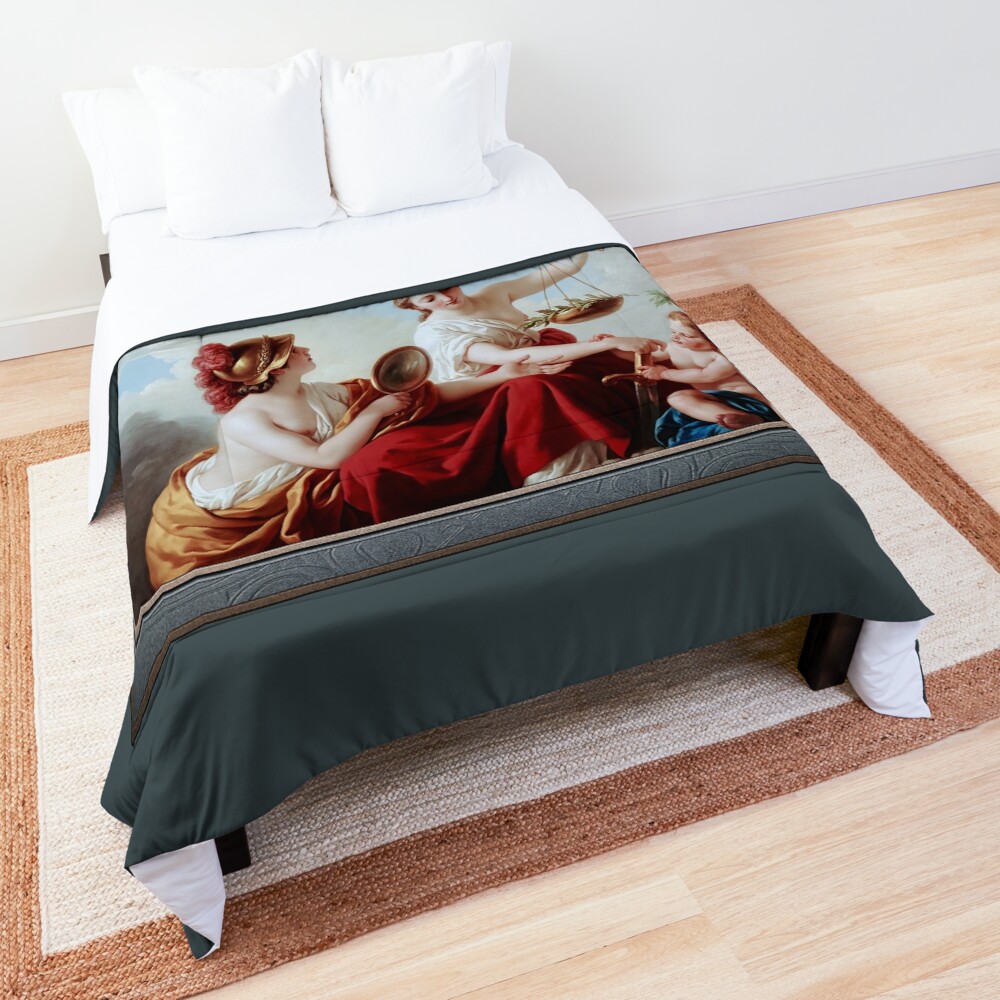
The core narrative revolves around three personified virtues: Gerechtigkeit, Unschuld, and Prudence. Gerechtigkeit, traditionally depicted as a blindfolded woman holding scales, is shown relinquishing her sword – a symbol of legal authority – to a youthful figure representing Innocence. This act signifies the triumph of purity and naiveté over established systems.
Unschuld, portrayed as a fair-skinned young man with flowing hair, gently guides Justice’s hand, his expression conveying tenderness and reassurance. Nach rechts, Prudence, an older woman adorned in rich fabrics, observes the scene with a knowing smile, offering her silent approval. Her presence underscores the wisdom inherent in embracing innocence and adapting to changing circumstances.
Symbolische Details & Künstlerische Technik
Lagrenee’s meticulous attention to detail enhances the painting’s symbolic richness. The scales held by Justice are perfectly balanced, suggesting impartiality and fairness. The laurel wreath adorning Innocence alludes to victory and honor. Prudence’s attire, reich an Farbe und Textur, speaks to her experience and discernment. Lagrenee’s technique is characterized by a delicate application of paint, creating soft transitions between colors and highlighting the figures’ smooth skin tones. He skillfully uses light and shadow to model forms and create a sense of depth, further enhancing the painting’s visual appeal. The artist’s use of warm hues – golds, Cremes, and rosy pinks – contributes to the overall feeling of warmth and serenity.
Historischer Kontext & Lagrenee’s Legacy
Lagrenee was a prominent figure in the French art world during the reign of Louis XV. His work often reflected the prevailing philosophical currents of the Enlightenment, emphasizing reason, Tugend, and humanism. “Justice Disarmed by Innocence and Applauded by Prudence” can be interpreted as an allegory for societal change and the potential for renewal through embracing new perspectives.
Lagrenee’s legacy extends beyond his individual works; he influenced a generation of artists with his elegant style and skillful depiction of classical subjects. His paintings remain highly regarded for their beauty, technische Meisterschaft, and insightful commentary on human nature. The painting is an excellent example of how allegorical art was used to convey complex ideas in a visually engaging manner during the 18th century.
A Timeless Representation of Virtue
“Justice Disarmed by Innocence and Applauded by Prudence” bleibt ein fesselndes Kunstwerk, Es lädt die Zuschauer ein, über die dauerhafte Kraft der Tugend und die Bedeutung der Akzeptanz von Veränderungen nachzudenken. Lagrenees meisterhafte Ausführung und durchdachte Symbolik sorgen dafür, dass dieses Gemälde noch Jahrhunderte nach seiner Entstehung beim Publikum Anklang findet. Es ist ein Beweis für das Können des Künstlers und die anhaltende Anziehungskraft der allegorischen Kunst innerhalb der Rokoko-Tradition.
Künstler Bio abgeleitet von Wikipedia.org
Louis wurde in Paris geboren, Frankreich in 1724, und war der älteste von zwei Brüdern, Beide sollten bekannte französische Maler werden; und zeigte schon in jungen Jahren eine Begabung zum Zeichnen und Malen.
Louis begann seine künstlerische Karriere an der Royal School of Protected Pupils oder der Royal School for Protected Pupils, die gegründet wurde 1748 unter der Leitung von Charles Antoine Coypel (1694 – 1752) vom französischen König Ludwig XV.
The master painters of the French Royal Academy offered artistic course to the public for a nominal fee in drawing and the principles and techniques of art; this would allow the masters to select from those who enrolled in the course, six of the most gifted individuals on an annual basis that would be offered free tuition and a small stipend for three years; and prepare the students for the Prix de Rome competitions.
After he was selected for the program, Louis began his training under the guidance of Carle van Loo (1705 – 1765); and on his first attempt in 1749 won the Prix de Rome with his Biblical painting “Joseph interpreting the dreams of Pharaoh”.
During his time at the French Academy in Rome Louis would dedicate his time to the Baroque painting style; which was inspired by the Bolognese School and the works of Italian Painters Francesco Albani (1578 – 1660) and Guido Reni (1575–1642).
Four years later he would return to France, and began work on The Abduction of Dejaneira by the Centaur Nessus; upon finishing the piece 2 Jahre später in 1755, it earned him with a unanimous vote, membership to the Académie de Peinture and Sculpture; establishing him as a prominent painter.
From this time on Louis would receive many commissions from eminent patrons, members of the growing financial community, as well as royalty; when he caught the attention of Elizabeth Petrovna, Empress of Russia, als er und sein Bruder in einen Schiffbruch auf der Seine in Frankreich verwickelt waren, im 1760, appointed him court painter and the director of the Academy at St. Petersburg.
Dies ist eine remasterte digitale Kunst-Reproduktion alter Meister eines gemeinfreien Bildes, das als verfügbar ist gerollter Leinwanddruck online.