

Paisaje en las altas montañas
La pintura titulada Paisaje en las Altas Montañas por el pintor holandés Alexander Joseph Daiwaille (1818 – 1888) invita al espectador a una escena tranquila y atemporal ambientada en las majestuosas tierras altas de un mundo alpino. Creado a mediados del siglo XIX., esta obra maestra ejemplifica la capacidad excepcional de Daiwaille para capturar la belleza natural y la profundidad atmosférica de los terrenos montañosos., invocando una sensación de serena grandeza y aislamiento distante..
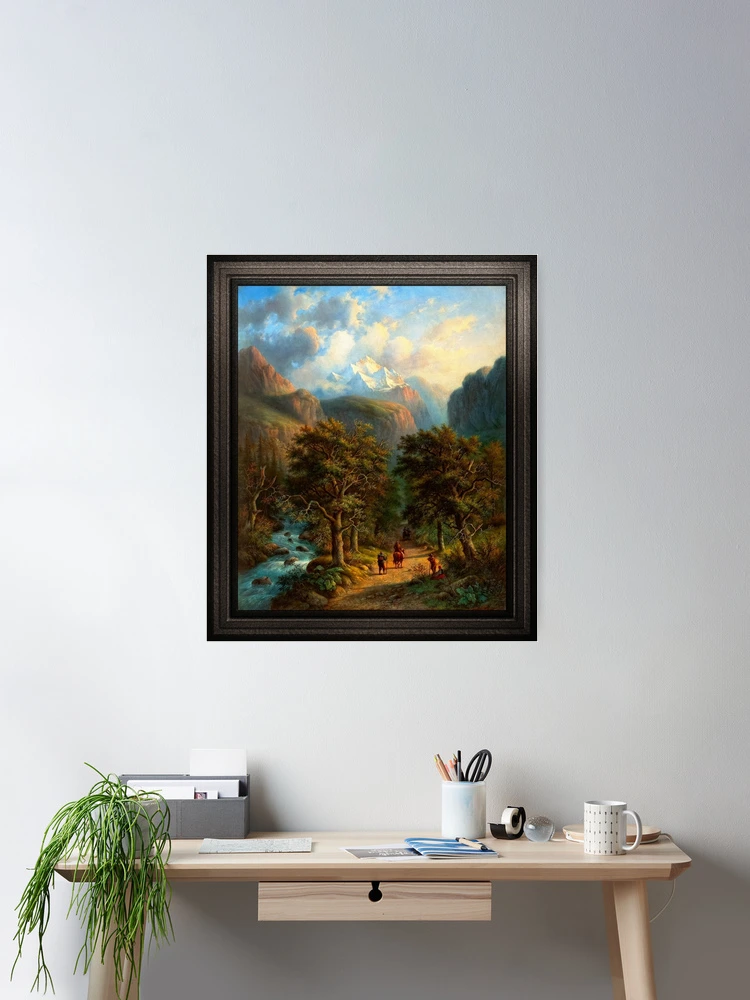
Tabla de contenido
El tema principal y la composición.
En el corazón de esta pintura se encuentra el extenso paisaje montañoso., con imponentes picos bañados en suave, luz dorada. La mirada del espectador se dirige hacia las cumbres nevadas del fondo., sus bordes dentados contrastan marcadamente con el suave, rolling slopes below. These mountains stand like silent sentinels, guarding the verdant valley and lush forests that stretch beneath them. The artist masterfully uses atmospheric perspective, with the distant mountains rendered in paler tones, progressively fading into the horizon, creating a depth that is both striking and immersive.
en primer plano, the focus shifts to the path meandering through a forested area, leading the viewer’s eye from the bottom-left corner toward the distant peaks. Lo suave, winding road curves through the middle of the composition, inviting the viewer to follow the trail as it gently disappears around the bend, suggesting an unexplored world beyond. Along this road, two figures can be seen traveling on horseback, their forms small yet significant, perhaps signifying the quiet, humble passage of time within the vastness of nature. Their presence in the painting suggests a subtle narrative of journey or migration, enhancing the timelessness of the scene.
Los detalles del terreno y el paisaje.
Daiwaille’s attention to the terrain is meticulous and adds great realism to the landscape. en primer plano, a gently flowing stream runs parallel to the path, its water tumbling over smooth stones, reflecting the surrounding greenery. The clear water creates a reflective surface, which contrasts beautifully with the darker tones of the forest, further enhancing the visual depth of the painting. The presence of the stream also adds a sense of serenity and calm, inviting the viewer to imagine the gentle sounds of the babbling brook as they explore the landscape in their mind.
The surrounding forest, lush with trees, es una cuidada mezcla de roble y pino, su corteza texturizada y su follaje verde vibrante contrastan con el tono dorado del cielo. Los árboles están densamente poblados en algunas áreas., sus ramas se entrelazan para crear un dosel natural, mientras que en otros, los árboles se destacan, permitiendo vislumbrar el terreno rocoso y el camino debajo. La cuidadosa representación de luces y sombras dentro del bosque por parte del artista crea una atmósfera de misterio., como si el bosque guardara secretos conocidos sólo por la tierra y el cielo.
La presencia de cadenas montañosas distantes más allá del valle sugiere un mundo vasto e inexplorado.. El primer plano sirve como una pequeña ventana a esta naturaleza grandiosa e indómita., con el camino y el arroyo actuando como rutas simbólicas hacia lo desconocido, fomentando la exploración. This juxtaposition between the familiar and the distant is part of the charm of Daiwaille’s work, as it instills a sense of wonder and adventure.
Materiales y Técnicas
Daiwaille was known for his skillful use of oil paints, and this work is no exception. Los ricos, luminous quality of the paint brings an almost three-dimensional quality to the landscape, allowing the viewer to feel the textures of the trees, rocas, and flowing water. The artist’s ability to manipulate light and color creates an ethereal atmosphere, particularly in the depiction of the sky and its soft interplay of warm, golden tones that gently blend into the cool blues of the higher altitudes. This use of color heightens the emotional depth of the painting, evoking a mood of peaceful solitude.
The brushwork in this piece is confident and refined, con trazos más amplios utilizados en la representación del cielo y las montañas., mientras más detallado, Se emplean trazos intrincados en la representación del follaje., las figuras, y el camino sinuoso. Esta técnica contrasta la amplia extensión de la naturaleza con la delicada presencia de la humanidad., Reforzando el tema general de la pintura de la armonía entre el hombre y la naturaleza..
El estado de ánimo y el tema
El estado de ánimo de Paisaje en las Altas Montañas es uno de tranquilidad y asombro. Hay una quietud palpable en el aire., una silenciosa reverencia por el mundo natural que envuelve toda la composición. Los colores y la luz del cuadro evocan una sensación de paz., sin embargo, también hay una corriente subyacente de grandeza, ya que la magnitud de las montañas y las amplias vistas provocan sentimientos de asombro y humildad.. Las figuras que viajan por el valle son pequeñas en el vasto telón de fondo de la naturaleza., suggesting a theme of human insignificance in comparison to the enduring and timeless beauty of the natural world.
This theme of human solitude amidst the overwhelming power and beauty of nature is central to the Romantic movement, which sought to explore the relationship between humans and the sublime. Daiwaille, as a Romantic painter, captures not just the physical beauty of the landscape, but also its emotional and philosophical weight. The path through the forest is not just a route for the travelers; it symbolizes the journey of the soul, the personal quest for understanding and connection with the vast and mysterious world around us.
Esta es una reproducción de viejos maestros de arte digital retocada de una imagen de dominio público.
Biografía del artista derivada de Wikipedia.org
Alejandro era hijo del retratista Jean Augustin Daiwaille. (1786 – 1850) y nació en Amsterdam, Países Bajos, en enero 21 de 1818.
Aunque, al igual que su padre, Alexander se especializó en retratos en la primera parte de su carrera.; Con el tiempo pasaría a pintar paisajes de los Países Bajos y Alemania..
Pintó escenas en Holanda., que incluía a Hilversum de 1833 – 1834, la haya de 1840 – 1848; luego en Alemania, incluida Kleve de 1834 – 1835 y 1840 – 1848.
También trabajó con su cuñado Barend Cornelis Koekkoek. (1803 – 1862) un paisajista y litógrafo holandés.