

Cruth-tìre Na Beanntan Àrd
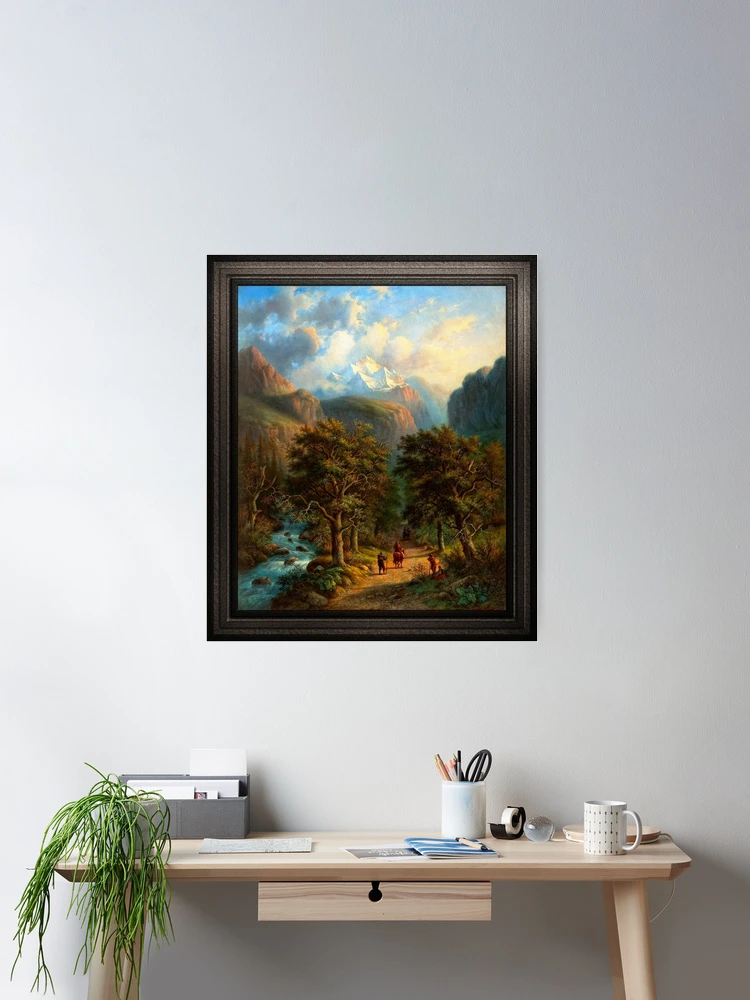
An dealbh leis an tiotal Landscape in the High Mountains by Dutch painter Alexander Joseph Daiwaille (1818 – 1888) invites the viewer into a tranquil and timeless scene set in the majestic highlands of an alpine world. Created in the mid-19th century, this masterpiece exemplifies Daiwaille’s exceptional ability to capture the natural beauty and atmospheric depth of mountainous terrains, invoking a sense of serene grandeur and distant isolation.
Clàr-innse
Am prìomh chuspair agus a 'sgrìobhadh
At the heart of this painting lies the expansive mountainous landscape, with towering peaks bathed in soft, solas òir. The viewer’s gaze is drawn toward the snow-capped summits in the background, their jagged edges sharply contrasting with the smooth, rolling slopes below. These mountains stand like silent sentinels, guarding the verdant valley and lush forests that stretch beneath them. The artist masterfully uses atmospheric perspective, with the distant mountains rendered in paler tones, progressively fading into the horizon, creating a depth that is both striking and immersive.
Ri aghaidh na deilbh, the focus shifts to the path meandering through a forested area, leading the viewer’s eye from the bottom-left corner toward the distant peaks. Am bog, winding road curves through the middle of the composition, inviting the viewer to follow the trail as it gently disappears around the bend, suggesting an unexplored world beyond. Along this road, two figures can be seen traveling on horseback, their forms small yet significant, perhaps signifying the quiet, humble passage of time within the vastness of nature. Their presence in the painting suggests a subtle narrative of journey or migration, enhancing the timelessness of the scene.
The Terrain and Landscape Details
Daiwaille’s attention to the terrain is meticulous and adds great realism to the landscape. Ri aghaidh na deilbh, a gently flowing stream runs parallel to the path, its water tumbling over smooth stones, reflecting the surrounding greenery. The clear water creates a reflective surface, which contrasts beautifully with the darker tones of the forest, further enhancing the visual depth of the painting. The presence of the stream also adds a sense of serenity and calm, inviting the viewer to imagine the gentle sounds of the babbling brook as they explore the landscape in their mind.
A’ choille mun cuairt, lush with trees, tha e na mheasgachadh faiceallach de dharach is giuthais, tha an rùsg teacsach agus an duilleach uaine beòthail aca an aghaidh dath òir nan speur. Tha na craobhan làn phasgan ann an cuid de sgìrean, na meuran aca ag eadar-fhighe gus canopy nàdarra a chruthachadh, agus ann an cuid eile, tha na craobhan a' seasamh air leth, a' toirt sealladh dhuinn air an talamh chreagach agus an rathad gu h-ìosal. Tha sealladh faiceallach an neach-ealain de sholas is dubhar taobh a-staigh na coille a’ cruthachadh faireachdainn de dhìomhaireachd, mar gum biodh dìomhaireachdan aig a’ choille a tha aithnichte a-mhàin don tìr agus don adhar.
Tha làthaireachd bheanntan fad às taobh a-muigh a’ ghlinne a’ nochdadh saoghal a tha farsaing agus neo-aithnichte. Tha aghaidh an deilbh na uinneag bheag a-steach don fhàsach mhòr gun ainm seo, leis an t-slighe agus an t-sruth ag obair mar shlighean samhlachail a-steach don neo-aithnichte, a’ brosnachadh rannsachadh. This juxtaposition between the familiar and the distant is part of the charm of Daiwaille’s work, as it instills a sense of wonder and adventure.
Stuthan agus dhòighean
Daiwaille was known for his skillful use of oil paints, and this work is no exception. Na beairteach, luminous quality of the paint brings an almost three-dimensional quality to the landscape, allowing the viewer to feel the textures of the trees, creagan, and flowing water. The artist’s ability to manipulate light and color creates an ethereal atmosphere, particularly in the depiction of the sky and its soft interplay of warm, golden tones that gently blend into the cool blues of the higher altitudes. This use of color heightens the emotional depth of the painting, evoking a mood of peaceful solitude.
The brushwork in this piece is confident and refined, with broader strokes used in the depiction of the sky and mountains, while more detailed, intricate strokes are employed in the rendering of the foliage, na figearan, and the winding path. This technique contrasts the broad expanse of nature with the delicate presence of humanity, reinforcing the painting’s overarching theme of harmony between man and nature.
Am faireachdainn agus an cuspair
Faireachdainn de Landscape in the High Mountains is one of tranquility and awe. There is a palpable stillness in the air, a quiet reverence for the natural world that envelops the entire composition. The colors and light in the painting evoke a sense of peace, yet there is also an undercurrent of grandeur, as the sheer scale of the mountains and the sweeping vistas provoke feelings of awe and humility. The figures traveling through the valley are small against the vast backdrop of nature, suggesting a theme of human insignificance in comparison to the enduring and timeless beauty of the natural world.
This theme of human solitude amidst the overwhelming power and beauty of nature is central to the Romantic movement, which sought to explore the relationship between humans and the sublime. Daiwaille, as a Romantic painter, captures not just the physical beauty of the landscape, but also its emotional and philosophical weight. The path through the forest is not just a route for the travelers; it symbolizes the journey of the soul, the personal quest for understanding and connection with the vast and mysterious world around us.
Is e seo ath-riochdachadh seann mhaighstirean ealain didseatach ath-riochdachadh de ìomhaigh raon poblach.
Neach-ealain bi a thàinig bho Wikipedia.org
Alexander was the son of portrait painter Jean Augustin Daiwaille (1786 – 1850) and was born in Amsterdam the Netherlands on January 21 de 1818.
Ged a bha e coltach ri athair Alasdair gu sònraichte ann an dealbhan camara tràth na dhreuchd; ghluaiseadh e mu dheireadh gu bhith a’ peantadh cruthan-tìre na h-Òlaind agus na Gearmailt.
Pheant e seallaidhean anns an Òlaind, a bha a’ toirt a-steach Hilversum bho 1833 – 1834, na Hàig bho 1840 – 1848; an uairsin sa Ghearmailt a’ toirt a-steach Kleve bho 1834 – 1835 agus 1840 – 1848.
Bha e cuideachd ag obair còmhla ri a bhràthair-cèile Barend Cornelis Koekkoek (1803 – 1862) Peantair Cruth-tìre Duitseach agus Lithographer.