

Laurel
Laurel del pintor checo Alphonse Mucha (1860 – 1939); así como un ilustrador y artista gráfico consumado que fue una fuerza importante del período Art Nouveau; conocido por su estilizado, carteles teatrales ornamentados y decorativos..
This is a wonderful illustration of an attractive young lady presented in the art nouveau style in a side portrait view within a circular view port.
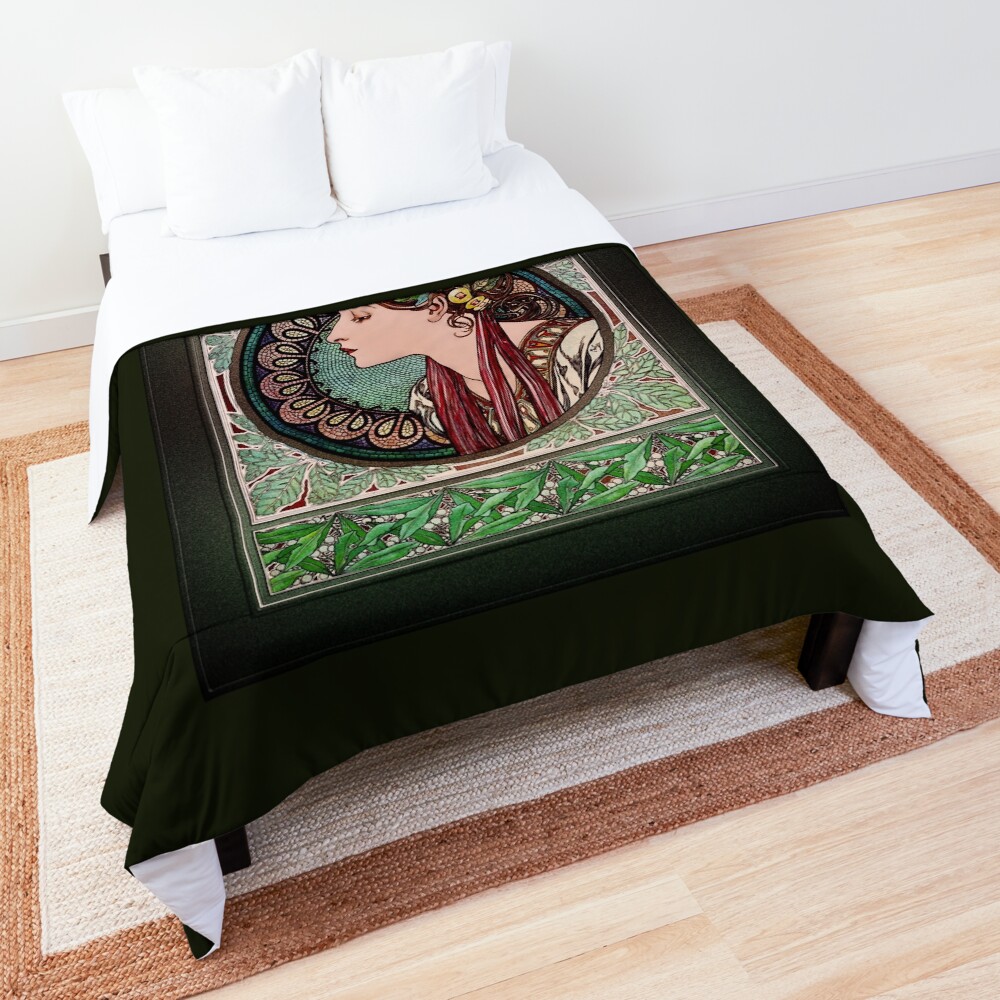
She is positioned in front of a circular tiled background at the inner core that is overlaid with wide tiled ring with with oval tiled shapes and then to a two layer tiled ring and finally a solid ring.
She has brown curly hair with yellow streaks running throughout with long strands of hair hanging on both side of her neck from the back of her head that are red and light pink.
Her hair is tied mid way on the top by a red ribbon and on the left side of her hair just above her ear is a flower with leaves; and below this is a head piece composed of disc that wraps around the back of her head.
She is wearing a white dress with a large wide collar that wraps around the entire upper portion of the dress that is decorated in colorful triangular and cone like designs.
Around this inner frame is a square frame filled with green plants that are directed to the four corners of the frame; and on the top and bottom of this frame are two rectangular boxes filled with plants and fruit, with the top box being smaller than the bottom box.

This all tied together with a separator the fits along the perimeter of the three different frames.
Esta es una reproducción de maestros antiguos de arte digital remasterizada de una imagen de dominio público que está disponible como impresión de lienzo en línea.
Información debajo de Wikipedia.org
Alfonso María Mucha July 24, 1860 – mes de julio 14, 1939), era conocido internacionalmente como Alphonse Mucha. Fue un destacado pintor checo, ilustrador y artista gráfico, vivir en París durante el período Art Nouveau, y es mejor conocido por sus carteles teatrales decorativos y estilizados, particularmente los de Sarah Bernhardt.
Produjo ilustraciones, anuncios, paneles decorativos, y diseños, que se convirtió en una de las imágenes más conocidas del período.
En la segunda parte de su carrera, a la edad de 43, Regresó a su tierra natal de la región de Bohemia-Moravia en Austria y se dedicó a pintar una serie de veinte lienzos monumentales conocidos como La epopeya eslava., que representa la historia de todos los pueblos eslavos del mundo, que pintó entre 1912 y 1926.
En 1928, en el décimo aniversario de la independencia de Checoslovaquia, presentó la serie a la nación checa. Lo consideró su obra más importante. Ahora está en exhibición en Praga..