

Le Sommeil: A Study in Restful Repose by Aimée Pagès-Brune
Aimée Pagès-Brune (1803 – 1866) was a French artist whose career flourished during the Romantic era, a period known for its emphasis on emotion and individualism. While less celebrated than some of her contemporaries, Pagès-Brune carved out a significant space for herself within the Parisian art scene, particularly recognized for her intimate depictions of women in domestic settings. “Le Sommeil,” or “The Sleep,”Peint autour 1830, exemplifies this focus, offering a glimpse into a private moment of tranquility and vulnerability. The artwork is currently housed at Musée Crozatier in Le Mans, La France.
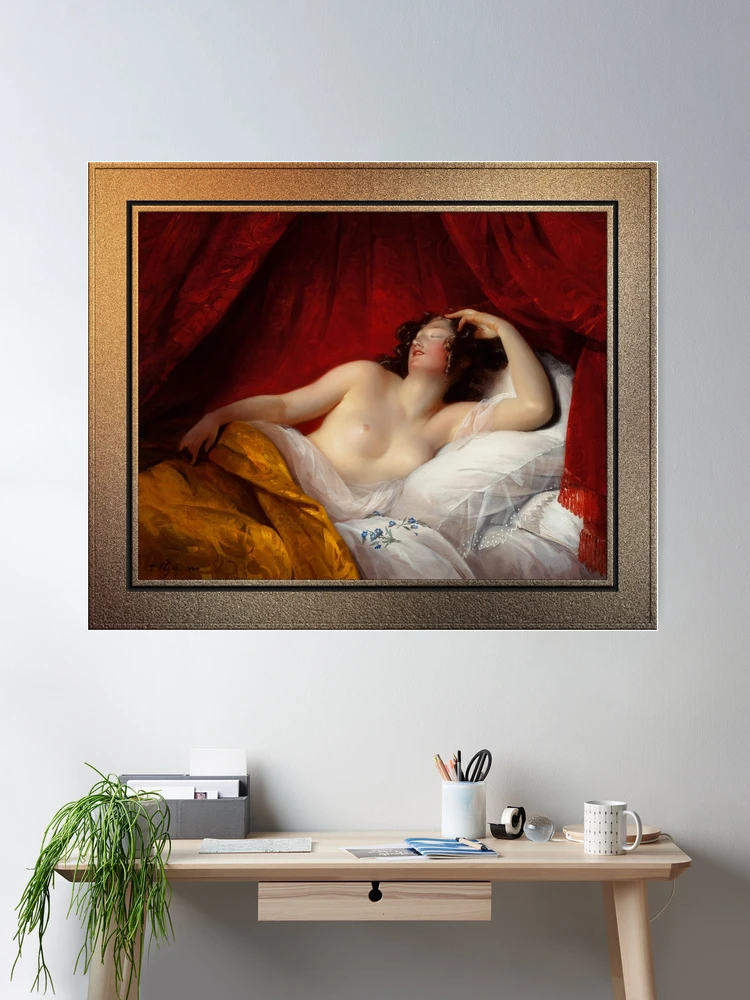
Table des matières
Éléments de composition & Technique
The painting’s composition immediately draws the viewer’s attention to the central figure: une nu woman reclining languidly upon a bed. The arrangement isn’t rigidly structured; plutôt, it possesses an organic flow that mirrors the naturalness of sleep itself. Pagès-Brune masterfully utilizes a triangular structure, with the woman forming the apex and the draped fabrics creating the base. This compositional choice provides stability while simultaneously guiding the eye across the canvas.
The artist’s technique is characterized by loose brushstrokes and a delicate handling of light and shadow. The application of paint isn’t smooth or blended; plutôt, it retains a visible texture that contributes to the overall sense of immediacy and intimacy. This approach aligns with the Romantic aesthetic, which favored expressive mark-making over meticulous realism. The use of impasto is evident in areas like the folds of the bedclothes and the highlights on the woman’s skin, ajouter de la profondeur et de la dimension à la scène.
Palette de couleurs & Éclairage
A rich and warm color palette dominates “Le Sommeil.” The dominant hues are variations of red, crème, et de l'or, creating a sense of warmth and comfort. A large crimson curtain forms a dramatic backdrop, its deep tones contrasting with the lighter shades of the bed linens and the woman’s skin. This contrast enhances the figure’s luminosity and draws attention to her form.
The lighting in the painting is soft and diffused, suggesting an early morning or late evening hour. It appears to emanate primarily from an unseen source outside the frame, gently illuminating the scene without harsh shadows. The subtle gradations of light across the woman’s body highlight the curves of her form while maintaining a sense of quietude. The interplay of light and shadow contributes significantly to the painting’s overall mood of peacefulness and repose.
Objet & Contexte
“Le Sommeil” is part of a broader artistic trend in 19th-century France that focused on depicting scenes of domestic life, particularly those involving women. These paintings often explored themes of privacy, intimité, and the idealized image of womanhood within the home. pourtant, Pagès-Brune’s approach differs from some of her contemporaries; she avoids overt sentimentality or moralizing narratives. Au lieu, she presents a straightforward observation of a woman at rest, emphasizing the beauty and serenity of the moment.
The painting reflects the broader cultural context of the Romantic era, which valued emotion, imagination, and individual expression. The focus on interior spaces and private moments aligns with this emphasis on subjectivity and introspection. While not overtly political or socially critical, “Le Sommeil” subtly challenges conventional representations of women by portraying her in a state of vulnerability and relaxation, free from the constraints of public scrutiny.
Influences artistiques & Héritage
Pagès-Brune’s work demonstrates influences from several artistic traditions. La composition et le sujet présentent des similitudes avec des œuvres d'artistes comme Jean-Auguste-Dominique Ingres., connu pour ses représentations néoclassiques de figures féminines au repos. pourtant, Le pinceau plus lâche de Pagès-Brune et l'utilisation plus expressive de la couleur distinguent son style de la technique précise et raffinée d'Ingres..
en outre, la peinture fait écho à des éléments trouvés dans les œuvres de maîtres antérieurs comme Peter Paul Rubens, en particulier dans sa représentation de la forme humaine et l'utilisation dramatique des draperies. Pagès-Brune synthétise habilement ces influences en une voix artistique unique, à la fois élégante et émotionnellement résonnante..
Bien qu'elle ait été quelque peu négligée de son vivant, L’héritage de Pagès-Brune a été réévalué au cours des dernières décennies. “Le Sommeil” témoigne de son talent et de sa vision, offrant un aperçu fascinant du monde de l'art français du XIXe siècle et de l'évolution du rôle des femmes artistes dans cette sphère. La peinture reste un exemple important de l'art de l'ère romantique, célébré pour sa représentation intime du repos féminin et son exécution habile.
Vidéo de retouche de l'œuvre d'art classique Le Sommeil c1830 by Aimée Brune Pagès
Biographie de l'artiste dérivée de Wikipedia.org
Aimée Brune Pagès était une élève du peintre historique français Charles Meynier (1763 ou alors 68 – 1832) des événements de la fin du 18e et du début du 19e siècle. Pendant son temps, elle était sous le règne de plusieurs régimes politiques, qui comprenait La Restauration, La monarchie de juillet, La Seconde République et le Second Empire.
Elle est considérée comme l'une des femmes peintres françaises les plus respectées, et elle expose régulièrement au Salon de 1822 à 1853; collaborant parfois avec son mari, le peintre paysagiste français Christian Brune (1793 – 1849).
Il s'agit d'une reproduction de maîtres anciens d'art numérique retouchée d'une image du domaine public.