

Temps libre
Temps libre c1874 par le peintre allemand Ludwig Thiersch-Niedziela (1825 – 1909); principalement de sujets religieux et mythologiques.
C'est une belle paysage peinture d'un jeune couple au bord d'une rivière, avec leur barque juste à droite de la scène et d'autres ramant sur la rivière.
Le jeune homme en veste habillée, un gilet et un pantalon gris et une chemise blanche avec nœud papillon reposent près d'un grand arbre avec un carnet de croquis, regarder est un sujet, la jeune femme avec qui il est qui est vêtue d'une robe blanche pleine longueur avec un col haut et des volants et des manches longues également avec des volants et un tour de cou noir.
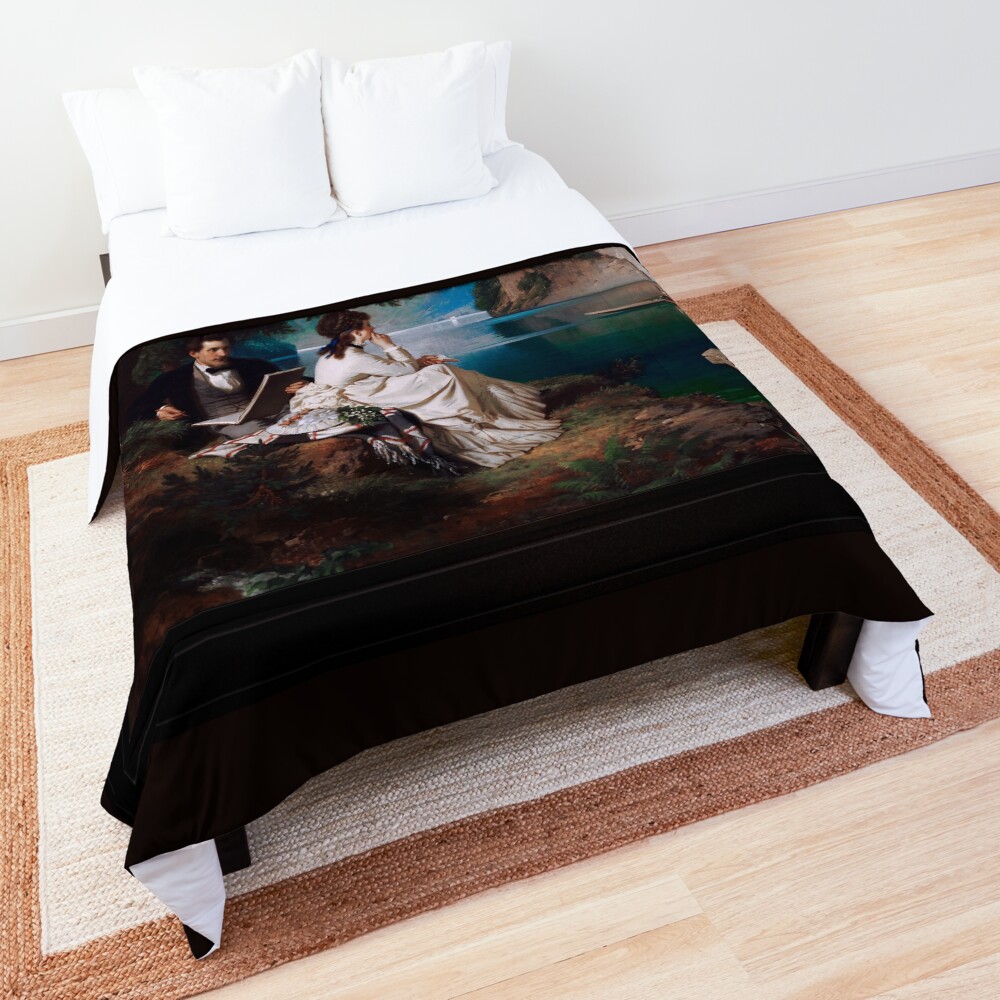
Ses cheveux sont tressés et enroulés autour de sa tête, maintenu en place par un ruban bleu avec un accent rouge sur le côté, et à côté d'elle se trouve son châle à pompons; qui ont un grand motif à rayures grises et blanches accentué par deux fines rayures rouges le long des bords de la partie blanche du châle; avec son chapeau orné de fleurs posé sur le châle.
Dans la scène on voit des plantes, des arbustes et des fleurs ainsi que des arbres ainsi que la grande étendue de la rivière, d'énormes falaises et des montagnes au loin.
Leisure Time est une reproduction retouchée de maîtres anciens d'art numérique d'une image du domaine public.
Informations ci-dessous dérivées de Wikipedia.org
Ludwig était le fils du classique (étude classique de l'antiquité) et philhellène (mouvement intellectuel pour l'admiration de la Grèce au tournant du 19ème siècle) Frédéric Thiersch, qui est né à Munich en Allemagne en 1825.
Il avait deux frères aînés; l'un était le chirurgien Karl Thiersch (1822 – 1895) et l'autre était le théologien H. W. J. Thiersch (1817 – 1885).
Ludwig began is artistic education as an attendee of the Academy of Fine Arts in Munich, studying sculpture; but after a few years changed over to painting and became the student of three German Painters; Heinrich Maria von Hess (1798 – 1863) of the Nazarene Movement (a German Romantic Movement who’s aim was to revive spirituality in art); Julius Schnorr von Carolsfeld (1794 – 1872 ), primarily a painter of biblical subjects, and Karl Schorn (1803 – 1850), as well as a painter he was also a chess master.
After completing his studies at the Academy of Fine Arts 1848, he painted the pieces Sakuntala (is the wife of Dushyanta and the mother of Emperor Bharata), and a scene of Camissards (were Huguenots or French Protestants who held to the Reformed, or Calvinist, tradition of Protestantism. n the early 1700s, they raised a resistance against the persecutions which followed Louis XIV’s Edict of Fontainebleau, making Protestantism illegal.)
On the completion of these works he then ventured off to Rome, Italie; where he sketched scenes of the daily lives of the Italian people and painted the piece Hiob unter seinen Freunden (Job among his friends ).
Dans 1852 he made he traveled to Athens, Greece with his father, where he replaced Italian Painter, Physician and amateur Archaeologist Rafaello Ceccoli (1800 – 1850); at the Athens School of Fine Arts; becoming interested in Byzantine Art.
During this from 1852 – 1855 Ludwig would painting several frescoes in Greek Churches and was a leading member of the movement to modernize Byzantine Art by introducing Western elements, such as naturalistic perspective and anatomy; which met with fierce Greek opposition from those that saw such reforms as a means of replacing longstanding Greek Traditions with foreign ones.
Throughout the rest of his life Ludwig would travel to different cities painting for patrons and creating frescoes for churches, which was particularly notable along with the wor done by Italian Painter Ludwig Seitz (1844 – 1908) and French Jean-Hippolyte Flandrin (1809 – 1864); he is considered to have led the revival in Western European Ecclesiastical Art.