

Leisure Time
Leisure Time c1874 by German Painter Ludwig Thiersch-Niedziela (1825 – 1909); primarily of religious and mythological subjects.
Dit is in prachtige lânskip painting of a young couple setting on the bank of a river, with their rowboat just off to the right of the scene and others rowing on the river.
The young man in a dress jacket, gray vest and pants and white shirt with bow tie is resting near a large tree with a sketch book, looking at is subject, the young lady that he is with who is dressed in a full length white dress with a high neck and ruffles and long sleeves also with ruffles and black choker.
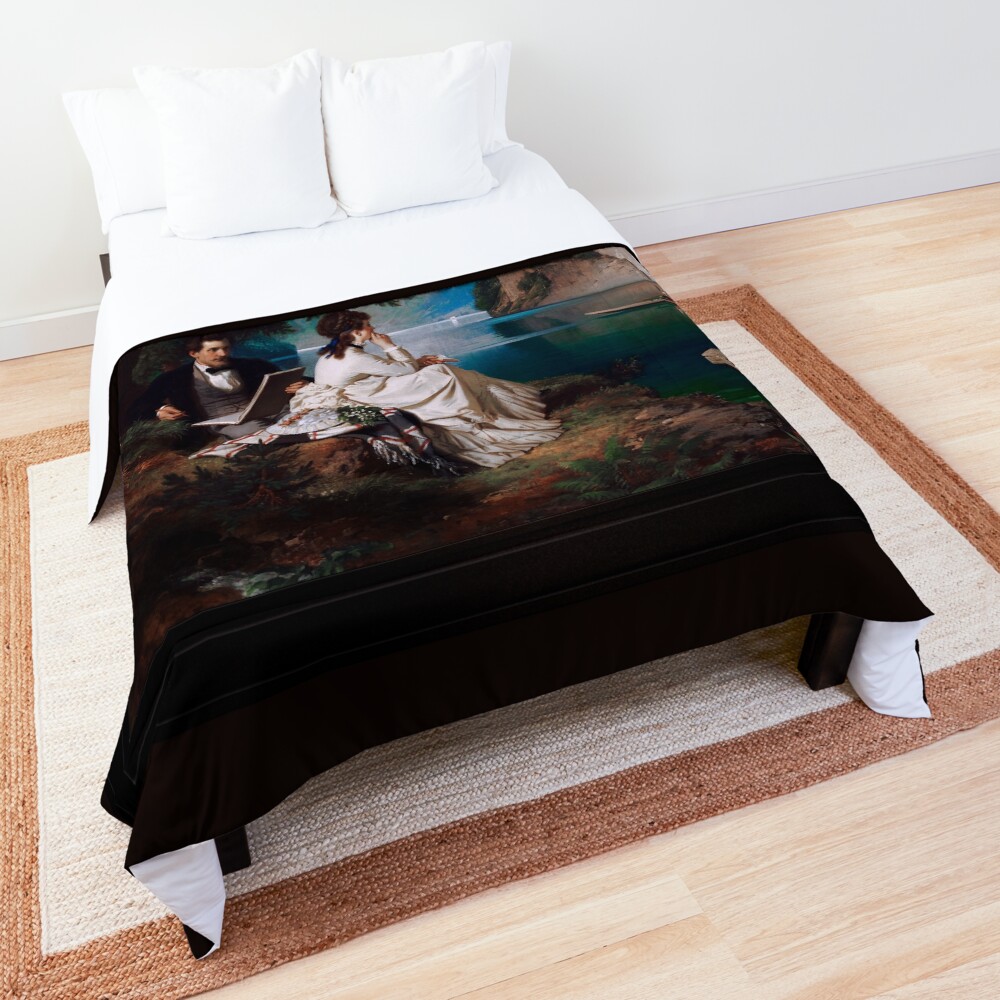
Her hair is braided and wrapped around her head, held in place with a blue ribbon with a red accent on the side, and beside her is her shawl with tassels; that have a large gray and white stripe pattern accented with dual thin red stripes along the edges of the white part of the shawl; with her hat that is embellished with flowers resting on the shawl.
In the scene we see plants, shrubs and flowers along with the trees as well as the large expanse of the river, huge cliffs and mountains in the far distance.
Leisure Time is a retouched digital art old masters reproduction of a public domain image.
Info hjirûnder ôflaat fan Wikipedia.org
Ludwig was the son of the classicist (classical study of antiquity) and philhellene (intellectual movement for the admiration of Greece at the turn of 19th century) Friedrich Thiersch, who was born in Munich Germany in 1825.
Hy hie twa âldere bruorren; ien wie de sjirurch Karl Thiersch (1822 – 1895) en de oare wie de teolooch H. W. J. Thiersch (1817 – 1885).
Ludwig begûn syn artistike oplieding as dielnimmer oan de Akademy foar Byldzjende Keunsten yn München, studearje byldhoukeunst; mar nei in pear jier feroare nei skilderjen en waard de studint fan trije Dútske skilders; Heinrich Maria von Hess (1798 – 1863) fan de Nazarene Beweging (in Dútske Romantyske Beweging dy't it doel wie om spiritualiteit yn 'e keunst te doen herleven); Julius Schnorr von Carolsfeld (1794 – 1872 ), benammen in skilder fan bibelske ûnderwerpen, en Karl Schorn (1803 – 1850), likegoed as skilder wie er ek skaakmaster.
Nei syn stúdzje oan de Akademy foar Byldzjende Keunsten 1848, hy skildere de stikken Sakuntala (is de frou fan Dushyanta en de mem fan keizer Bharata), en in sêne fan Camissards (were Huguenots or French Protestants who held to the Reformed, or Calvinist, tradition of Protestantism. n the early 1700s, they raised a resistance against the persecutions which followed Louis XIV’s Edict of Fontainebleau, making Protestantism illegal.)
On the completion of these works he then ventured off to Rome, Itaalje; where he sketched scenes of the daily lives of the Italian people and painted the piece Hiob unter seinen Freunden (Job among his friends ).
Yn 1852 he made he traveled to Athens, Greece with his father, where he replaced Italian Painter, Physician and amateur Archaeologist Rafaello Ceccoli (1800 – 1850); at the Athens School of Fine Arts; becoming interested in Byzantine Art.
During this from 1852 – 1855 Ludwig would painting several frescoes in Greek Churches and was a leading member of the movement to modernize Byzantine Art by introducing Western elements, such as naturalistic perspective and anatomy; which met with fierce Greek opposition from those that saw such reforms as a means of replacing longstanding Greek Traditions with foreign ones.
Throughout the rest of his life Ludwig would travel to different cities painting for patrons and creating frescoes for churches, which was particularly notable along with the wor done by Italian Painter Ludwig Seitz (1844 – 1908) and French Jean-Hippolyte Flandrin (1809 – 1864); he is considered to have led the revival in Western European Ecclesiastical Art.