

Lily Fairy c1888
Luis Ricardo Falero, né dans 1851 et décéder dans 1896, was a Spanish painter of remarkable skill, and his artwork titled fée lys, créé dans 1888, stands as a testament to his expertise in rendering ethereal subjects. Known for his romantic and mythical approach, Falero often depicted women in a range of fantasy and allegorical settings. Dans ce travail particulier, fée lys, he captures the beauty of a mythical creature, a fairy who embodies both the ethereal and the terrestrial, her form blending seamlessly into the natural surroundings that encircle her. The piece merges the dreamlike quality of the mythical world with the meticulous attention to natural detail typical of the artist’s style.
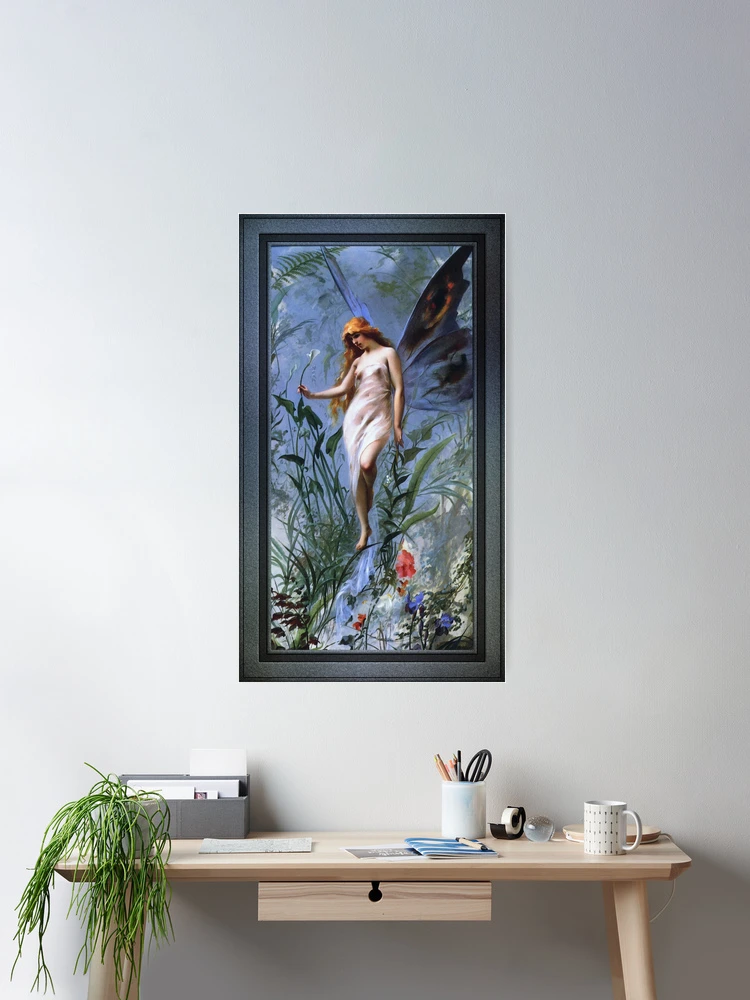
Table des matières
Sujet principal: The Lily Fairy
Le personnage central de fée lys is a delicate, ethereal fairy standing amidst a lush forested backdrop. Sa longue, golden hair flows freely, a visual extension of her otherworldly essence. This character, draped in a translucent, robe fluide, carries a subtle air of vulnerability and grace. The gown itself is a delicate white, nearly blending into the light surroundings of the forest, reflecting the diaphanous nature of the fairy. Falero’s skillful use of light and shade accentuates her lithe form, almost making her appear to float, caught between the realms of fantasy and reality.
The fairy’s wings, which rise gently behind her, are painted with a mix of bright and muted hues, shimmering in a way that suggests the fragility of her presence. These wings are depicted with a certain detail, resembling that of a butterfly’s delicate texture, inviting the viewer to both admire their beauty and wonder at their delicate strength. The artist’s handling of her wings suggests a supernatural connection with nature, as if the fairy herself is an embodiment of the surrounding plant life and flowers. Sa pose, one arm slightly raised and holding a lily flower, gives her an air of graceful serenity, further linking her image with the purity and grace of nature.
Le terrain: A Lush Garden of Life
The environment in fée lys is a vibrant representation of a natural world brimming with life. Surrounding the fairy are various plants, fleurs, and green foliage that seem to thrive in harmony with her. The landscape is dense with greenery, soft sweeping fronds of ferns and thick, undulating blades of grass, interspersed with clusters of colorful blooms. These flowers, mostly in shades of red, mauve, et blanc, contribute to the dreamlike atmosphere, their bright petals stark against the more muted greens of the foliage. Falero’s meticulous brushwork brings these elements of nature to life, each leaf and flower rendered with a clarity and precision that showcases his ability to capture the organic beauty of the world around him.
The background is soft and blurred, creating a sense of depth and a feeling that the fairy is standing at the boundary between the known and the unknown, between the familiar world of flora and the mystical world that she inhabits. This boundary is marked subtly by the slight distortion of the plants surrounding her, suggesting that they, trop, are part of the enchanted realm that the fairy occupies.
Style et thème
Falero’s style in fée lys reflects a combination of Romanticism and Symbolism, genres that often explore the intersection between the natural world and the supernatural. This fairy, like many of the mythological subjects depicted by Falero, is shown as a creature of beauty and grace, yet her fragile form and connection to nature hint at an ephemeral existence. La technique de l'artiste, a combination of fine brushwork and gentle transitions of color, evokes a sense of movement and breath within the stillness of the painting. His use of soft, blended light against darker shadows enhances the mystical atmosphere, creating a soft halo around the fairy’s figure.
The theme of the artwork is one of harmony between the magical and the natural, illustrating a world where the two are intimately connected. The fairy seems to emerge from the very earth itself, her form perfectly integrated with the flora that surrounds her. This suggests that Falero was interested not only in the beauty of women but also in exploring their symbolic relationship with nature. The fairy, in this light, is more than a mythical being; she represents a harmonious integration between humanity and the environment, an idealized version of purity and beauty.
Humeur et atmosphère
L'ambiance de fée lys is serene and tranquil, with an underlying sense of delicate mysticism. The soft color palette dominated by pastel tones and gentle greens, evokes a feeling of peacefulness, as though the viewer has been transported into a quiet, enchanted glade. The fairy herself embodies an air of calm, her gaze downward, presque mélancolique, as though lost in a reverie. The surrounding flora further enhances this quiet mood, its lush, abundant growth suggesting a peaceful, undisturbed natural world where everything is in balance.
pourtant, beneath the peaceful serenity, there is also a subtle sense of fleetingness. The fairy’s translucent dress, the soft light surrounding her, and the ephemeral nature of her wings all contribute to a feeling that this moment is precious and will not last forever. This transient quality is a hallmark of Falero’s approach, capturing a snapshot of a world that exists only in the viewer’s imagination.
Conclusion
Luis Ricardo Falero’s fée lys is a captivating example of his ability to merge realism with fantasy, creating a magical, ethereal world that is both grounded in nature and transcendent of it. The delicate fairy, surrounded by a lush, vibrant garden, becomes a symbol of the harmony between the supernatural and the natural world. Through his meticulous attention to detail and his ethereal handling of light and color, Falero invites the viewer to step into a world of tranquility and beauty, where the boundaries between the real and the fantastical blur into a singular, harmonious vision.
Lily Fairy est une reproduction de maîtres anciens d'art numérique retouchée d'une image du domaine public.
Biographie de l'artiste dérivée Wikipedia.org
Falero est né à Grenade et a d'abord poursuivi une carrière dans la marine espagnole, mais a abandonné à la déception de ses parents; comme il a décidé de voyager à Paris, où il a étudié l'art, chimie et génie mécanique.
Pendant ses études en chimie et génie mécanique; il considérait les expériences qu'il devait mener trop dangereuses, l'amenant ainsi à concentrer son attention sur la peinture seule.
En conséquence, il est devenu un élève du portraitiste et orientaliste français Gabriel-Joseph-Marie-Augustin Ferrier (1847 – 1914). Après Paris, il a déménagé à Londres, où il a poursuivi ses études, et finalement réglé.
Falero avait un intérêt particulier pour l'astronomie et a incorporé des constellations célestes dans plusieurs de ses œuvres, tel que “Le mariage d'une comète” et “Étoiles jumelles”. Son intérêt et sa connaissance de l'astronomie l'ont également amené à illustrer les œuvres de Camille Flammarion.
Dans 1896, l'année de sa mort, Maud Harvey a poursuivi Falero pour paternité. La poursuite alléguait que Falero avait séduit Harvey alors qu'elle était 17, servant d'abord de femme de chambre, puis son modèle. Quand il a découvert qu'elle était enceinte, il l'a renvoyée.
Elle a gagné l'affaire et a reçu cinq shillings par semaine pour soutenir leur enfant. Falero est décédé au University College Hospital, Londres, à l'âge de 45