

Nymphe
Nymphe: A Study in Romantic Idealism by Luis Ricardo Falero
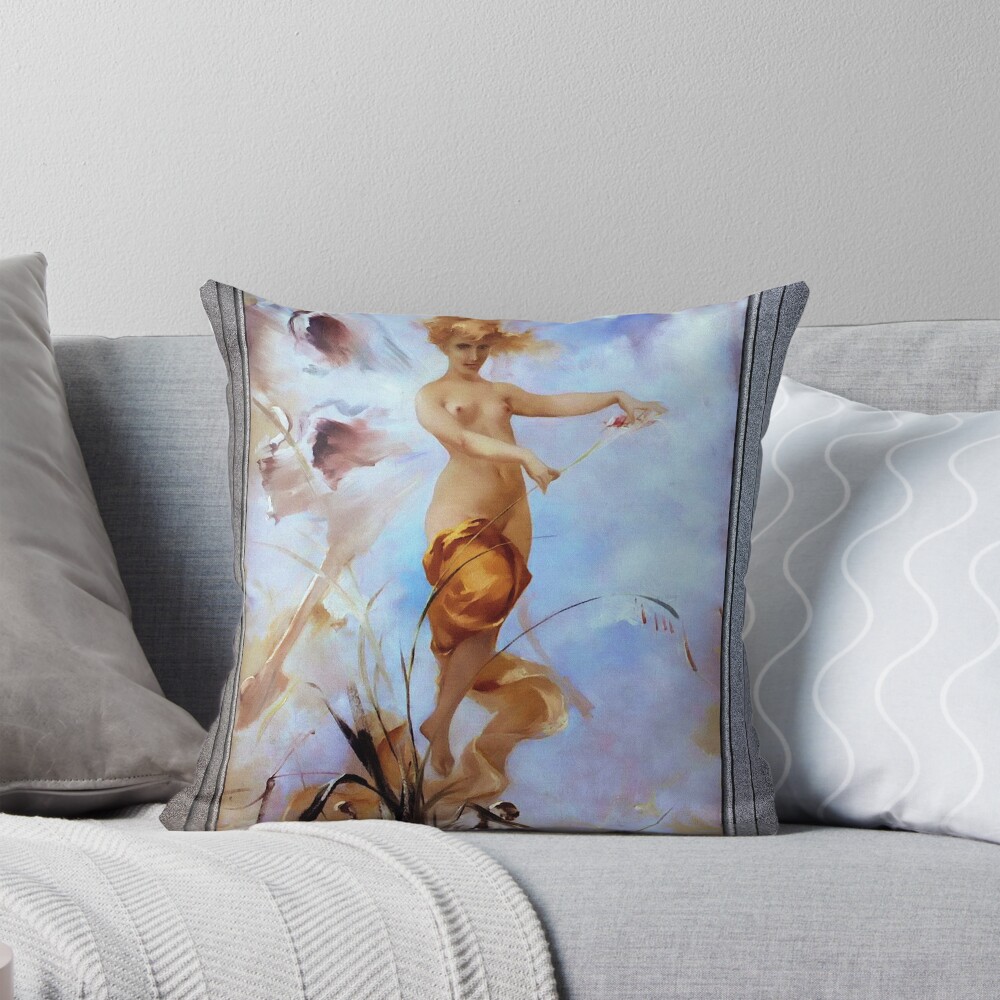
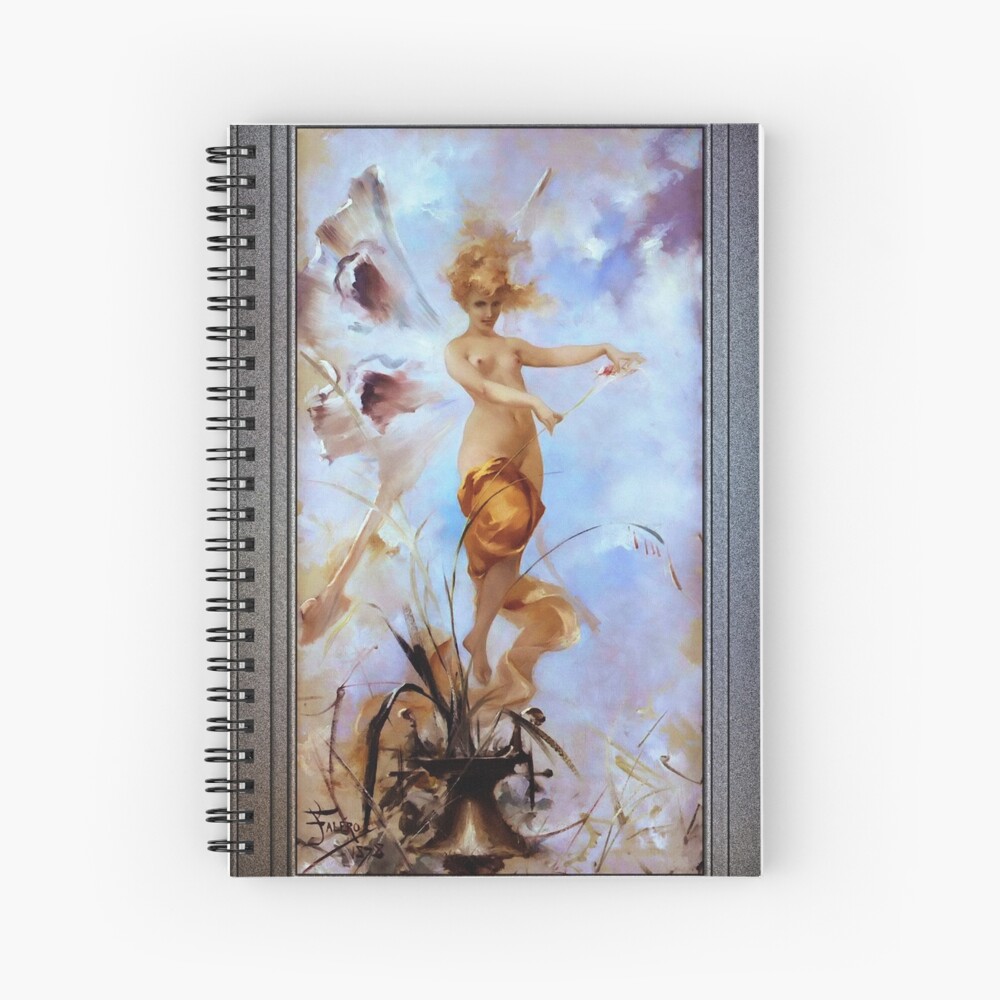
Luis Ricardo Falero’s “Nymph,”Peint autour 1878, is a captivating example of late 19th-century Spanish academic painting, deeply rooted in the traditions of Neoclassicism and infused with the burgeoning aesthetic sensibilities of Symbolism. The artwork presents a solitary female figure – a nymph – poised within an ethereal landscape, evoking a sense of dreamlike tranquility and classical beauty. Falero’s work reflects the artistic climate of his time, where mythological subjects were frequently employed to explore themes of idealized femininity, nature’s allure, et le sublime.
Éléments de composition & Technique
Table des matières
The composition is vertically oriented, drawing the viewer’s eye upwards towards the nymph who occupies the central space. She stands atop a cluster of reeds and grasses that rise from what appears to be an ornate vessel or urn at the base of the painting. This placement elevates her, visually separating her from the background and emphasizing her importance within the scene.
The background itself is rendered in soft, hazy tones of lavender, rose, et bleu pâle, suggesting a cloudy sky or atmospheric perspective. These colors contribute significantly to the overall sense of otherworldliness. Falero’s brushwork is characterized by a delicate blending of colors, créer une douceur, almost porcelain-like finish on the nymph’s skin. The details in her hair are meticulously rendered, with individual strands cascading around her face and shoulders.
La figure: A Study in Classical Beauty
The nymph herself embodies the classical ideal of feminine beauty. Her pose is graceful and fluid; she extends one arm forward as if gesturing towards something unseen, while her other arm rests gently at her side. Her head is turned slightly to the left, creating a dynamic sense of movement within the otherwise static composition.
The figure’s nudity is presented in an un-sensual manner, devoid of any overt eroticism. Au lieu, it serves to highlight the purity and innocence associated with mythological figures. Falero’s treatment of the human form aligns with the academic tradition that prioritized anatomical accuracy and idealized proportions. Her hair is a vibrant golden hue, contrasting beautifully with her pale skin and the muted tones of the background. La draperie, a loosely wrapped cloth around her waist, adds another layer of visual interest without obscuring her form entirely.
Palette de couleurs & Perspective atmosphérique
Falero’s masterful use of color contributes significantly to the painting’s evocative atmosphere. The soft pastel hues create a sense of dreamlike serenity and contribute to the overall feeling of otherworldliness. The limited palette, dominated by pinks, violets, bleus, et or, reinforces the painting’s connection to Romanticism and Symbolism.
Falero skillfully employs atmospheric perspective, using lighter tones in the background to suggest distance and depth. This technique further enhances the ethereal quality of the scene, blurring the boundaries between reality and fantasy. The interplay of light and shadow across the nymph’s body creates a subtle sense of volume and form, adding to her three-dimensionality.
Symbolisme & Interprétation
While seemingly straightforward in its depiction, “Nymph” is rich with symbolic meaning. The nymph herself represents an idealized vision of feminine beauty and purity—a recurring motif in 19th-century art. The reeds and grasses symbolize the natural world, suggesting a connection between the nymph and the forces of nature.
The urn or vessel at the base could represent mortality or the passage of time, contrasting with the nymph’s eternal youthfulness. Falero’s painting can be interpreted as an exploration of themes such as beauty, innocence, and the relationship between humanity and the natural world. It reflects a broader cultural fascination with mythology and classical antiquity during this period.
Contexte artistique & Influence
Luis Ricardo Falero was a prominent Spanish painter known for his academic style and his depictions of mythological subjects. His work demonstrates a clear influence from Neoclassical artists such as Jacques-Louis David, but also reveals an emerging interest in the Symbolist movement, which emphasized subjective experience and emotional expression over realistic representation.
“Nymph” exemplifies Falero’s ability to synthesize these diverse influences into a unique artistic vision. L’accent mis par le tableau sur la beauté idéalisée et son atmosphère évocatrice s’alignent sur les tendances plus larges du romantisme et de l’esthétisme qui caractérisaient l’art européen du XIXe siècle..
Biographie de l'artiste dérivée Wikipedia.org
Falero est né à Grenade et a d'abord poursuivi une carrière dans la marine espagnole, mais a abandonné à la déception de ses parents; comme il a décidé de voyager à Paris, où il a étudié l'art, chimie et génie mécanique.
Pendant ses études en chimie et génie mécanique; il considérait les expériences qu'il devait mener trop dangereuses, l'amenant ainsi à concentrer son attention sur la peinture seule.
En conséquence, il est devenu un élève du portraitiste et orientaliste français Gabriel-Joseph-Marie-Augustin Ferrier (1847 – 1914). Après Paris, il a déménagé à Londres, où il a poursuivi ses études, et finalement réglé.
Falero avait un intérêt particulier pour l'astronomie et a incorporé des constellations célestes dans plusieurs de ses œuvres, tel que “Le mariage d'une comète” et “Étoiles jumelles”. Son intérêt et sa connaissance de l'astronomie l'ont également amené à illustrer les œuvres de Camille Flammarion.
Dans 1896, l'année de sa mort, Maud Harvey a poursuivi Falero pour paternité. La poursuite alléguait que Falero avait séduit Harvey alors qu'elle était 17, servant d'abord de femme de chambre, puis son modèle. Quand il a découvert qu'elle était enceinte, il l'a renvoyée.
Elle a gagné l'affaire et a reçu cinq shillings par semaine pour soutenir leur enfant. Falero est décédé au University College Hospital, Londres, à l'âge de 45
Nymph est une reproduction retouchée de maîtres anciens d'art numérique d'une image du domaine public disponible à l'achat sous forme d'acrylique., métal, bois, et Les Monuments de Paris par Hubert Robert.