

Lily Fairy c1888
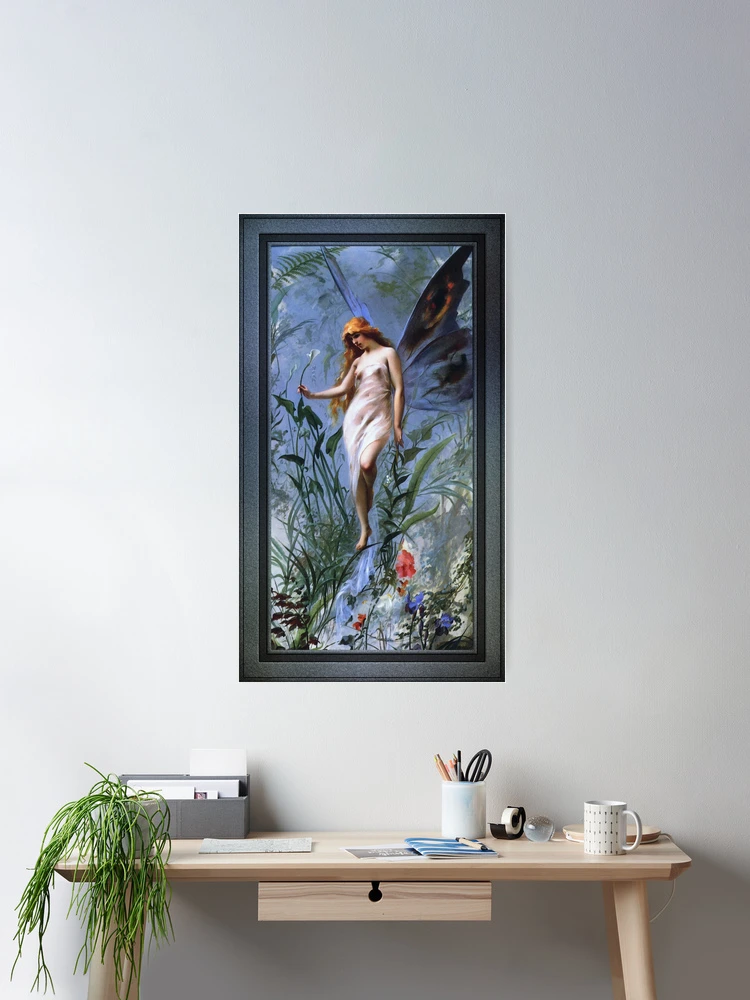
Luis Ricardo Falero, gebuer zu 1851 a passéiert fort 1896, was a Spanish painter of remarkable skill, and his artwork titled Lily Fee, erstallt an 1888, stands as a testament to his expertise in rendering ethereal subjects. Known for his romantic and mythical approach, Falero often depicted women in a range of fantasy and allegorical settings. An dësem speziellen Aarbecht, Lily Fee, he captures the beauty of a mythical creature, a fairy who embodies both the ethereal and the terrestrial, her form blending seamlessly into the natural surroundings that encircle her. The piece merges the dreamlike quality of the mythical world with the meticulous attention to natural detail typical of the artist’s style.
Inhaltsverzeechnes
Haaptthemium: The Lily Fairy
Déi zentral Figur an Lily Fee is a delicate, ethereal fairy standing amidst a lush forested backdrop. Hir laang, golden hair flows freely, a visual extension of her otherworldly essence. This character, draped in a translucent, fléissendem Kleed, carries a subtle air of vulnerability and grace. The gown itself is a delicate white, nearly blending into the light surroundings of the forest, reflecting the diaphanous nature of the fairy. Falero’s skillful use of light and shade accentuates her lithe form, almost making her appear to float, caught between the realms of fantasy and reality.
The fairy’s wings, which rise gently behind her, are painted with a mix of bright and muted hues, shimmering in a way that suggests the fragility of her presence. These wings are depicted with a certain detail, resembling that of a butterfly’s delicate texture, inviting the viewer to both admire their beauty and wonder at their delicate strength. The artist’s handling of her wings suggests a supernatural connection with nature, as if the fairy herself is an embodiment of the surrounding plant life and flowers. Hir Pose, one arm slightly raised and holding a lily flower, gives her an air of graceful serenity, further linking her image with the purity and grace of nature.
Den Terrain: A Lush Garden of Life
The environment in Lily Fee is a vibrant representation of a natural world brimming with life. Surrounding the fairy are various plants, Blummen, and green foliage that seem to thrive in harmony with her. The landscape is dense with greenery, soft sweeping fronds of ferns and thick, undulating blades of grass, interspersed with clusters of colorful blooms. Dës Blummen, mostly in shades of red, MOV, a Wäissen, contribute to the dreamlike atmosphere, hir hell Bléieblieder staark géint déi méi gedämpft Gréng vum Blieder. Dem Falero seng virsiichteg Pinselwierk bréngt dës Elementer vun der Natur zum Liewen, all Blat a Blummen mat enger Kloerheet a Präzisioun gemaach, déi seng Fäegkeet weist d'organesch Schéinheet vun der Welt ronderëm him z'erfaassen.
Den Hannergrond ass mëll an onscher, e Gefill vun Déift ze kreéieren an e Gefill datt d'Fee op der Grenz tëscht dem Bekannten an dem Onbekannte steet, tëscht der vertrauter Welt vun der Flora an der mystescher Welt, déi si bewunnt. Dës Grenz ass subtil markéiert duerch déi liicht Verzerrung vun de Planzen ronderëm si, suggeréiert datt si, ze, sinn Deel vum verzauberte Räich dat d'Fee besetzt.
Styl an Thema
Falero Stil an Lily Fee reflektéiert eng Kombinatioun vu Romantik a Symbolismus, genres that often explore the intersection between the natural world and the supernatural. This fairy, like many of the mythological subjects depicted by Falero, is shown as a creature of beauty and grace, yet her fragile form and connection to nature hint at an ephemeral existence. The artist’s technique, a combination of fine brushwork and gentle transitions of color, evokes a sense of movement and breath within the stillness of the painting. His use of soft, blended light against darker shadows enhances the mystical atmosphere, creating a soft halo around the fairy’s figure.
The theme of the artwork is one of harmony between the magical and the natural, illustrating a world where the two are intimately connected. The fairy seems to emerge from the very earth itself, hir Form perfekt integréiert mat der Flora déi si ëmginn. Dëst hindeit datt Falero net nëmmen un d'Schéinheet vun de Fraen interesséiert war, awer och fir hir symbolesch Relatioun mat der Natur z'erklären. D'Fee, an dësem Liicht, ass méi wéi e mythescht Wesen; si stellt eng harmonesch Integratioun tëscht Mënschheet an Ëmwelt duer, eng idealiséiert Versioun vu Rengheet a Schéinheet.
Stëmmung an Atmosphär
D'Stëmmung vum Lily Fee ass roueg a roueg, mat engem ënnerierdesche Gefill vu delikater Mystik. Déi mëll Faarfpalette dominéiert vu Pastelltéin a sanft Gréng, erënnert e Gefill vu Fridden, wéi wann de Betrachter an eng Rou transportéiert gouf, verzaubert Glade. D'Fee selwer verkierpert eng Loft vu Rou, hire Bléck no ënnen, bal wuel, wéi wann an engem Reverie verluer. D'Flora ëmginn verbessert dës roueg Stëmmung weider, seng lëschteg, reichend Wuesstum suggeréiert eng friddlech, undisturbed natural world where everything is in balance.
Allerdéngs, beneath the peaceful serenity, there is also a subtle sense of fleetingness. The fairy’s translucent dress, the soft light surrounding her, and the ephemeral nature of her wings all contribute to a feeling that this moment is precious and will not last forever. This transient quality is a hallmark of Falero’s approach, capturing a snapshot of a world that exists only in the viewer’s imagination.
Conclusioun
Luis Ricardo Falero’s Lily Fee is a captivating example of his ability to merge realism with fantasy, creating a magical, ethereal world that is both grounded in nature and transcendent of it. The delicate fairy, surrounded by a lush, vibrant garden, becomes a symbol of the harmony between the supernatural and the natural world. Through his meticulous attention to detail and his ethereal handling of light and color, Falero invites the viewer to step into a world of tranquility and beauty, where the boundaries between the real and the fantastical blur into a singular, harmonious vision.
Lily Fairy ass eng retouchéiert digital Konscht al Masters Reproduktioun vun engem Public Domain Bild.
Kënschtler Bio ofgeleet Wikipedia.org
De Falero gouf zu Granada gebuer an huet ursprénglech eng Karriär an der spuenescher Marine verfollegt, awer huet et seng Elteren Enttäuschung opginn; wéi hien decidéiert huet op Paräis ze reesen, wou hien Konscht studéiert huet, Chimie a Maschinnebau.
Wärend ass Studien a Chimie a Maschinnebau; hien huet d'Experimenter als déi hien huet misse maachen ze geféierlech betruecht, sou datt hien dozou féiert seng Opmierksamkeet eleng op Molerei ze fokusséieren.
Als Resultat gouf hie Student vum franséische Portraitmoler an Orientalist Gabriel-Joseph-Marie-Augustin Ferrier (1847 – 1914). No Paräis, hien ass op London geplënnert, wou hie weider studéiert huet, a schliisslech niddergelooss.
De Falero hat e besonneschen Interêt un der Astronomie an huet Himmelskonstellatiounen a ville vu senge Wierker agebaut, sou wéi “D'Bestietnes vun engem Koméit” an “Zwilling Stars”. Säin Interesse a Wësse vun der Astronomie hunn hien och dozou bruecht d'Wierker vum Camille Flammarion ze illustréieren.
An 1896, d'Joer vu sengem Doud, De Maud Harvey huet de Falero wéinst Pappa verklot. De Kostüm behaapt datt de Falero den Harvey verféiert huet wéi se war 17, als éischt säin Heemechtsdéngscht, an duerno säi Modell. Wéi hien entdeckt hatt war schwanger, hien huet hatt entlooss.
Si huet de Fall gewonnen a gouf fënnef Shilling pro Woch ausgezeechent fir hir Kanner z'ënnerstëtzen. De Falero ass am University College Hospital gestuerwen, London, am Alter vun 45