

Looking For Trouble
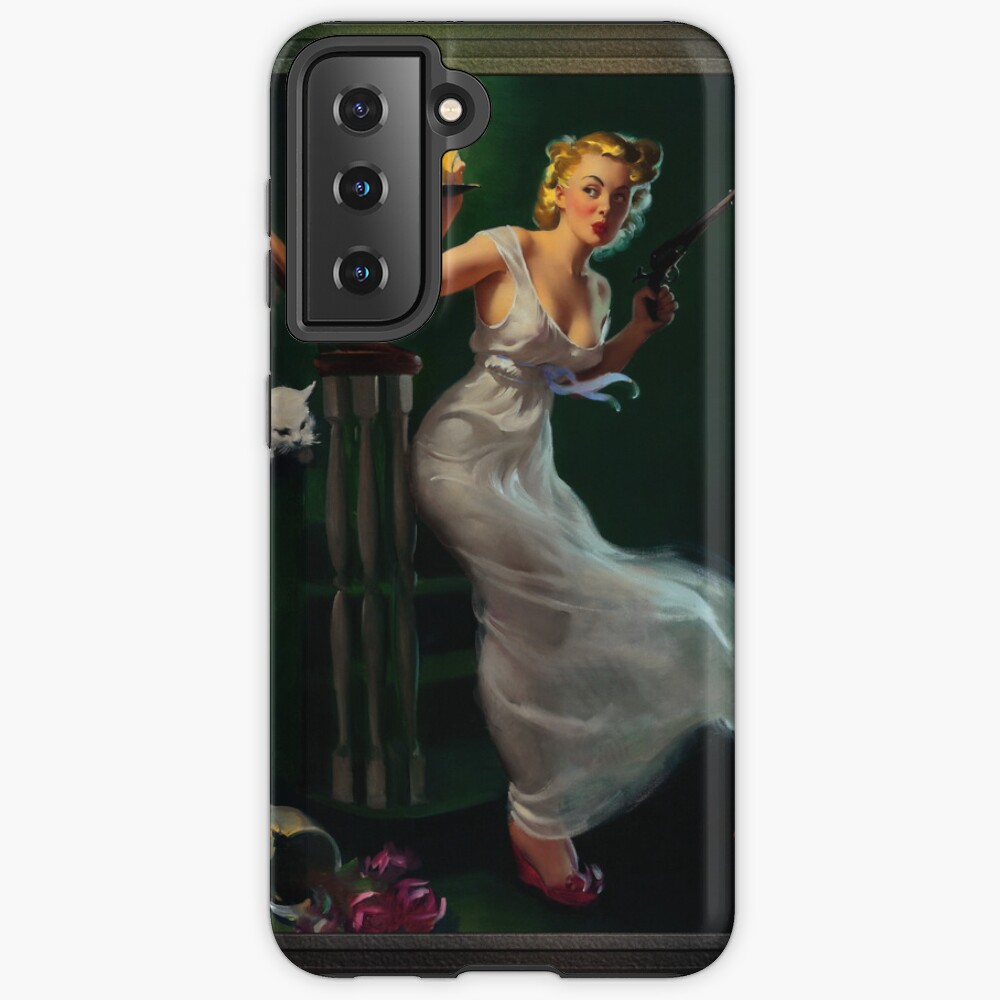
“Looking For Trouble” is an iconic artwork created by the renowned American painter Gil Elvgren. Known for his mastery in depicting the female form with a blend of charm and wit, Elvgren’s works often embody a distinct style that is at once nostalgic, playful, and highly evocative. Nascut a 1914 i morir en 1980, Elvgren’s legacy as a prominent pin-up artist remains firmly entrenched in the American art scene. This particular piece exemplifies his talent for capturing the timeless allure of mid-20th-century pin-up art while telling a story full of suspense and intrigue.
Taula de continguts
Tema principal
At the forefront of “Looking For Trouble” és una dona jove preparada en una escala en un acte que parla tant de vulnerabilitat com de determinació. La seva aparença està meticulosament dissenyada, amb tots els detalls, des del seu camisó blanc fluït fins als seus cabells ros desordenats, imbuïnt l'escena d'una sensació de dinamisme. La seva vestimenta, un lliscament senzill però elegant, és lleugerament transparent, potenciant la sensualitat subtil de l'obra d'art. El seu cos és capturat a mig moviment, li va aixecar la cama dreta, com si s'estigués retirant o es preparés per fugir.
La seva expressió és d'intriga cautelosa, amb els ulls amples i la boca cap amunt, evocant una barreja de sorpresa i atreviment. Sosté un llum a la mà esquerra, la llum càlida que vessa del recipient de vidre, contrastant amb el fons ombrívol. A la seva mà dreta, agafa un petit revòlver, mantinguda d'una manera defensiva però una mica insegura. La juxtaposició del llum, que simbolitza la seguretat, i la pistola, un instrument de possible perill, crea una atmosfera de tensió i incertesa.
Objectes i simbolisme
Els objectes de l'escena serveixen com a elements simbòlics que amplifiquen l'estat d'ànim de la pintura. El petit gat blanc a terra sota la dona afegeix un element de domesticitat, però la seva col·locació casual al costat de les escales també contrasta amb l'aparent alerta de la dona. Aquest animal pot suggerir innocència o la possibilitat d'un perill desapercebut. La pistola, per altra banda, introdueix un element de suspens, indicant que la dona podria estar reaccionant davant una amenaça invisible.
La llum de les espelmes és un altre objecte important de la peça. No només il·lumina la seva cara i projecta ombres dramàtiques sobre la seva forma, però també serveix com a metàfora de la vulnerabilitat i la fragilitat. The flame, burning brightly in a world of dark shadows, offers both literal and figurative light in a tense moment of uncertainty.
The presence of the staircase itself is a key architectural detail. It conveys a sense of upward or downward movement, suggesting that the woman may be trapped in her current position or on the verge of making a quick escape. The environment, cloaked in darkness and illuminated only by the soft light of the lamp, adds to the mysterious nature of the scene. The walls, dark and textured, amplify the sense of being confined or isolated.
Terreny i Medi Ambient
El terreny dins “Looking For Trouble” is minimal but significant. The staircase and the hallway surrounding the woman suggest an interior domestic setting, perhaps an old mansion or a cozy home. La foscor, rich tones of the woodwork, along with the shadows that seem to envelop the space, contribute to the overall mysterious and somewhat foreboding mood of the scene. The shadows in the background hint at an unseen world outside the woman’s immediate area, adding an element of suspense.
The way the light spills from the lantern in her hand creates pools of bright clarity in an otherwise dark environment, guiding the viewer’s eye directly to the woman’s form. The shadows that cling to the walls add depth to the scene, creating a sense of three-dimensionality that draws the viewer into the space. This clever manipulation of light and dark allows Elvgren to weave tension into the narrative of the painting.
Estil i tècnica
Gil Elvgren’s style in “Looking For Trouble” is rooted in the traditional techniques of realism, yet it is infused with an unmistakable sense of glamour and drama typical of mid-century pin-up art. His precise attention to detail, particularly in his rendering of the woman’s figure, emphasizes the sensual curves of her body, which was characteristic of his pin-up portraits. malgrat això, beyond mere physical beauty, Elvgren’s ability to capture a moment of emotional tension—one in which the woman might be confronted by danger or intrigue—elevates the work from a simple portrait into a narrative.
The rendering of light and shadow is masterful, with Elvgren’s use of chiaroscuro enhancing the dramatic impact of the scene. The way he plays with the contrasting elements of light from the lamp and the surrounding shadows helps reinforce the suspenseful and mysterious mood of the piece. The texture of the woman’s gown, the soft curls of her hair, and the delicate features of her face demonstrate Elvgren’s technical skill and understanding of human anatomy.
Estat d'ànim i tema
L'estat d'ànim de “Looking For Trouble” is one of suspense and intrigue, capturing a brief moment of potential danger. The young woman’s startled yet bold posture, combined with the symbolic elements of the gun and lantern, creates a narrative of tension, misteri, and possible trouble ahead. Her wide-eyed expression suggests that she may be confronted by an unseen foe, while her gun and poised stance indicate that she is ready to face whatever challenges arise. There is a sense of vulnerability in her posture—yet also a sense of control, as she seems ready to act in an uncertain situation.
The theme of this painting revolves around the concept of danger and the unexpected. The woman’s appearance in a vulnerable setting—her nightgown, her home—suggests a break from the ordinary into the realm of the unknown. The combination of innocence and threat, encapsulated by the woman’s attire and her readiness with a firearm, brings to mind the themes of adventure and bravery that were often woven into the tales of the era.
Elvgren’s use of color, composició, and light enhances the sense of drama, while the intimate setting adds an underlying layer of personal tension to the work. L'ambient és ple d'expectació, as if the viewer is witnessing the very moment before a crucial decision is made, making it a powerful narrative piece.
Conclusió
En conclusió, “Looking For Trouble” is a compelling work that captures the essence of mid-century American pin-up art, while also delving deeper into a moment of personal drama and suspense. Through his technical skill and careful composition, Gil Elvgren is able to transport the viewer into a world where beauty, perill, and mystery intersect in a captivating and timeless narrative.
Es tracta d'una reproducció d'antics mestres d'art digital remasteritzada d'una imatge de domini públic que està disponible com a Impressió de tela en línia.
Biografia de l'artista derivada de Wikipedia.org
Gillette A.. Elvgren va néixer a St.. Paul, Minnesota, i va assistir a l'escola secundària universitària. Després de la graduació, va començar a estudiar art al Minneapolis Institute of Arts.
Més tard es va traslladar a Chicago per estudiar a l'Acadèmia Americana d'Art, i es va graduar de l'Acadèmia durant la gran depressió, als vint-i-dos anys.
Després de graduar-se, Elvgren es va unir a l'estable d'artistes de Stevens i Gross, L’agència de publicitat més prestigiosa de Chicago, i es va convertir en un protegit de l'artista Haddon Sundblom.
En 1937, Gil va començar a pintar pin-ups del calendari per a Louis F.. Dow, una de les principals empreses editorials nord-americanes, durant aquest temps va crear aproximadament 60 pin-up girl treballa sobre tela de 22 "× 28" i les distingeix per una signatura impresa.
Molts dels seus pin-ups es van reproduir com a art nasal en avions militars durant la Segona Guerra Mundial; i va ser per aquesta època a 1944, que Brown i Bigelow Publishing Company van abordar Elvgren; una empresa que encara domina el camp en la producció de calendaris, especialitats publicitàries i mercaderies promocionals.
El proper any a partir de 1945 fins 1972, Elvgren es va associar amb el Brown & Empresa editorial Bigelow, i va començar a treballar amb 24 centímetres per 30 llenços de polzades, un format que utilitzaria per al següent 30 anys, i va signar la seva obra en cursiva.
Elvgren va ser un èxit comercial. Va viure en diversos llocs, i va estar actiu des dels anys 30 fins als 70. En 1951 va començar a pintar en un estudi de casa seva, després a Winnetka, Illinois, mitjançant un ajudant per configurar la il·luminació, construir accessoris i escenes, conjunts de fotografies, i prepara les seves pintures.
Entre els seus clients hi havia empreses conegudes com Brown i Bigelow, Coca-Cola, General Electric i la companyia de matalassos Sealy, per anomenar-ne uns quants. A més, durant els anys quaranta i cinquanta, va il·lustrar històries per a un munt de revistes, com ara The Saturday Evening Post i Good Housekeeping.
Entre les models i llegendes de Hollywood que Elvgren va pintar durant la seva carrera, incloïa Myrna Hansen, Donna Reed, Barbara Hale, Arlene Dahl, Lola Albright i Kim Novak.