

Nach Ärger suchen
“Nach Ärger suchen” is an iconic artwork created by the renowned American painter Gil Elvgren. Known for his mastery in depicting the female form with a blend of charm and wit, Elvgren’s works often embody a distinct style that is at once nostalgic, playful, and highly evocative. Geboren in 1914 und vergeht in 1980, Elvgren’s legacy as a prominent pin-up artist remains firmly entrenched in the American art scene. This particular piece exemplifies his talent for capturing the timeless allure of mid-20th-century pin-up art while telling a story full of suspense and intrigue.
Inhaltsverzeichnis
Hauptthema
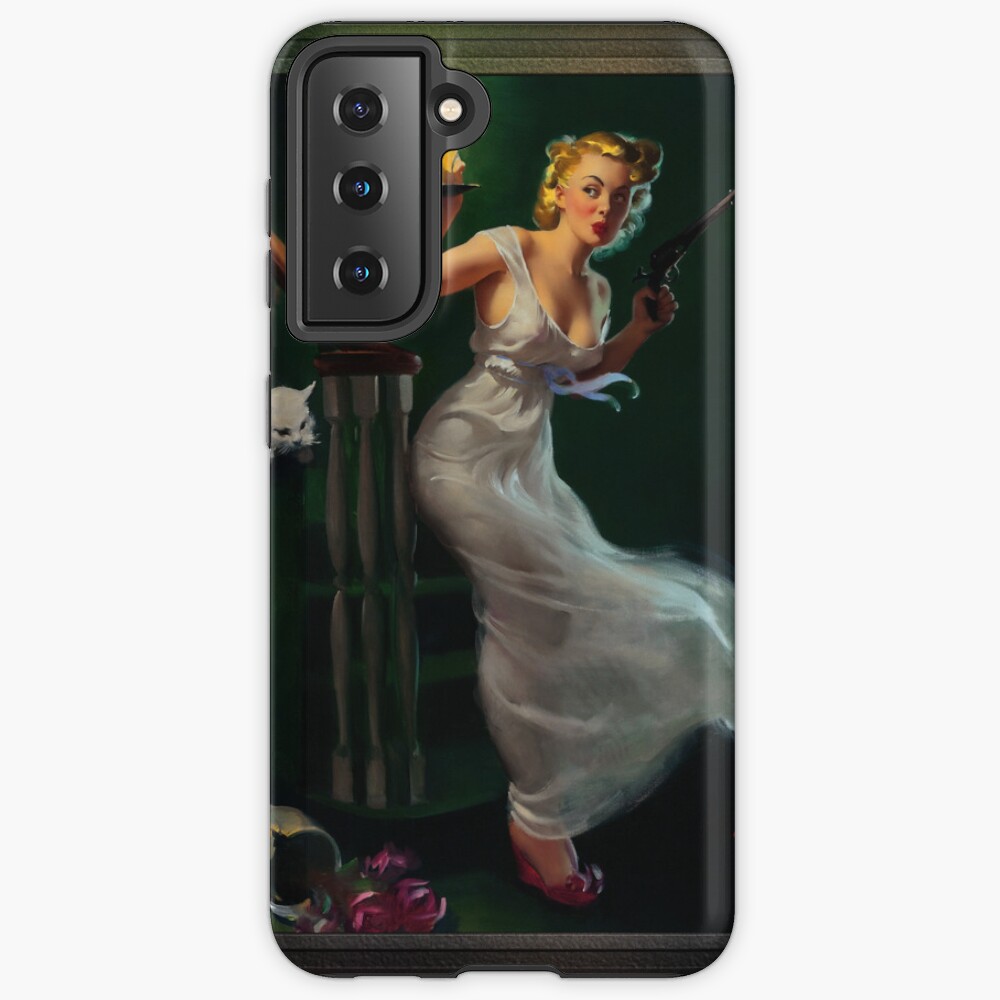
At the forefront of “Nach Ärger suchen” is a young woman poised on a staircase in an act that speaks to both vulnerability and determination. Her appearance is meticulously crafted, with every detail—from her flowing white nightgown to her disheveled blonde hair—imbuing the scene with a sense of dynamism. Ihre Kleidung, a simple yet elegant slip, is slightly transparent, enhancing the subtle sensuality of the artwork. Her body is captured in mid-motion, her right leg lifted, as if she is either stepping down or preparing to flee.
Her expression is one of cautious intrigue, with wide eyes and an upturned mouth, evoking a mixture of surprise and daring. She holds a lamp in her left hand, the warm light spilling from the glass vessel, contrasting with the shadowy background. In ihrer rechten Hand, she grips a small revolver, held in a defensive yet somewhat unsure manner. The juxtaposition of the lamp, which symbolizes safety, and the gun, an instrument of possible danger, creates an atmosphere of tension and uncertainty.
Objekte und Symbolik
The objects within the scene serve as symbolic elements that amplify the mood of the painting. The small white cat on the floor beneath the woman adds an element of domesticity, but its casual placement by the stairs also contrasts with the woman’s apparent alertness. This animal might suggest innocence or the possibility of an unnoticed danger. The gun, andererseits, introduces an element of suspense, signaling that the woman might be reacting to an unseen threat.
The candlelight is another important object in the piece. It not only illuminates her face and casts dramatic shadows across her form, but it also serves as a metaphor for vulnerability and fragility. The flame, burning brightly in a world of dark shadows, offers both literal and figurative light in a tense moment of uncertainty.
The presence of the staircase itself is a key architectural detail. It conveys a sense of upward or downward movement, suggesting that the woman may be trapped in her current position or on the verge of making a quick escape. The environment, cloaked in darkness and illuminated only by the soft light of the lamp, adds to the mysterious nature of the scene. The walls, dark and textured, amplify the sense of being confined or isolated.
Gelände und Umwelt
Das Gelände in “Nach Ärger suchen” is minimal but significant. The staircase and the hallway surrounding the woman suggest an interior domestic setting, perhaps an old mansion or a cozy home. Die Dunkelheit, rich tones of the woodwork, along with the shadows that seem to envelop the space, contribute to the overall mysterious and somewhat foreboding mood of the scene. The shadows in the background hint at an unseen world outside the woman’s immediate area, adding an element of suspense.
The way the light spills from the lantern in her hand creates pools of bright clarity in an otherwise dark environment, guiding the viewer’s eye directly to the woman’s form. The shadows that cling to the walls add depth to the scene, creating a sense of three-dimensionality that draws the viewer into the space. This clever manipulation of light and dark allows Elvgren to weave tension into the narrative of the painting.
Stil und Technik
Gil Elvgren’s style in “Nach Ärger suchen” is rooted in the traditional techniques of realism, yet it is infused with an unmistakable sense of glamour and drama typical of mid-century pin-up art. His precise attention to detail, particularly in his rendering of the woman’s figure, emphasizes the sensual curves of her body, which was characteristic of his pin-up portraits. jedoch, beyond mere physical beauty, Elvgren’s ability to capture a moment of emotional tension—one in which the woman might be confronted by danger or intrigue—elevates the work from a simple portrait into a narrative.
The rendering of light and shadow is masterful, with Elvgren’s use of chiaroscuro enhancing the dramatic impact of the scene. The way he plays with the contrasting elements of light from the lamp and the surrounding shadows helps reinforce the suspenseful and mysterious mood of the piece. The texture of the woman’s gown, the soft curls of her hair, and the delicate features of her face demonstrate Elvgren’s technical skill and understanding of human anatomy.
Stimmung und Thema
Die Stimmung von “Nach Ärger suchen” is one of suspense and intrigue, capturing a brief moment of potential danger. The young woman’s startled yet bold posture, combined with the symbolic elements of the gun and lantern, creates a narrative of tension, Geheimnis, and possible trouble ahead. Her wide-eyed expression suggests that she may be confronted by an unseen foe, while her gun and poised stance indicate that she is ready to face whatever challenges arise. There is a sense of vulnerability in her posture—yet also a sense of control, as she seems ready to act in an uncertain situation.
The theme of this painting revolves around the concept of danger and the unexpected. The woman’s appearance in a vulnerable setting—her nightgown, her home—suggests a break from the ordinary into the realm of the unknown. The combination of innocence and threat, encapsulated by the woman’s attire and her readiness with a firearm, brings to mind the themes of adventure and bravery that were often woven into the tales of the era.
Elvgren’s use of color, Zusammensetzung, and light enhances the sense of drama, while the intimate setting adds an underlying layer of personal tension to the work. The atmosphere is thick with anticipation, as if the viewer is witnessing the very moment before a crucial decision is made, making it a powerful narrative piece.
Abschluss
Abschließend, “Nach Ärger suchen” is a compelling work that captures the essence of mid-century American pin-up art, while also delving deeper into a moment of personal drama and suspense. Through his technical skill and careful composition, Gil Elvgren is able to transport the viewer into a world where beauty, danger, and mystery intersect in a captivating and timeless narrative.
Dies ist eine remasterte digitale Kunst-Reproduktion alter Meister eines gemeinfreien Bildes, das als verfügbar ist Leinwanddruck online.
Künstler Bio abgeleitet von Wikipedia.org
Gillette A. Elvgren wurde in St . geboren. Paul, Minnesota, und besuchte das Gymnasium. Nach dem Abschluss, er begann ein Kunststudium am Minneapolis Institute of Arts.
Später zog er nach Chicago, um an der American Academy of Art zu studieren, und absolvierte die Akademie während der Weltwirtschaftskrise, im Alter von zweiundzwanzig.
Nach seinem Abschluss trat Elvgren in den Stall der Künstler bei Stevens und Gross . ein, Chicagos renommierteste Werbeagentur, und wurde Schützling des Künstlers Haddon Sundblom.
Im 1937, Gil begann, Kalender-Pin-ups für Louis F . zu malen. Dow, einer der führenden amerikanischen Verlage, während dieser Zeit schuf er ungefähr 60 Pin-Up-Girl arbeitet auf 22″ × 28″ Leinwand und zeichnet sie durch eine gedruckte Signatur aus.
Viele seiner Pin-ups wurden während des Zweiten Weltkriegs als Nasenkunst auf Militärflugzeugen reproduziert; und es war ungefähr um diese Zeit in 1944, dass Elvgren von der Brown and Bigelow Publishing Company angesprochen wurde; ein Unternehmen, das immer noch das Feld der Kalenderproduktion dominiert, Werbeartikel und Werbeartikel.
Im nächsten Jahr von 1945 bis um 1972, Elvgren wurde mit dem Brown in Verbindung gebracht & Bigelow-Verlag, und fing an zu arbeiten mit 24 Zoll von 30 Zoll Leinwände, ein Format, das er für das nächste verwenden würde 30 Jahre, und signierte seine Arbeit kursiv.
Elvgren war ein kommerzieller Erfolg. Er lebte an verschiedenen Orten, und war von den 1930er bis in die 1970er Jahre aktiv. Im 1951 er begann in einem Atelier in seinem Haus zu malen, dann in Winnetka, Illinois, mit einem Assistenten die Beleuchtung einrichten, Requisiten und Szenen bauen, Foto-Sets, und bereite seine Farben vor.
Zu seinen Kunden gehörten bekannte Unternehmen wie Brown und Bigelow, Koks, General Electric und die Sealy Mattress Company, um ein paar zu nennen. In Ergänzung, in den 1940er und 1950er Jahren illustrierte er Geschichten für eine Vielzahl von Zeitschriften, wie The Saturday Evening Post und Good Housekeeping.
Zu den Models und Hollywood-Legenden, die Elvgren während seiner Karriere malte, gehörte Myrna Hansen, Donna Reed, Barbara Hale, Arlene Dahl, Lola Albright und Kim Novak.