

Buscando problemas
“Buscando problemas” es una obra de arte icónica creada por el renombrado pintor estadounidense Gil Elvgren. Conocido por su maestría al representar la forma femenina con una mezcla de encanto e ingenio., Las obras de Elvgren a menudo encarnan un estilo distinto que es a la vez nostálgico., juguetón, y muy evocador. Nacido en 1914 y falleciendo en 1980, El legado de Elvgren como destacado artista pin-up sigue firmemente arraigado en la escena artística estadounidense.. Esta pieza en particular ejemplifica su talento para capturar el encanto atemporal del arte pin-up de mediados del siglo XX mientras cuenta una historia llena de suspenso e intriga..
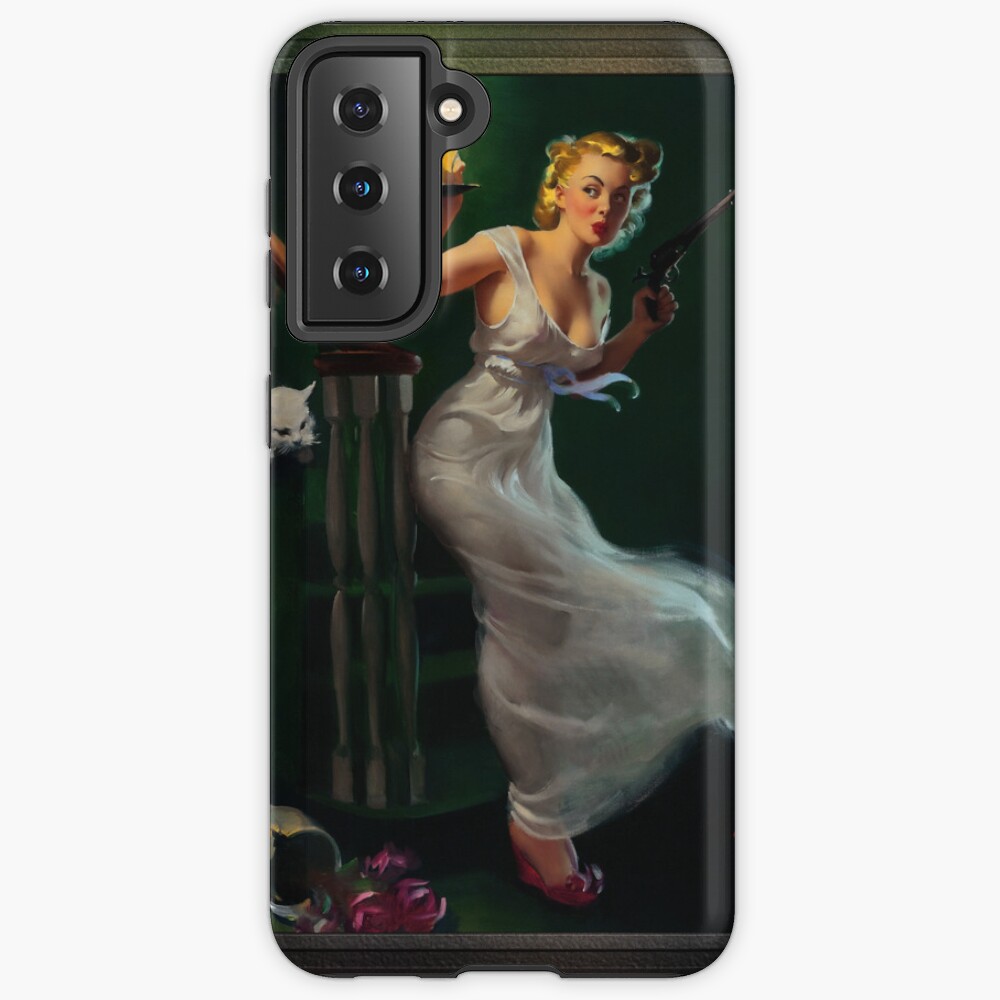
Tabla de contenido
Asunto principal
A la vanguardia de “Buscando problemas” es una mujer joven parada en una escalera en un acto que habla tanto de vulnerabilidad como de determinación.. Su apariencia está meticulosamente elaborada., con cada detalle, desde su camisón blanco fluido hasta su cabello rubio despeinado, imbuyendo la escena con una sensación de dinamismo.. Su atuendo, un resbalón simple pero elegante, es ligeramente transparente, realzando la sutil sensualidad de la obra de arte. Su cuerpo es capturado en pleno movimiento., su pierna derecha levantada, como si estuviera renunciando o preparándose para huir.
Su expresión es de cautelosa intriga., con los ojos muy abiertos y la boca hacia arriba, evocando una mezcla de sorpresa y atrevimiento. Ella sostiene una lámpara en su mano izquierda., la cálida luz que se derrama desde el recipiente de vidrio, contrastando con el fondo oscuro. en su mano derecha, ella empuña un pequeño revólver, sostenido de una manera defensiva pero algo insegura. La yuxtaposición de la lámpara., que simboliza la seguridad, y el arma, un instrumento de posible peligro, crea una atmósfera de tensión e incertidumbre.
Objetos y Simbolismo
Los objetos dentro de la escena sirven como elementos simbólicos que amplifican el ambiente de la pintura.. El pequeño gato blanco en el suelo debajo de la mujer añade un elemento de domesticidad., pero su ubicación casual junto a las escaleras también contrasta con el aparente estado de alerta de la mujer.. Este animal podría sugerir inocencia o la posibilidad de un peligro inadvertido.. el arma, por otra parte, introduce un elemento de suspenso, indicando que la mujer podría estar reaccionando a una amenaza invisible.
La luz de las velas es otro objeto importante de la pieza.. No sólo ilumina su rostro y proyecta sombras dramáticas sobre su forma., pero también sirve como metáfora de la vulnerabilidad y la fragilidad.. la llama, ardiendo intensamente en un mundo de sombras oscuras, Ofrece luz tanto literal como figurada en un momento tenso de incertidumbre..
La presencia de la propia escalera es un detalle arquitectónico clave. Transmite una sensación de movimiento hacia arriba o hacia abajo., lo que sugiere que la mujer puede estar atrapada en su posición actual o a punto de escapar rápidamente. el medio ambiente, envuelto en oscuridad e iluminado sólo por la suave luz de la lámpara, se suma a la naturaleza misteriosa de la escena. las paredes, oscuro y texturizado, amplificar la sensación de estar confinado o aislado.
Terreno y medio ambiente
el terreno en “Buscando problemas” es mínimo pero significativo. La escalera y el pasillo que rodea a la mujer sugieren un ambiente interior doméstico., tal vez una antigua mansión o una casa acogedora. La oscuridad, ricos tonos de la carpintería, junto con las sombras que parecen envolver el espacio, Contribuir al ambiente general misterioso y algo premonitorio de la escena.. Las sombras del fondo insinúan un mundo invisible fuera del área inmediata de la mujer., agregando un elemento de suspenso.
La forma en que la luz se derrama desde la linterna que tiene en la mano crea charcos de claridad brillante en un ambiente que de otro modo sería oscuro., guiando el ojo del espectador directamente a la forma de la mujer. Las sombras que se adhieren a las paredes añaden profundidad a la escena., creando una sensación de tridimensionalidad que atrae al espectador al espacio. Esta inteligente manipulación de la luz y la oscuridad le permite a Elvgren tejer tensión en la narrativa de la pintura..
Estilo y técnica
El estilo de Gil Elvgren en “Buscando problemas” tiene sus raíces en las técnicas tradicionales del realismo, sin embargo, está impregnado de una inconfundible sensación de glamour y dramatismo típico del arte pin-up de mediados de siglo.. Su precisa atención al detalle., particularmente en su interpretación de la figura de la mujer, enfatiza las curvas sensuales de su cuerpo, que era característico de sus retratos pin-up. sin emabargo, más allá de la mera belleza física, La capacidad de Elvgren para capturar un momento de tensión emocional, uno en el que la mujer podría enfrentarse a un peligro o una intriga, eleva la obra de un simple retrato a una narración..
La representación de luces y sombras es magistral., con el uso del claroscuro por parte de Elvgren realzando el impacto dramático de la escena. La forma en que juega con los elementos contrastantes de la luz de la lámpara y las sombras circundantes ayuda a reforzar el ambiente misterioso y de suspenso de la pieza.. La textura del vestido de la mujer., los suaves rizos de su cabello, y los delicados rasgos de su rostro demuestran la habilidad técnica y la comprensión de la anatomía humana de Elvgren..
Estado de ánimo y tema
El estado de ánimo de “Buscando problemas” es uno de suspenso e intriga, capturar un breve momento de peligro potencial. La postura sorprendida pero audaz de la joven., combinado con los elementos simbólicos de la pistola y la linterna., crea una narrativa de tensión, misterio, y posibles problemas por delante. Su expresión con los ojos muy abiertos sugiere que puede enfrentarse a un enemigo invisible., mientras que su arma y su postura equilibrada indican que está lista para enfrentar cualquier desafío que surja.. Hay una sensación de vulnerabilidad en su postura, pero también una sensación de control., ya que parece lista para actuar en una situación incierta.
El tema de esta pintura gira en torno al concepto de peligro y lo inesperado.. La apariencia de la mujer en un entorno vulnerable: su camisón, su hogar—sugiere una ruptura de lo ordinario hacia el reino de lo desconocido. La combinación de inocencia y amenaza., encapsulado por el atuendo de la mujer y su preparación con un arma de fuego, recuerda los temas de aventura y valentía que a menudo se entretejían en los cuentos de la época..
El uso del color por parte de Elvgren, composición, y la luz realza la sensación de dramatismo, mientras que el entorno íntimo añade una capa subyacente de tensión personal al trabajo. El ambiente está cargado de anticipación., como si el espectador estuviera presenciando el momento justo antes de que se tomara una decisión crucial, convirtiéndolo en una poderosa pieza narrativa.
Conclusión
En conclusión, “Buscando problemas” es una obra convincente que captura la esencia del arte pin-up estadounidense de mediados de siglo., al mismo tiempo que profundiza en un momento de drama personal y suspenso.. A través de su habilidad técnica y cuidadosa composición., Gil Elvgren es capaz de transportar al espectador a un mundo donde la belleza, peligro, y el misterio se cruzan en una narrativa cautivadora y atemporal.
Esta es una reproducción de maestros antiguos de arte digital remasterizada de una imagen de dominio público que está disponible como Esta es una elegante chica de glamour art deco vintage..
Biografía del artista derivada de Wikipedia.org
Gillette A. Elvgren nació en St. Paul, Minnesota, y asistió a la escuela secundaria universitaria. Después de la graduación, comenzó a estudiar arte en el Instituto de Artes de Minneapolis.
Más tarde se mudó a Chicago para estudiar en la Academia Estadounidense de Arte., y se graduó de la Academia durante la gran depresión, a la edad de veintidós.
Después de graduarse, Elvgren se unió al grupo de artistas en Stevens and Gross, La agencia de publicidad más prestigiosa de Chicago, y se convirtió en un protegido del artista Haddon Sundblom.
En 1937, Gil comenzó a pintar calendarios para Louis F. Dow, una de las editoriales líderes de Estados Unidos, durante el cual creó sobre 60 chica pin-up trabaja en lienzo de 22 ″ × 28 ″ y los distingue por una firma impresa.
Muchas de sus pin-ups se reprodujeron como arte de nariz en aviones militares durante la Segunda Guerra Mundial.; y fue por esta época en 1944, que Elvgren fue contactado por Brown and Bigelow Publishing Company; una empresa que todavía domina el campo en la producción de calendarios, especialidades publicitarias y productos promocionales.
El próximo año desde 1945 hasta 1972, Elvgren se asoció con el Brown & Compañía editorial Bigelow, y comencé a trabajar con 24 pulgada por 30 lienzos de pulgadas, un formato que usaría para el próximo 30 años, y firmó su trabajo en cursiva.
Elvgren fue un éxito comercial. Vivió en varios lugares, y estuvo activo desde la década de 1930 hasta la de 1970. En 1951 empezó a pintar en un estudio de su casa, luego en Winnetka, Illinois, usar un asistente para configurar la iluminación, construir utilería y escenas, conjuntos de fotografías, y prepara sus pinturas.
Entre sus clientes se encuentran empresas conocidas como Brown y Bigelow., Coca-Cola, General Electric y Sealy Mattress Company, para nombrar unos pocos. Además, Durante las décadas de 1940 y 1950 ilustró historias para una gran cantidad de revistas., como The Saturday Evening Post y Good Housekeeping.
Entre las modelos y leyendas de Hollywood que Elvgren pintó durante su carrera se encontraba Myrna Hansen., Donna Reed, Barbara Hale, Arlene Dahl, Lola Albright y Kim Novak.