

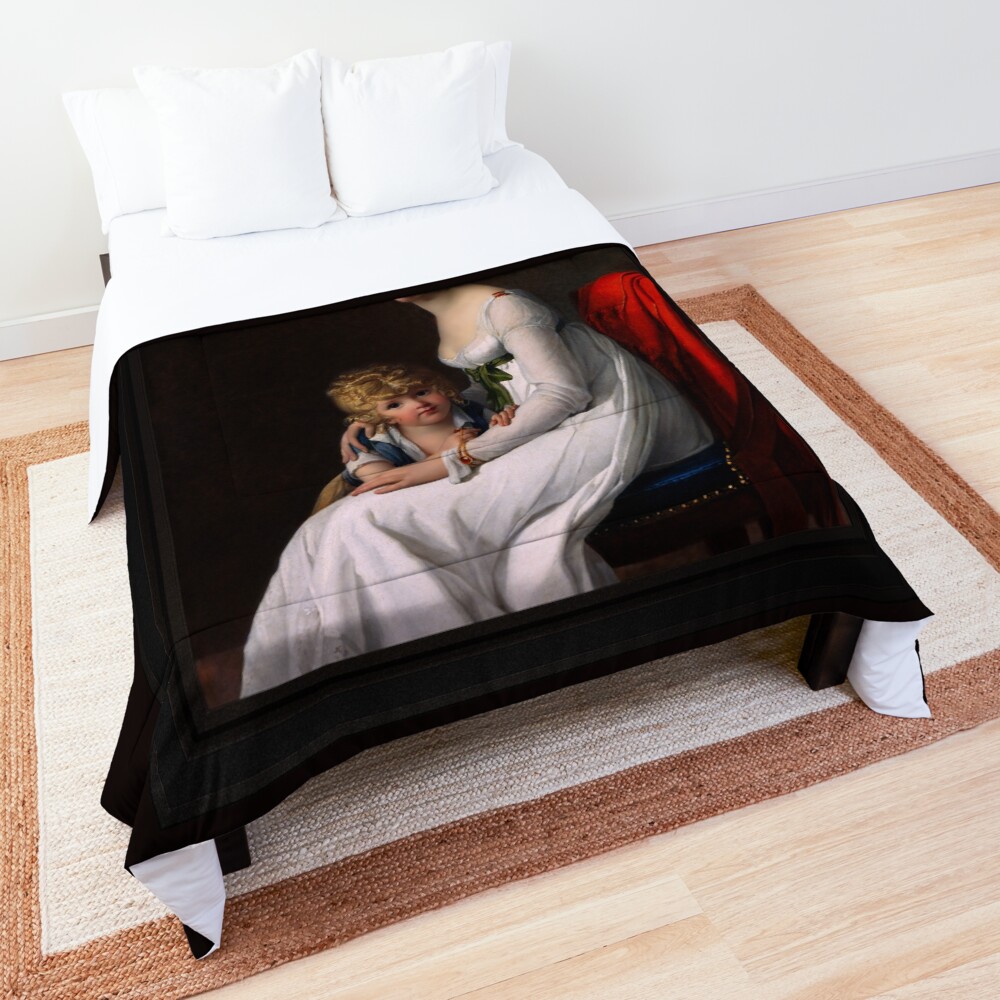
Mevrouw Philippe Panon Desbassayns van Richemont en haar zoon, Eugène
Madame Philippe Panon Desbassayns de Richemont (Jeanne Eglé Mourgue) and Her Son, Eugène probably c1802 by French Painter Marie-Guillemine Benoist (1768 – 1826); a Neoclassical, Historical, Genre and Portrait Painter.
Dit is een prachtige portret of Jeanne Eglé Mourgue (1778 – 1855) and her sone Eugène (1800 – 1859), the wife of diplomat Philippe Panon Desbassayns de Richemont (1774 – 1840).
She is depicted sitting in a wooden chair with a blue silk seat trimmed with brass buttons, that has a shawl draped over the back rest.

She is wearing a long white dress that has two red gemstones on the shoulder, that match the gold braided string bracelet with a round gemstone that she is wearing on her left wrist; and she also has a green sash tied just below her breast line.
She also is wearing a gold head piece attached to the back of her brown folded hair with curls that fall over her forehead and sides of her face and gold loop earrings.
Her son, who is is leaning on her lap has his left hand on her left forearm and is holding in his hand part of her bracelet by another gemstone; and he is wearing a white-bluish shirt, blue vest, and gold tone shorts that complement his blonde colored hair.
Dit is een remastered reproductie van digitale kunst oude meesters van een openbaar domeinafbeelding die als canvasdruk online beschikbaar is.
Info hieronder afgeleid van Wikipedia.org
Marie began her artistic training under the French Portrait Painter Élisabeth Vigée Le Brun (1755 – 1842), op de leeftijd van 13; and then 5 jaar later binnen 1786, along with her sister Marie-Élisabeth Laville-Leroux (1770 – 1826), began studying with the French Painter Jacques-Louis David (1748 – 1825).
She began exhibiting her artwork in 1791 at the Paris Salon with the mythological inspired piece Psyché faisant ses adieux à sa famille; en 9 years later at the Salon exhibited Portrait d’une Négresse (which in 2019 was renamed Portrait de Madeleine), which became a symbol of women’s emancipation and black peoples rights; as slavery had been abolished in 1794.
In 1803 Marie received an important commission to create a full length portrait of Napoleone Buonaparte (1769 – 1821) First French Consul (Premier Consul Français), then a year later she was awarded the Gold Medal at the Paris Salon, that led to her receiving a governmental allowance; and it was during this time that she opened her own atelier (art studio), for the purpose of training women in art.